MCP Applications & RAG over MCP: overview
- Source
- From the RAG & Agents Engineering course
- By
- Sourav Banerjee
- Last updated
- 8 Nov 2026
Larkspur now needs MCP applications that return validated results and keep their data and process lifetimes clear. You will inspect local and desktop hosts, recompute a data-analysis report, expose RAG through MCP and test the session and deployment boundaries of a research assistant.
The module's lessons are runnable projects, not notebooks, and they ship without recorded output. The running example puts the Larkspur Cloud handbook from T5.1 to T5.3 behind one stdio server, larkspur-handbook, with the same retrieve(query, n) tool as the 06 project. The golden questions are the T5.1 ones: How long does a refund take?, Can I export my data after I cancel my plan? and What happens if my server goes down? Every library behaviour quoted here was checked against the versions in the course's mcp-apps dependency group: mcp 1.30.0, fastmcp 3.4.11, langchain-mcp-adapters 0.3.2, mcp-use 1.7.1, langchain-chroma 1.1.0 and LangGraph 1.2.18.
In short
- A server is written once and reached by any host: Claude Desktop starts it from a config entry, an
mcp_useagent on Ollama starts it from the same kind of entry, and a LangGraph app loads its tools throughlangchain-mcp-adapters. The host, not the server, decides how long a session lives. - The client decides how long a session lives, and nothing in the server's code shows the cost. In the lab, three questions with two retrieval calls each start the server once when the client holds a session, three times with a session per question (06's
app.py) and seven times withMultiServerMCPClient.get_tools()(07's client): 17, 27 and 47 messages on the wire. - Over stdio, the server's stdout is the protocol channel. With unbuffered output, each stray
print()reaches the client as a line it cannot parse; mcp 1.30.0's client logs "Failed to parse JSONRPC message from server" and carries on, and other hosts may not be as forgiving. - A tool result is a contract every client reads. 06's
retrievereportssimilarity_score = 1 - distanceon Chroma's default squared L2 distance, so a chunk at right angles to the query scores −1.0 and an opposite one −3.0. A client that filters on that field filters on the wrong scale. - The EC2 server binds
0.0.0.0with no authentication. fastmcp's default is127.0.0.1:8000/mcp; changing the host publishes every tool, including one that passes a model-chosen topic name toshutil.rmtree.
Mental model
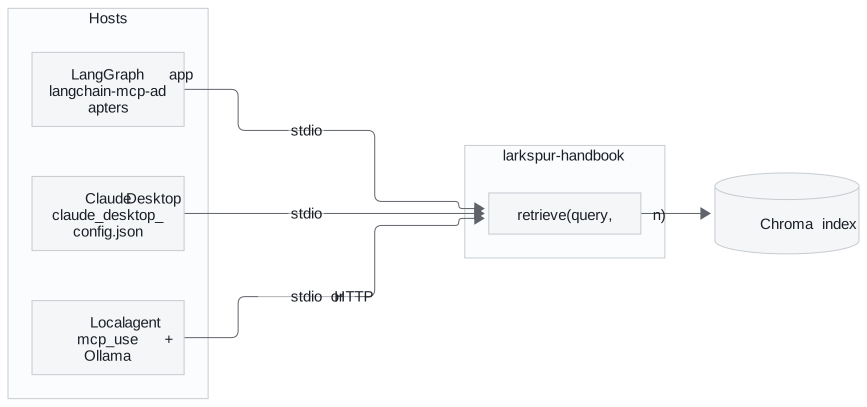
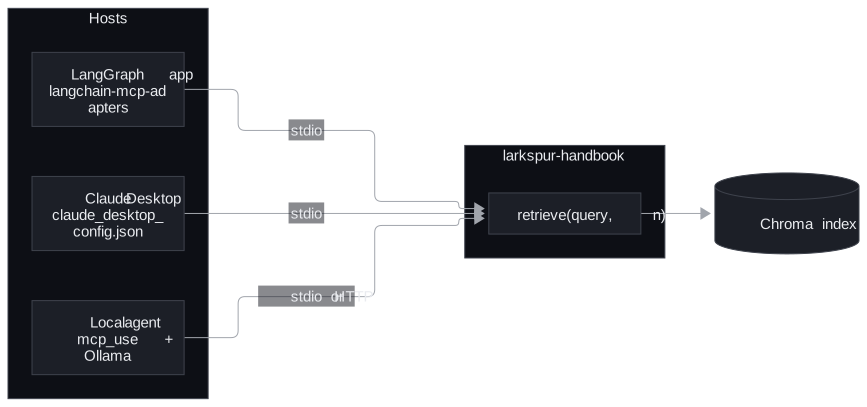
The server holds the retriever and the index; everything to its left belongs to the host. Each host picks the model, writes the queries, decides when to start and stop the server process, and reads the tool result in its own way. Two hosts can send the same question to the same server and get different answers, and the difference is almost always on the host side: a different query, a different n, or a different reading of the result.
Interactive lab
One server, three clients: open the file in a browser. Start on Session per tool call with three questions and two calls each: seven server starts and 35 of 47 messages spent on setup. Switch to Hold one session and the same conversation needs one start and 17 messages. Then pick Session per question with one question, and see that it matches the held session exactly until a second question arrives.
How it connects
- Before: T12.1 covers the handshake, the three server primitives and remote transports; T12.2 covers multi-server clients, client sessions and streamable HTTP. The retriever served here is the T5.1 to T5.5 pipeline (T5.1, T5.5), and the LangGraph loop is the one from T9.4.
- Next: T12.4 moves from agents calling tools to agents calling agents over A2A; its capstone puts an MCP retriever behind an A2A agent.
Key Takeaways
- Write the server once and test it from more than one host; the host owns the model, the queries and the session, so most cross-client differences start there.
- Decide session lifetime on purpose. Hold one session per conversation unless you need isolation, and count server starts the way the lab does.
- Treat tool names, argument schemas and result fields as a public interface: a return value that breaks its own output schema, or a score on an undocumented scale, breaks every client at once.
- A deployed MCP server is an API with an LLM choosing the arguments. Bind it narrowly, authenticate it, and validate every argument that touches the filesystem.