Chunking Strategies: overview
- Source
- From the RAG & Agents Engineering course
- By
- Sourav Banerjee
- Last updated
- 8 Nov 2026
The chunk is the unit of retrieval. The retriever scores chunks, returns chunks and hands chunks to the model, so a chunk boundary decides whether a fact can be found whole. T5.3 rests on four ideas: chunk size and overlap, the breakpoint threshold in semantic chunking, propositions, and structure-aware splitting.
The running example is the "Refunds and cancellations" section of the Larkspur Cloud handbook, 1,111 characters long, and one golden question: How long do I have to get a full refund on an annual plan? The answer is one 141-character sentence: You can get a full refund on an annual plan within 30 days of purchase, as long as the account has used less than 100 GB of outbound traffic.
In short
- Small chunks retrieve precisely but can cut a fact in two; large chunks keep facts whole but dilute the embedding and cost tokens. The right size comes from measurement on your own corpus.
- Overlap repeats the tail of one chunk at the head of the next. It rescues facts that straddle a boundary, but only when the cut piece fits inside the overlap, and it inflates the index.
- Semantic chunking cuts where neighbouring sentences drift apart in embedding space. The breakpoint threshold is computed from each document's own distances; the default
percentiletype always produces some cuts, whilestandard_deviationandinterquartilecan find none. - Propositions are atomic, self-contained facts written by an LLM. They retrieve sharply, cost an LLM call per chunk, and need a grading pass because an LLM can invent text and a splitter cannot.
- Structure-aware splitting uses the document's own boundaries (headings, HTML tags, code blocks) first, and falls back to size limits second.
Mental model
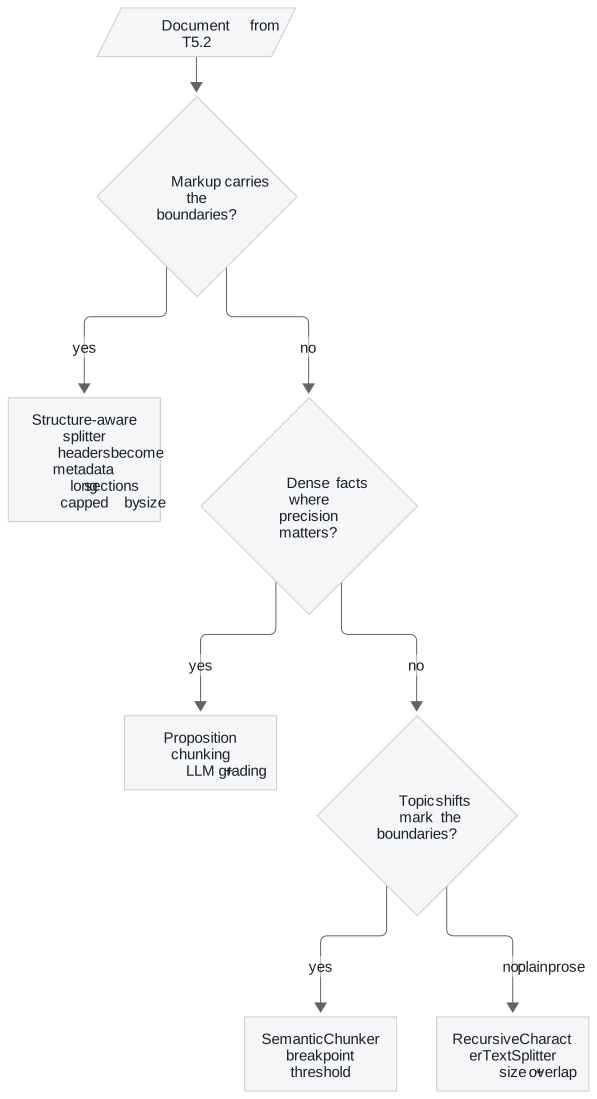
Every route then feeds the embedder (T5.4) and ends with the same check. Read a sample of the chunks, because the parameters say what the splitter was asked to do and only the chunks show what it did, then run the golden set.
Interactive lab
Chunk size and overlap: open the file in a browser. Click 300 and 0 to see the refund answer cut after "used less than", then 300 and 150 to watch overlap carry it whole into chunk 3, and 1200 and 0 to see the answer shrink to 13% of its chunk.
How it connects
Key Takeaways
- The chunk boundary decides whether a fact can be retrieved whole. Read the chunks as well as the parameters.
- Overlap only rescues a cut piece that fits inside it, and you pay for it in storage.
- Semantic thresholds come from each document's own distances and do not transfer between corpora; propositions need a grading pass; structural boundaries come first when the document has them.
- Choose chunk size by sweeping it on your golden set against the T5.1 baseline. If no size wins on both precision and completeness, index small and return large (T5.6).