Collaboration, Control & Parallel Agents: overview
- Source
- From the RAG & Agents Engineering course
- By
- Sourav Banerjee
- Last updated
- 8 Nov 2026
Larkspur needs several specialists to contribute without repeating work or losing a branch at synthesis. You will compare a shared board, debate, multi-perspective research and parallel execution, then inspect the result each control pattern can actually guarantee.
The running example is the Larkspur Cloud handbook from T5.1 to T5.3. One compound support question carries the parallel lessons and the lab: "I'm cancelling my annual plan after this week's outages. Can I get a full refund, how long will it take, can I still export my data, and do I get credits for the outages?" It splits into four sub-questions whose evidence is the handbook's refund-window, refund-timing, export and retention, and SLA chunks. The blackboard lesson uses an outage escalation from the same handbook; debate and STORM use a decision and an article about it.
In short
- A blackboard is one shared list that every specialist reads and appends to. A controller re-reads it after every contribution and picks the next specialist, so it can skip a branch that a fixed pipeline always runs. Guard it with a typed decision and a call cap (the notebook stops at 6 specialist calls, with a recursion limit of 20 behind it).
- Debate gives two agents opposite sides and a judge who reasons past both. It costs
2N + 1calls forNrounds (7 atN = 3), so keep it for trade-offs; a factual question is better answered in one call. - STORM researches from several perspectives before it writes: personas, simulated interviews, one merged outline, one draft per section. Its cost is countable:
1 + P × (2T + 1) + 1 + S + 1calls, 22 to 24 in the notebook. - LangGraph runs parallel branches in supersteps: every node of a step runs at once and the next step starts when the slowest one ends. In the lab, the four sub-questions take 5.7 s one at a time, 3.4 s in parallel, and 2.7 s once the outage rewrite moves inside its agent node.
- Parallel branches need a join that waits (a list edge or
defer=True) and a reducer on every key they share; without them the synthesizer answers from half the evidence, or the run raisesInvalidUpdateError.
Mental model
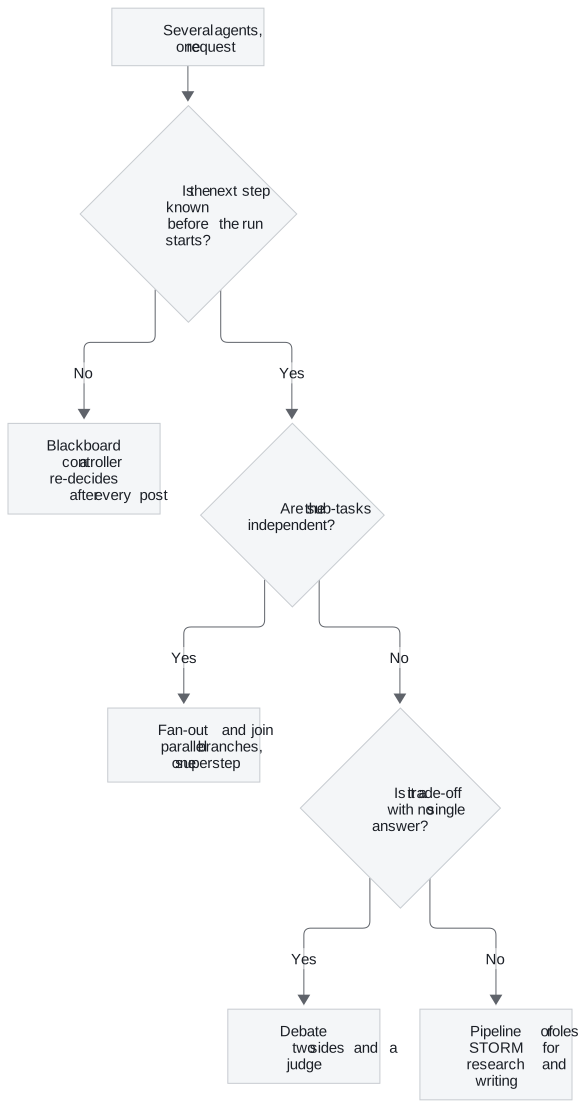
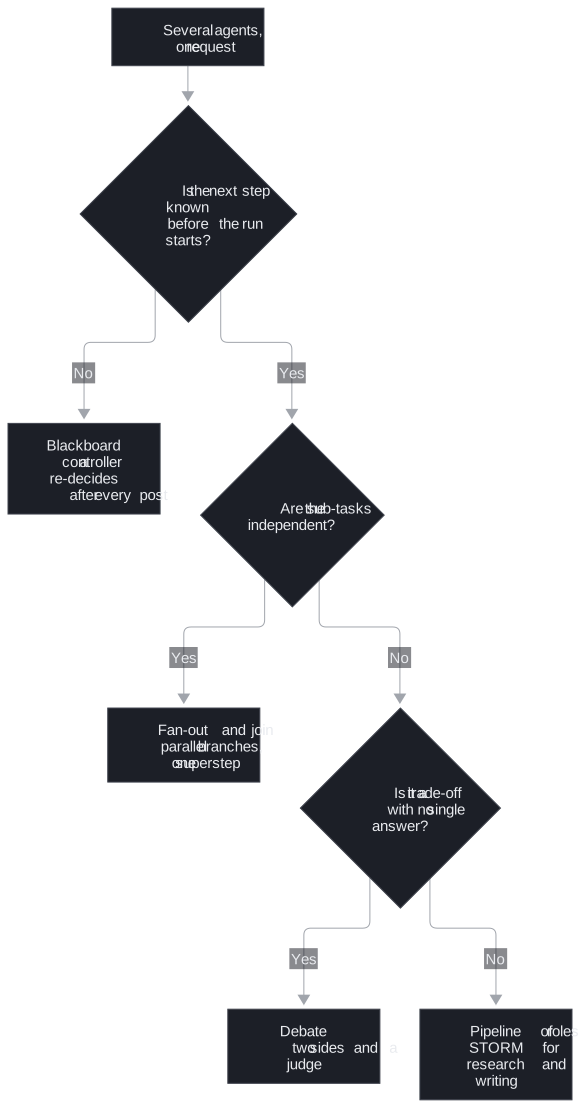
The patterns differ in who decides what runs next and when that decision is made. A pipeline and STORM fix the order when you build the graph. A fan-out fixes the shape but lets the branches overlap in time. A blackboard leaves the order to a controller at run time, which buys flexibility and costs a model call per step. All four write to one shared state, so all four need the same guards: typed decisions, reducers on shared keys and a cap on the number of steps.
Interactive lab
Parallel sub-question agents: open the file in a browser. It opens on a parallel run with the outage rewrite as its own node and separate edges into the synthesizer: the synthesizer runs twice, and its first run saw 3 of 4 sub-answers. Switch the join to a list edge and it runs once, at 3.4 s. Then move the rewrite inside the agent and the answer lands at 2.7 s, against 5.7 s one at a time. Finally drag max_concurrency down to 1 and watch the parallel graph give the time back.
How it connects
- Before: T11.1 builds supervisors and handoffs; this module adds shared-state collaboration and parallel execution to them. T4.4 covers the LangGraph runtime (streaming, retries, checkpoints) that 36.5 relies on, and T6.2 decomposes a question into the sub-questions the lab runs in parallel. The lab reports against the baseline from T5.1.
- Next: T11.3 builds full multi-agent applications, including a research system that dispatches a variable number of workers with
Sendand streams the run.
Key Takeaways
- Choose the collaboration pattern by who decides the next step and when: fixed at build time (pipeline, STORM), shaped but overlapping (fan-out), or decided at run time (blackboard).
- Give every LLM controller a typed decision, a call cap enforced in code and a computed check of what actually ran.
- Parallel branches cost as much as the slowest task in each superstep; keep branches the same length, join with a list edge or
defer=True, and put a reducer on every shared key. - Debate and STORM multiply calls by design. Count them, run the cheap baseline beside them, and keep them for trade-offs and research where the trail is the product.