LangChain 1.x recap course, ending in a structured-output Q&A bot
- Source
- From the RAG & Agents Engineering course
- By
- Sourav Banerjee
- Last updated
- 9 Nov 2026
Structured output
What you'll learn
- Explain where
with_structured_outputputs the schema, compared with an output parser.- Choose between structured output and the four parsers with one decision chain.
- Diagnose a batch that loses every answer when one input fails.
- Copy the bot design that always returns the same type to its caller.
Lesson 6 of T4.1 put the schema in the prompt and checked the reply afterwards. The parser could refuse a bad reply; it could not stop the model from writing one.
Larkspur's assistant still pays for that design on every call. The format instructions for CitedAnswer run to 803 characters of input, and a reply that opens with a sentence of prose before the JSON still raises, as the lesson 6 of T4.1 lab shows. The rule that the reply must be JSON lives only in the prompt, where the model may ignore it.
llm.with_structured_output(Schema) returns a new runnable whose output is an instance of the schema. It sends the schema to the provider with the request instead of writing it into the prompt, and providers that support structured output constrain the reply to it. Notebook 07g's advice is to prefer it over PydanticOutputParser for any model that supports it:
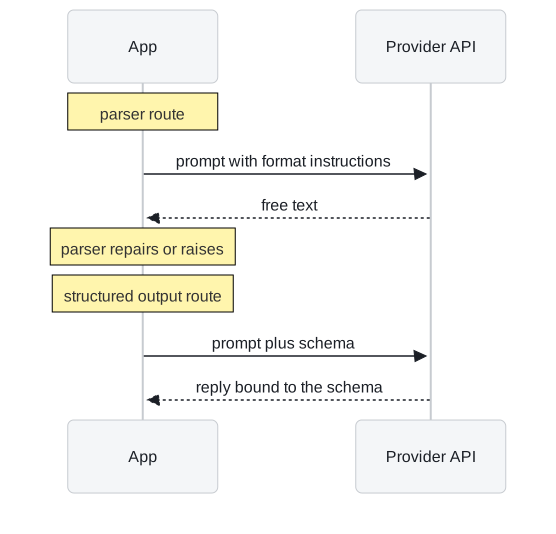
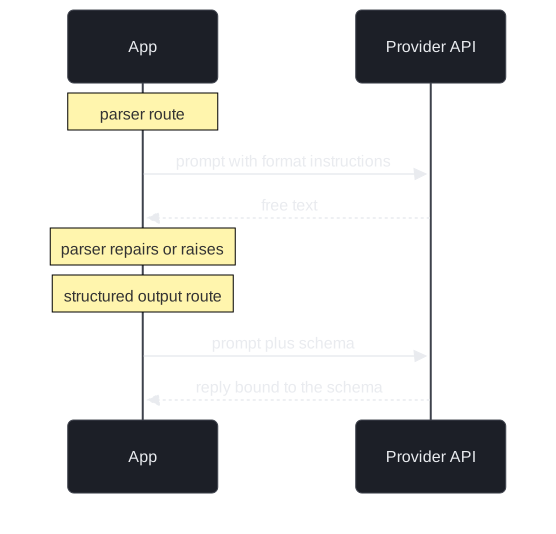
Figure 1: The two routes. The parser checks the reply after the fact; structured output tells the provider the shape before it writes.
PydanticOutputParser |
with_structured_output |
|
|---|---|---|
| Where the schema goes | into the prompt, as format instructions (748 to 803 characters for the lesson 6 of T4.1 schemas) | to the provider's API |
| Which models | any model that follows instructions | models with structured-output or tool-calling support |
| Prose around the JSON, fences, trailing notes | repaired or raised by the parser | not produced when the provider constrains the reply |
| Values the schema allows but your app does not | pass | pass |
Table 1: The two approaches side by side.
The last row is the same for both. A schema bound to the model still lets through a made-up passage id if citations is list[str]. The lesson 6 of T4.1 rule holds: put every rule you can into the schema, with Literal for ids and fixed labels. We call the gap the allowed-but-wrong value: valid against the schema, wrong for the app.
Notebook 07g also binds nested schemas (a company with an address object and a product list) the same way; validation covers the whole structure.
Picking the tool comes down to a few questions in order:
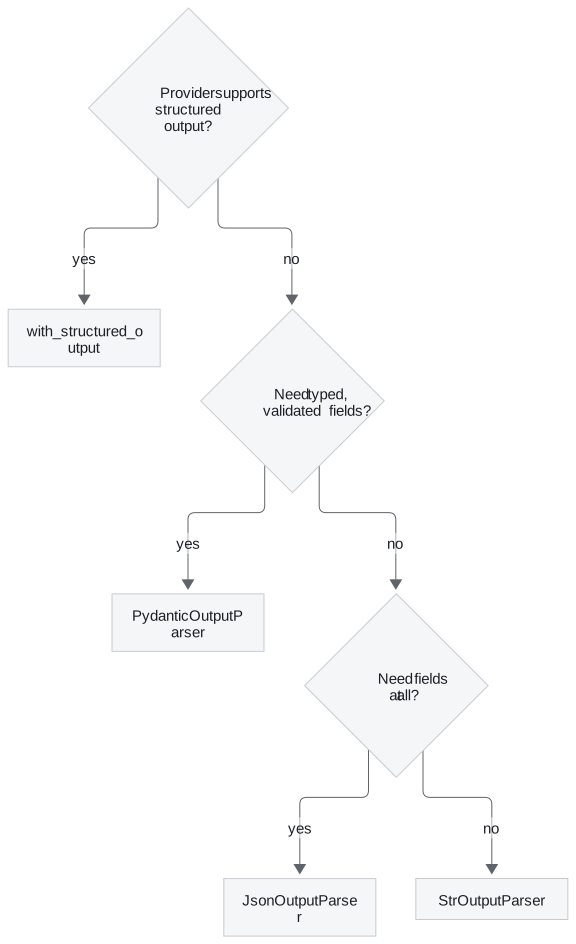
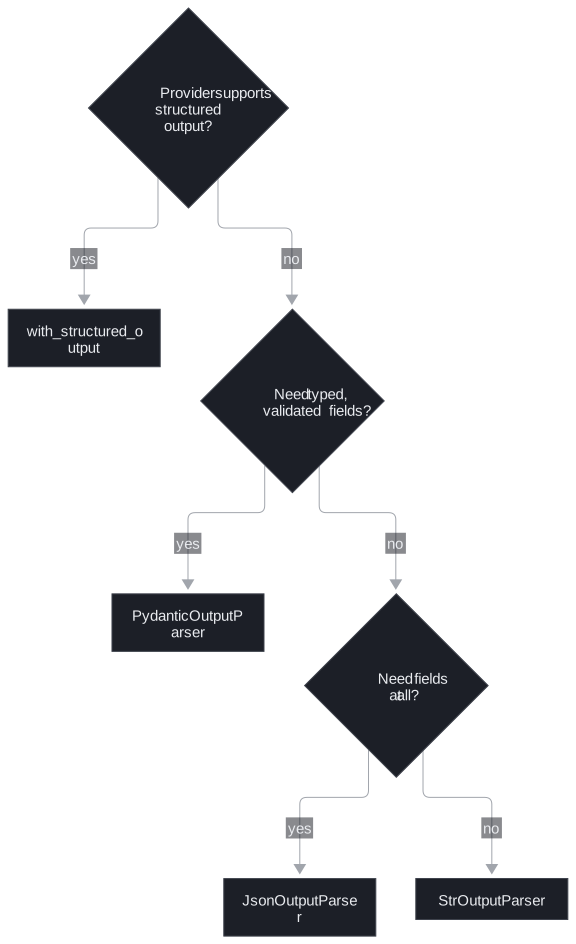
Figure 2: Choosing between structured output and the parsers. Each "no" moves one question down.
Inside SmartQABot
Notebook 07a builds SmartQABot on structured output: a ChatPromptTemplate with a system prompt and a {question} slot, piped into a chat model bound to QAResponse. The schema has five fields:
| Field | Type | Purpose |
|---|---|---|
answer |
string | the answer |
confidence |
string | asked to be high, medium or low |
reasoning |
string | why the bot answered as it did |
follow_up_questions |
list of strings, empty by default | suggestions for the user |
sources_needed |
boolean, false by default | whether external sources would help |
Table 2: QAResponse, the bot's return type.
Two of its choices are worth copying, and two are worth fixing before Larkspur uses the pattern:
- Copy: a fallback object.
ask()catches any exception and returns a validQAResponsewithconfidence="low"and the error inreasoning. The caller always gets the same type back. - Copy: tracing.
@traceablesends every call to LangSmith when a LangSmith API key is set, and a bad answer can then be traced to its exact prompt and reply. - Fix:
confidenceis astr. Its description asks for high, medium or low, but nothing enforces it;Literal["high", "medium", "low"]would. - Fix:
ask_batch()has no fallback. It callschain.batch(inputs), and by defaultbatchraises the first exception and loses every result.
Planted failure: the all-or-nothing batch
We checked the batch behaviour with a three-input batch whose middle input fails, using a stub step in place of the model:
| Call | Result |
|---|---|
batch([1, 2, 3]) |
raises the middle input's ValueError; no results returned |
batch([1, 2, 3], return_exceptions=True) |
the first and third results, with the exception object in the middle slot |
Table 3: One failing input in a batch of three, run with langchain-core 1.7.0.
We call the default the all-or-nothing batch: one bad question costs the answers to the good ones. With return_exceptions=True, the caller can replace each exception with the same fallback object ask() returns.
In practice: Larkspur's cited answer
For the lab brief, the same shape answers Larkspur's refund question:
- Use
CitedAnswerfrom lesson 6 of T4.1 as the schema, withLiteralpassage ids. - Put the three passages and the question in the human message; the system message holds the rules, with no format instructions.
- Bind the schema with
with_structured_outputif the provider supports it, and fall back toPydanticOutputParserif not (Figure 2). - On any exception, return a
CitedAnswer-shaped fallback that says the handbook could not be checked, instead of guessing. - Batch with
return_exceptions=Trueand trace every call.
Interview tip: structured output removes a class of format failures; it does not validate meaning. Name the check you still run after it.
Run the notebooks
The code for this lesson is in these notebooks. Colab runs one in your browser: install the packages its first cell imports and set the API keys it reads. To run every notebook as written, clone the repository and use its uv environment.
| Notebook | GitHub | Colab |
|---|---|---|
| Smart bot section1 | Open on GitHub | Open in Colab |
| Output parsers demo (optional) | Open on GitHub | Open in Colab |
| Output parsers final (optional) | Open on GitHub | Open in Colab |
Key Takeaways
- Prefer
with_structured_outputon models that support it. It sends the schema to the provider instead of the prompt, and the provider constrains the reply to it. - Neither approach stops values the schema allows, so type fixed labels and ids as
Literal. - Return a fallback object of the same type when a call fails, trace every call, and pass
return_exceptions=Truetobatchso one failure does not lose the other results.
Check yourself
1. How does with_structured_output differ from the Pydantic output parser in where the schema goes, and what does that buy?
It sends the schema to the provider's API with the request instead of writing it into the prompt as format instructions (748 to 803 characters for the lesson 6 of T4.1 schemas). Providers that support structured output constrain the reply to it, so prose around the JSON, fences and trailing notes are not produced.
2. You bind CitedAnswer with citations typed as a list of strings to the model. Can it still return a made-up passage id?
Yes. A schema bound to the model still passes any value the schema allows, and any string is allowed. The lesson 6 of T4.1 rule holds for both approaches: put the rule into the schema, with Literal for passage ids and fixed labels.
3. SmartQABot's ask_batch sends three questions and the middle one fails. What does the caller get, and how do you fix it?
An exception and no results, because batch raises the first exception by default and loses every result. batch(..., return_exceptions=True) returns the two good results with the exception in place of the middle one, which a fallback like the one in ask() can then replace.