State schemas and validation
- Source
- From the RAG & Agents Engineering course
- By
- Sourav Banerjee
- Last updated
- 9 Nov 2026
A number where a question goes
What you'll learn
- Compare the four kinds of state schema
StateGraphaccepts:dict,TypedDict, dataclass and Pydantic.- Explain where each one catches a bad input: at
invoke, inside a node, or nowhere.- Diagnose a late failure and an unchecked node write.
- Choose a schema for a graph whose input comes from outside.
Lesson 2 of T4.3 ended with a router that trusts whatever is in the state. Every node so far has done the same.
Here is that trust failing. Larkspur's support graph sits behind a web widget, and a client bug sends the question as a ticket number, 123, instead of text. The state schema says the question is a string. The run starts anyway, classify tries to split the number into words, and the graph fails inside the first node with an error about an int. With a model call in that node, the failure would also have cost a request.
The one-line reason: a TypedDict annotation is a hint for people and editors, and LangGraph checks no types against it. This page compares the four schema kinds by what they check, and when.
Choosing a state schema
A state schema is the type you pass to StateGraph to declare the state's keys, their types and their reducers. StateGraph accepts four kinds, and the schemas notebook runs the same two-node graph on each. The wiring, the nodes and the reducers (custom_add on step_count, add_messages on messages) stay the same. The choice changes how nodes read the state and where a bad input is caught. Measured on LangGraph 1.2.18:
| Schema | Nodes read | Defaults | Wrong type in the input |
|---|---|---|---|
dict |
state["key"] |
none | accepted |
TypedDict |
state["key"] |
none | accepted |
@dataclass |
state.key |
yes | accepted |
Pydantic BaseModel |
state.key |
yes | ValidationError at invoke |
Table 1: The four schema kinds by how nodes read them and what they check.
dicthas no schema at all, and so no place to attach a reducer.TypedDictnames keys and types, and checks neither.@dataclassadds defaults (private_data: str = "") and passes nodes an instance, but checks no types.- Pydantic checks the input against the model before the first node, and converts values where it can.
Both nodes in the schemas notebook return one message and a step_count of 1. We reran all four builds:
| Schema | Final messages |
Final step_count |
Type invoke returns |
|---|---|---|---|
dict |
only "Step B Completed" | 1 | dict |
TypedDict |
2 messages | 2 | dict |
@dataclass |
2 messages | 2 | dict |
| Pydantic | 2 messages | 2 | dict |
Table 2: The schemas notebook's two-node graph under each schema (rerun on LangGraph 1.2.18).
The dict row is lesson 1 of T4.3's lost write again: with no schema there are no reducers, and node B's write replaces node A's. The last column holds for every schema. Nodes of a dataclass or Pydantic graph receive an instance, yet invoke hands the caller a plain dict.
Where a bad input stops
The validation notebook builds a one-key graph (name: str) whose node appends a greeting to the name, then feeds it a number. We planted that case and its neighbours on each schema:
| Planted case | What happened | Where |
|---|---|---|
TypedDict, name is 123 |
TypeError: unsupported operand type(s) for +: 'int' and 'str' |
inside the node |
TypedDict, name missing |
KeyError: 'name' |
inside the node |
dataclass, name is 123 |
the node receives the int 123; no error |
nowhere |
Pydantic, name is 123 |
ValidationError; no node runs |
at invoke |
Pydantic, name missing |
ValidationError; no node runs |
at invoke |
Pydantic, "5" for an int field |
the node receives the int 5; the returned state still holds the string "5" |
converted for nodes only |
Pydantic, a node writes 5 into the str field |
no error; the final state holds 5 | nowhere |
Pydantic input_schema on a TypedDict state, question 123 |
the number reaches the first node, which fails | inside the node |
Table 3: One planted case per check, on LangGraph 1.2.18. The first and fourth rows are the validation notebook's own runs.
Two named failures come out of this table.
- Late failure. A bad input passes the schema and fails deep inside a node, after any work that node did first. The
TypedDictand dataclass rows show it. The error names an operand, not the field the caller got wrong. - Unchecked write. Pydantic validates what comes in, never what nodes write. A node that returns 5 for a
strfield finishes cleanly and leaves a wrong type in the state for every later node.
The last row is a trap worth naming separately. An input schema narrows which keys a caller may send (lesson 5 of T4.3). Made from a Pydantic model on a TypedDict state, it still let the number through on LangGraph 1.2.18. The type check comes from the state schema itself.
Where each kind of input stops, as a check order:
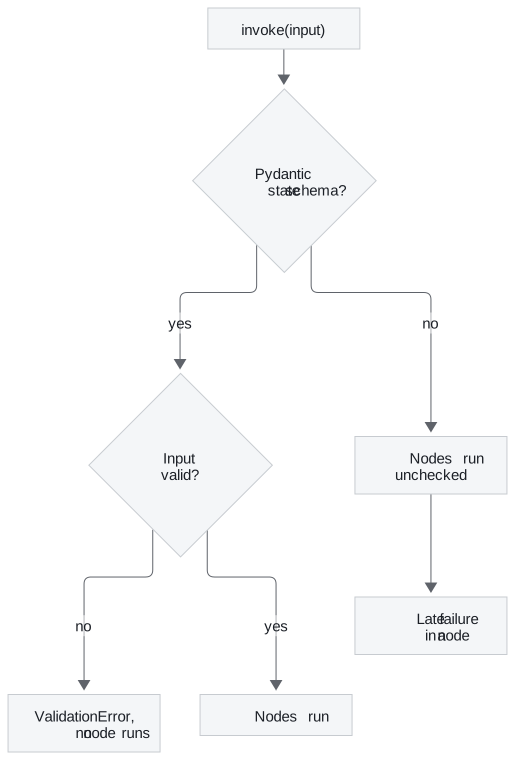
Figure 1: Where a bad input stops. Only a Pydantic state schema stops it before the first node.
The validation notebook also runs a message graph under TypedDict and Pydantic state. Both end with the same three messages, all HumanMessage: Pydantic changes nothing about reducers, and lesson 1 of T4.3's speaker drift happens under either schema.
Which schema, when
The choice reduces to two questions:
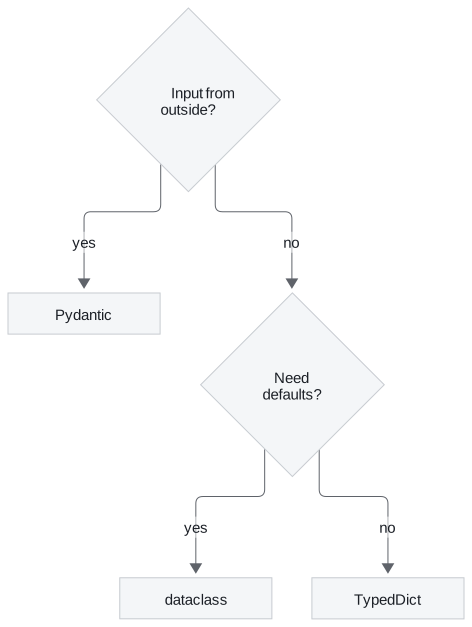
Figure 2: Choosing a state schema. Outside input decides first.
Validation costs a parse on every invoke, small next to a single model call. A TypedDict stays the right choice for a graph whose only callers are your own code and tests, where a late failure is a bug you will see in a stack trace.
In practice: the widget question
For Larkspur the question arrives from a web widget, and the state schema itself becomes a Pydantic model: question as a string, with route and answer given defaults.
- The client bug returns. The widget sends 123 as the question.
invokeraisesValidationErrornaming thequestionfield. No node runs and no model is called. - A real question arrives. When will my refund appear on my statement? passes validation, and
classifyreceives an instance withquestionas text. - The billing node answers. Pydantic will not check what it writes. The node builds its structured answer (route, source, text) as a Pydantic model of its own before returning it, and a malformed answer fails inside the node that produced it.
- The caller reads the result.
invokereturns a plaindictholding every key. Lesson 5 of T4.3 narrows that to the answer alone.
Next lesson: every node so far has taken one argument, the state. Lesson 4 of T4.3 shows what else a node can ask for, and how a node can route the run by itself.
Run the notebooks
The code for this lesson is in these notebooks. Colab runs one in your browser: install the packages its first cell imports and set the API keys it reads. To run every notebook as written, clone the repository and use its uv environment.
| Notebook | GitHub | Colab |
|---|---|---|
| Different Graph States | Open on GitHub | Open in Colab |
| Pydantic State Validation | Open on GitHub | Open in Colab |
Key Takeaways
TypedDictand dataclass annotations check no types, so a bad input fails late, inside a node. A plaindictcannot attach reducers at all.- Use a Pydantic state schema when input comes from outside. It raises
ValidationErroratinvokebefore any node runs, and converts values for nodes where it can. - Pydantic validates input only, never what nodes write, and
invokealways returns a plain dict. Validate important node output, such as a structured answer, inside the node.
Check yourself
1. A graph with a TypedDict state receives a name of 123, and its node fails with a TypeError. Why did the schema not stop it?
TypedDict annotations are hints for people and editors; LangGraph checks no types against them. The run starts and the node fails when it adds a string to the int: a late failure. With a Pydantic BaseModel state, the same input raises ValidationError at invoke and no node runs.
2. The Larkspur question arrives from a web widget. Why make the state schema itself Pydantic instead of adding a Pydantic input schema to a TypedDict state?
On LangGraph 1.2.18 a Pydantic input schema on a TypedDict state let a question of 123 through to the first node, which failed there. The type check comes from the state schema: with a Pydantic state the same input stops at invoke before any node runs.
3. A node in a Pydantic-state graph returns 5 for a str field, and the run finishes cleanly. How should Larkspur protect its structured answer?
Validate it in the node. Pydantic checks what comes in at invoke, not what nodes write, and the final state simply holds 5: an unchecked write. A node whose output matters builds its answer as a Pydantic model before returning it, and a bad answer then fails in the node that made it.