Nodes, runtime context and Command
- Source
- From the RAG & Agents Engineering course
- By
- Sourav Banerjee
- Last updated
- 9 Nov 2026
A route with no reason
What you'll learn
- Explain the three node signatures and what LangGraph passes into each.
- Trace typed runtime context through a call, with its defaults and overrides.
- Diagnose absent context, a silent dead end from
gotoand double dispatch.- Choose between a conditional edge and
Commandfor a routing step.
Lesson 3 of T4.3 made the Larkspur state check its input. The nodes still take one argument, the state, and that leaves two jobs undone.
The triage team wants each route logged with the reason for it, such as "matched refund". Lesson 2 of T4.3 showed that a router's writes are thrown away, so the reason has to be written by classify, while a separate router reads route: two pieces of code that must agree. And classify should check the customer's plan in the account database, but the database client is not something the graph computes. The first attempt put the client into the input state, where it came back out in every result.
The one-line reason: a node had only the state to work with, and could only write, never route. This page gives it two more inputs and one more kind of return.
Node signatures and runtime context
A node's signature decides what LangGraph passes into it: the state always, and, if the node declares them, the run's config or its runtime context. A node asks for more by declaring a second parameter:
| Signature | The node also gets | Larkspur use |
|---|---|---|
f(state) |
nothing | classify reads the question |
f(state, config: RunnableConfig) |
config["configurable"] |
the thread_id for logs |
f(state, runtime: Runtime[Ctx]) |
runtime.context |
the customer's plan, a database client |
Table 1: The three node signatures.
The node patterns notebook chains one node of each kind and invokes the graph with a state of input "World", a config holding thread_id "user-1234" and a context holding user_id "alice_smith". The plain node writes "Hello, World!", the config node reads the thread id, and the runtime node reads the user id. None of the config or context values appears in the final state.
Each kind of input enters the run through its own channel:
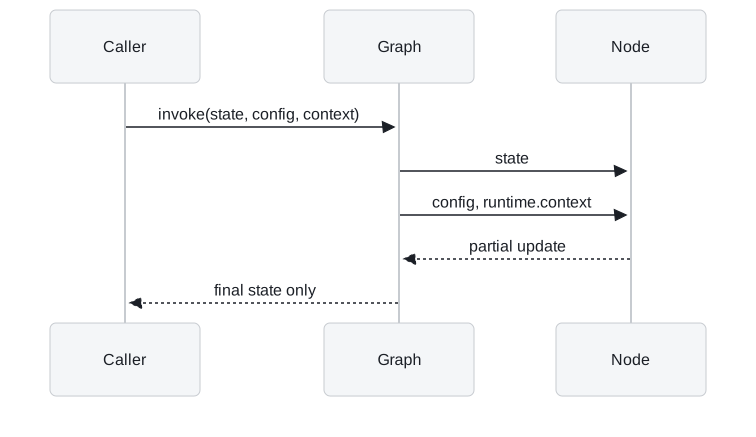
Figure 1: Config and context reach the node beside the state, and only the state comes back.
Runtime context is a typed set of dependencies the caller passes on each call: connections, clients, the caller's identity. The graph declares its shape with a context_schema, and each invoke passes values in a context argument. The runtime context notebook uses a dataclass, where fields without a default are required: user_agent has none, while docs_url and db_connection default to a docs address and a MySQL connection string. We reran its calls and two planted ones:
| Call | What the node saw | Result |
|---|---|---|
user_agent "Default-Run" only |
the default MySQL connection | runs |
user_agent "Override-Run" and a Postgres db_connection |
the Postgres connection | runs |
no context at all |
runtime.context is None |
AttributeError: 'NoneType' object has no attribute 'user_agent' in the node |
an empty context |
nothing: the call fails before the node | TypeError, missing user_agent |
Table 2: The runtime context notebook's two calls and two planted ones (LangGraph 1.2.18).
The third row is absent context: the graph starts without the dependency and fails only when a node reads it. The returned state in the first two rows holds input and result and nothing from the context. That is the property we want for a database client: the graph uses it and never hands it back.
Context gives classify its client. The other half of the opening problem is the route and its reason.
Command
Command is a value a node returns instead of a dict to do two jobs at once: update is merged into the state like any node's return, and goto names the node that runs next. The Command notebook's check_temp_node sends a reading above 90 to warn_user with warning_sent set, and anything else to success. No edge leaves the node, and none leaves either handler, which end the run:
| Input temperature | goto |
Final state |
|---|---|---|
| 100 | warn_user |
status "Routing to warning handler...", warning_sent true, action "Warning Notification sent" |
| 40 | success |
status "Routing to success handler...", action "Temperature Safety Confirmed" |
Table 3: The Command notebook's two runs, rerun on LangGraph 1.2.18.
The two ways of routing, side by side:
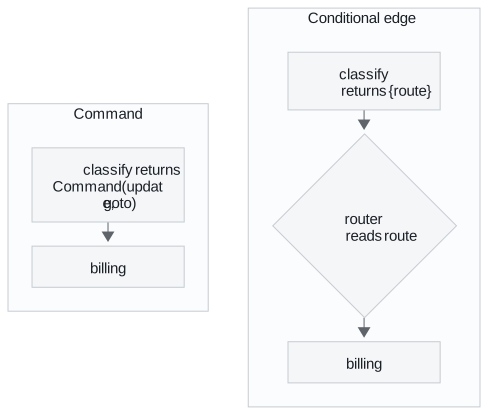
Figure 2: A conditional edge splits writing and routing across two functions. Command does both in one return.
The Command traps
The node's return annotation, Command[Literal["warn_user", "success"]], looks like a check, and the notebook calls it compile-time safety. On LangGraph 1.2.18 it only draws the graph. We planted one case per assumption:
| Planted case | What happened | Named failure |
|---|---|---|
Literal annotation removed |
routing still works; the drawing shows the node going straight to END |
invisible branches |
goto names a real node missing from the Literal |
that node runs | no check |
goto names a node that does not exist |
logs "wrote to unknown channel branch:to:nowhere, ignoring it"; the run ends with no handler output | silent dead end |
static edge to success added; reading 95 |
warn_user and success run in the same step, both write final_action_performed: InvalidUpdateError |
double dispatch |
| same static edge; reading 40 | runs: goto and the edge name the same node |
hidden until a hot reading |
Table 4: One planted case per assumption about Command.
The silent dead end is the one from lesson 2 of T4.3, reached by a different road: a misspelled goto ends the run with an empty answer and no error. Double dispatch comes from goto adding to static edges rather than replacing them. It also hides: the cool reading passes, and only a hot reading triggers it.
Which one, when
The choice turns on whether the deciding node must also write:
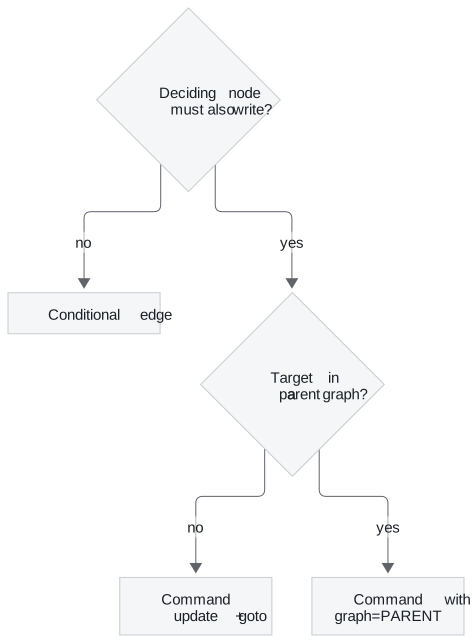
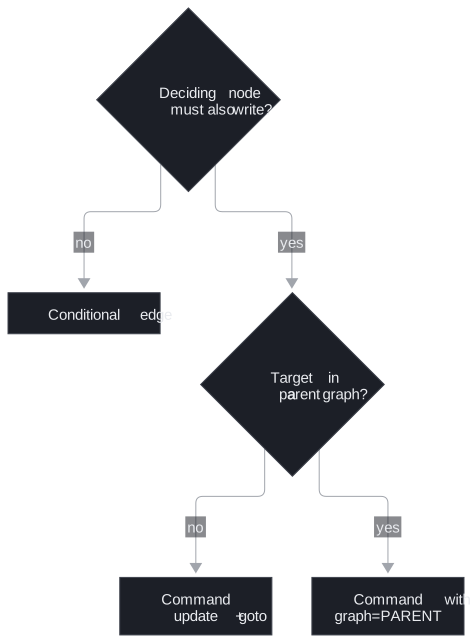
Figure 3: Choosing between a conditional edge and Command.
Choose a conditional edge when routing is a pure read of state. The router is testable alone, and the destination list names every target at build time. Choose Command when the node that decides must also write, such as the route with its reason, or when the target lies outside the current graph.
The same object returns in later modules. It carries resume for a paused run in T4.4.
With graph=Command.PARENT it hands work from one agent to another in T11.1.
In practice: classify with a reason
In this design classify takes the runtime parameter and returns a Command:
- The call. The widget invokes the graph with the question as state, the conversation's
thread_idin config, and the customer id and database client as context. classifyreads the customer's plan through the client inruntime.context, matches refund, and returnsCommandwithroutebilling and the reason "matched refund" as the update, andbillingas thegoto.billinganswers. The final state holds the route and its reason for the triage log. The client and customer id appear nowhere in it.- The guard. A test runs one question per route and asserts that every run ends with an
answerkey. A misspelledgotofails that test instead of shipping as a silent dead end.
Next lesson: the final state still returns every key, including the reason and the message history. Lesson 5 of T4.3 decides what a caller may send and receive, and where per-call settings such as the reply language go.
Run the notebooks
The code for this lesson is in these notebooks. Colab runs one in your browser: install the packages its first cell imports and set the API keys it reads. To run every notebook as written, clone the repository and use its uv environment.
| Notebook | GitHub | Colab |
|---|---|---|
| Node Patterns | Open on GitHub | Open in Colab |
| Runtime Context | Open on GitHub | Open in Colab |
| Command Objects | Open on GitHub | Open in Colab |
Key Takeaways
- A node gets extra inputs by declaring them:
configfor per-call settings,runtimefor typed context. Absent context fails only when a node reads it. Command(update=..., goto=...)lets a node write and route in one return. ItsLiteralannotation only draws the graph, and agototo an unknown node is silently ignored.- Use a conditional edge when routing is a pure read of state, and
Commandwhen the deciding node must also write. Never combinegotowith a static edge from the same node.
Check yourself
1. When should a node return a Command instead of leaving the route to a conditional edge?
When the node that decides must also write, such as the route with the reason for it, or when the target lies outside the current graph. When routing is a pure read of state, a conditional edge is better: the router is testable alone and the destination list names every target at build time.
2. The temperature node that returns a Command also gets a static edge to success, and a reading of 95 arrives. What happens?
The run fails. A reading above 90 makes the node goto warn_user, and goto adds to static edges, so warn_user and success run in the same step. Both write final_action_performed, and LangGraph raises InvalidUpdateError: double dispatch. A reading of 40 passes, which is why the bug hides.
3. A node reads user_agent from runtime context and fails with an AttributeError on NoneType. What went wrong?
The graph was invoked with no context, and runtime.context was None. On LangGraph 1.2.18 absent context fails when a node reads it, not when the graph starts. Pass it in the context argument and include user_agent, which has no default; an empty context raises TypeError for it.