RunnableWithMessageHistory, multi-user sessions and persistence
- Source
- From the RAG & Agents Engineering course
- By
- Sourav Banerjee
- Last updated
- 9 Nov 2026
Two customers, one list
What you'll learn
- Explain how a wrapper loads and saves one conversation's history around any chain.
- Trace two interleaved customers through one chain and count what each history holds.
- Diagnose a session id taken from the wrong place, and a store that forgets on restart.
- Choose a history backend by restart, user count and concurrent writers.
Lesson 1 of T10.1 kept the conversation in one list and resent it every turn. That works for a single customer in a notebook.
Put the Larkspur assistant behind a web endpoint and two customers arrive at once. Customer A says she is on the annual Team plan; customer B asks Which plan am I on? With one shared list, B's call carries A's turns and the model answers with A's plan. Restart the server and both lists are gone.
Two jobs follow from that failure. Each conversation needs its own history, chosen by something the server trusts. And the history has to live somewhere that outlasts the process.
One history per session
RunnableWithMessageHistory does the load and save of lesson 1 of T10.1 around any runnable. You give it the chain and a session factory, a function that takes a session id and returns that conversation's history object. Every call then carries the id in its config, under session_id, next to the input:


Figure 1: One wrapped call. The wrapper loads the session's history before the chain runs and saves both new messages after it.
When the chain takes a dict, three keys tell the wrapper where things go:
| Key | What it names | What goes wrong without it |
|---|---|---|
input_messages_key |
The input field holding the new user message, saved after the call | The wrapper cannot find the message to store |
history_messages_key |
The MessagesPlaceholder in the prompt that receives the stored history |
The history loads but never reaches the prompt |
output_messages_key |
Which field of a dict output to save as the AI message | A chain that returns a dict, such as lesson 4 of T10.1's retrieval chain, has no single reply to store |
Table 1: The wrapper's keys. The model receives the system message, the history at the placeholder and the new question, in that order.
Tracing two interleaved customers
The notebook runs two users through the same chain with their turns interleaved, then asks each for a summary. Counting what each call loads:
| Call | Session | Message | History loaded | Stored after |
|---|---|---|---|---|
| 1 | sourav |
Explain AI in 3 bullet points | 0 | 2 |
| 2 | arnab |
Explain an LLM in 2 bullet points | 0 | 2 |
| 3 | sourav |
Now do the same for deep learning | 2 | 4 |
| 4 | sourav |
Summarise what we have discussed | 4 | 6 |
| 5 | arnab |
Summarise what we have discussed | 2 | 4 |
Table 2: Five calls on one chain. Each count follows from the wrapper saving one human and one AI message per call; the answers themselves come from the model.
Call 3 resolves the same only because sourav's first exchange was loaded. Call 5 summarises LLMs alone, because arnab's history never contained the other topics. Streaming works through the wrapper as well: the answer streams out, and the full text is saved to the session once the stream ends.
Planted failures: where the id comes from
The session_id is the only thing separating one customer's conversation from another's. Whoever supplies it chooses which history loads, which makes its source matter more than its format:
| Session id taken from | What happens |
|---|---|
| The authenticated server session | Each customer reads only their own history |
| A field in the request body the user can edit | Any customer can load another customer's chat by changing one string: a borrowed session |
| The user id alone | One customer's separate chats merge into a single history |
| A fresh value on every request | Every turn starts empty, and the app forgets as in lesson 1 of T10.1 |
Table 3: Four sources for the session id. Only the first is safe and correct.
Any string works as an id: a user id, a chat id, or both combined, which lets one customer hold several separate chats. Build it on the server from the authenticated user, never from text the user can edit.
Where the history lives
Only the factory changes when the store changes. The chain and the wrapper stay the same, and Table 4 compares the three backends the notebook uses:
| Backend | Survives a restart | Many users | Typical use |
|---|---|---|---|
InMemoryChatMessageHistory in a dict |
No | Yes, one per key | Tests and notebooks |
FileChatMessageHistory |
Yes | One JSON file per session | Single-user CLI or desktop tools |
SQLChatMessageHistory |
Yes | Yes, one table keyed by session_id |
Web apps and services |
Table 4: Three history backends behind the same interface.
Figure 2 turns the table into a check order:
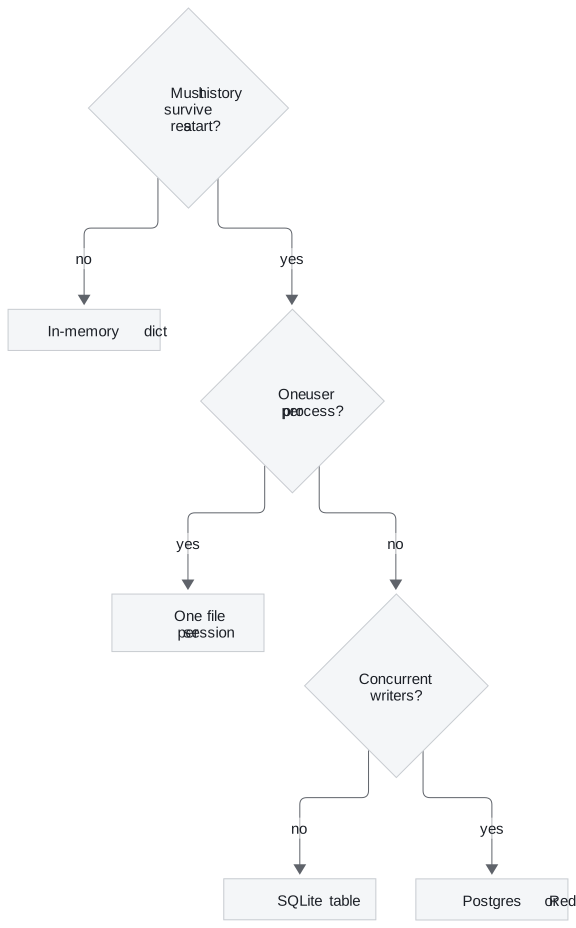
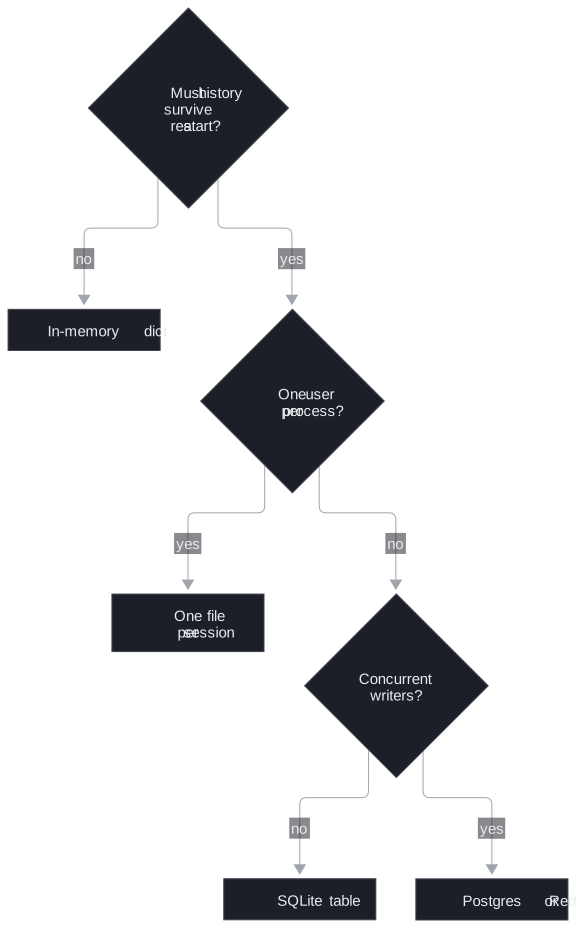
Figure 2: Choosing a history backend. Every answer leaves the chain untouched; only the factory changes.
Proving the database remembers
The notebook separates the chain from the store by throwing the chain away. Run 1 builds a chain on SQLite, sends two messages about a user's preferences and deletes the chain object. Run 2 builds a brand-new chain with no Python-side state and asks three questions about those preferences:
| Moment | Rows in message_store |
Where the answer can come from |
|---|---|---|
| After run 1 (2 turns) | 4 | |
| Run 2 asks What's my name? | 4 loaded | Only the database |
| After run 2 (3 more turns) | 10 |
Table 5: Row counts across the restart test. Each turn writes two rows, one per message.
Any correct recall in run 2 came from the rows, because nothing else survived. The rows also outlive the kernel: rerun only the second half after a restart and the answers still come from the file. A file-backed history works the same way for one session, and the notebook resumes a saved JSON conversation from a copy.
Pitfall: the positional connection. The second positional argument of
SQLChatMessageHistoryistable_name. Passing the database URL second creates no connection, and the error appears only at the first call. Pass it by keyword, asconnection.
SQLite is fine for one process. For a service with concurrent writers, use the same interface on Postgres or Redis. These history classes come from the sunset langchain-community package, and RunnableWithMessageHistory is deprecated in langchain-core 1.3.3 and removed in 2.0. Lesson 6 of T10.1 does the same job with a LangGraph checkpointer, which is where new code should go.
In practice: Larkspur's support endpoint
Applying both halves to the Larkspur assistant:
- Keying. The endpoint builds the session id from the logged-in account and the chat, for example the customer
cust-4821plus a chat number, and never reads it from the request body. - Storing. The factory returns a SQL-backed history for that id. A deploy that restarts the service loses no conversation.
- Checking. A test interleaves two customers and asserts that each summary mentions only its own topics, the same check as Table 2.
What changes next: every stored message still goes back to the model on every turn. Lesson 3 of T10.1 bounds that list with trimming, windows and a running summary.
Run the notebooks
The code for this lesson is in these notebooks. Colab runs one in your browser: install the packages its first cell imports and set the API keys it reads. To run every notebook as written, clone the repository and use its uv environment.
| Notebook | GitHub | Colab |
|---|---|---|
| Runnable with message history | Open on GitHub | Open in Colab |
| Multi user sessions and persistence | Open on GitHub | Open in Colab |
Key Takeaways
RunnableWithMessageHistoryloads and saves history around any runnable, and thesession_idin the call's config alone separates conversations. Take that id from the authenticated server session, never from text the user can edit.- Changing the store means changing only the factory: an in-memory dict for tests, one file per session for single-user tools, and SQL, Postgres or Redis for services that must survive restarts.
- Pass the database URL to
SQLChatMessageHistoryby keyword, because the second positional argument istable_name. Put new code on a LangGraph checkpointer, sinceRunnableWithMessageHistoryis deprecated.
Check yourself
1. Two customers send interleaved turns to the same chain wrapped in RunnableWithMessageHistory. What keeps their conversations apart?
The session_id in each call's config. The wrapper passes it to the session factory, which returns that conversation's history, loads it before the call and saves the new messages after it. A new session_id starts empty, so each customer's summary sees only their own turns.
2. A notebook prototype keeps histories in a dict of InMemoryChatMessageHistory. It must now serve a web app and survive restarts. What do you change?
Only the factory: return SQLChatMessageHistory keyed by session_id, and the chain and wrapper stay the same. The in-memory store loses everything on restart. For a service with concurrent writers, use the same interface on Postgres or Redis rather than SQLite.
3. SQLChatMessageHistory built with the session id and the database URL as two positional arguments fails on the first invoke. What went wrong?
The second positional argument is table_name, not the connection, so this form creates no database connection and fails only when invoked. Pass the URL by keyword, as connection, next to session_id.