Postgres + pgvector with metadata-filtered search
- Source
- From the RAG & Agents Engineering course
- By
- Sourav Banerjee
- Last updated
- 9 Nov 2026
Metadata filters
What you'll learn
- Explain how a metadata filter becomes a
WHEREclause in pgvector.- Write filters that work across stores, and spot the syntax that breaks when code moves.
- Compare pre-filtering with post-filtering by how many results each returns.
- Diagnose a filtered query that returns fewer than
kresults after an index is added.
Lesson 3 of T5.5 separated tenants with containers. Inside one container, filters do the narrowing.
Larkspur adds an HNSW index to its pgvector table to speed up search. A support query filtered to the refunds page asks for k = 5 and gets 2 back, with no error.
A metadata filter restricts a similarity search to entries whose metadata matches a predicate. It is how one index serves many scopes: one customer, one product, one section of the handbook, documents newer than a date. The notebook indexes two restaurants' FAQs and reviews into one PGVector collection and narrows each query with a filter on restaurant, category or cuisine.
LangChain's PGVector (from langchain_postgres) keeps everything in two tables. langchain_pg_collection has one row per collection. langchain_pg_embedding has one row per chunk: the embedding vector, the document text, a collection_id, and the metadata as a JSONB column, cmetadata, with a GIN index on it. A filter becomes a WHERE clause on cmetadata.
| Filter | Meaning |
|---|---|
{"source": "refunds.md"} |
Equality on one key |
{"source": "refunds.md", "category": "policy"} |
Two keys: PGVector treats it as AND |
{"source": {"$in": ["refunds.md", "billing.md"]}} |
Operator form |
{"$and": [{...}, {...}]}, {"$or": [...]} |
Explicit logic; the portable form |
Table 1: Filter forms PGVector accepts.
PGVector accepts $eq, $ne, $lt, $lte, $gt, $gte, $in, $nin, $between, $exists, $like, $ilike, $and, $or and $not. Stores share most of this syntax but differ at the edges. The two-key dict that PGVector reads as AND makes Chroma raise ValueError: Expected where to have exactly one operator, so write $and when code may move between stores.
Filters are exact. "Engineering" does not match "engineering", the case-split filter from lesson 1 of T5.2, and a field that was never written matches nothing. Normalise metadata at ingestion (T5.2) so the filter has something consistent to match.
A filter is not access control, and relying on one as a boundary is the filter-as-access-control mistake. Lesson 1 of T5.5's notebook makes the point: a caller who omits the filter sees everything. For tenant isolation, enforce the filter in the service that builds the query, or use a namespace or a separate collection per tenant (lesson 3 of T5.5).
Filtering before or after the search
There are two ways to combine a filter with a top-k search, and they return different results:
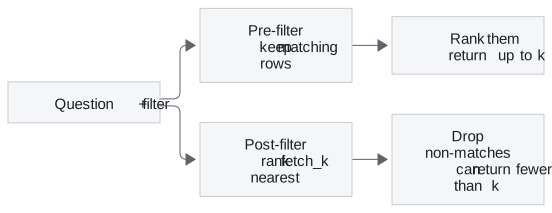
Figure 1: Pre-filtering and post-filtering on the same question.
Pre-filtering restricts the candidates, then ranks them. If at least k entries match, you get k. LangChain's PGVector builds one SQL query, WHERE collection_id = … AND <filter> then ORDER BY distance, and it creates no vector index of its own, so Postgres compares the query with every matching row: an exact, pre-filtered search.
Post-filtering ranks first, then drops what fails the filter. LangChain's FAISS wrapper does this on fetch_k=20 candidates (lesson 2 of T5.5). A selective filter can return fewer than k results or none.
Adding an ANN index to pgvector moves it towards post-filtering. The pgvector README says: "With approximate indexes, filtering is applied after the index is scanned." Its example: if a condition matches 10% of rows, an HNSW scan with the default hnsw.ef_search of 40 leaves "only 4 rows" on average. From version 0.8.0, iterative index scans (SET hnsw.iterative_scan = strict_order or relaxed_order) keep scanning until enough rows pass the filter.
The symptom of post-filtering is a query that asks for k = 5 and gets 2, a short result set, as in the opening example. Log len(results) beside k on every filtered query; raising k hides the problem without fixing it.
In practice: filtered search over the Larkspur handbook
For the handbook in pgvector, filters follow four rules:
- Normalise metadata at ingestion (T5.2), so
section = "Refunds"matches every refund chunk. - Write filters with explicit
$andand$or, so the code still runs if the store changes. - Enforce the tenant filter in the service, or use a namespace per tenant (lesson 3 of T5.5).
- After adding an HNSW index, turn on iterative scans and log the result count beside
kon every filtered query.
Next: lesson 5 of T5.5 keeps the store itself correct as the handbook changes, with the Indexing API.
Run the notebooks
The code for this lesson is in these notebooks. Colab runs one in your browser: install the packages its first cell imports and set the API keys it reads. To run every notebook as written, clone the repository and use its uv environment.
| Notebook | GitHub | Colab |
|---|---|---|
| Filtered search pgvector | Open on GitHub | Open in Colab |
Key Takeaways
- PGVector turns a metadata filter into a
WHEREclause on JSONB metadata. Filters match exactly, so normalise values at ingestion, and write$andso filters stay portable. - A filter is not access control, because a caller can omit it. Enforce it in the service, or use a namespace or collection per tenant.
- Pre-filtering returns up to
kmatches; post-filtering, including pgvector with an ANN index, can return fewer. Loglen(results)besidekon every filtered query.
Check yourself
1. Why is a metadata filter on the tenant not enough for access control?
A caller who omits the filter sees everything. Enforce the filter in the service that builds the query, or give each tenant its own namespace or collection (lesson 3 of T5.5).
2. A filter dict with source and category as two keys works on PGVector. What happens when the same code moves to Chroma, and how should it be written?
PGVector reads the two keys as AND, but Chroma raises ValueError: Expected where to have exactly one operator. Write {"$and": [{...}, {...}]}, the portable form, whenever code may move between stores.
3. You add an HNSW index to pgvector, and a filtered query asking for 5 results now returns 2. What happened, and what do you change?
With an approximate index, pgvector applies the filter after scanning the index, so it behaves like post-filtering: a condition matching 10% of rows leaves about 4 rows at the default hnsw.ef_search of 40. From version 0.8.0, iterative index scans keep scanning until enough rows pass the filter. Log len(results) beside k on every filtered query, because raising k hides the problem without fixing it.