Your first LangChain RAG with Chroma
- Source
- From the RAG & Agents Engineering course
- By
- Sourav Banerjee
- Last updated
- 9 Nov 2026
What LangChain replaces
What you'll learn
- Explain which steps of the hand-built index a LangChain vector store takes over.
- Diagnose a duplicated index, a lost index and an unset
kfrom what retrieval returns.- Explain why Chroma's default distance breaks relevance-score thresholds.
- Choose the distance metric when you create a collection, because it cannot change afterwards.
Lessons 2 and 3 of T5.1 built the index by hand: embed each chunk, keep the vectors in an array, fit a nearest-neighbour search, embed the question, look up its neighbours. This lesson hands that work to a library.
A teammate reruns the indexing cell to pick up an edit to the handbook, then asks How long does a refund take? The top three comes back with refund-timing twice. Nothing raised an error, and the index now holds every chunk twice.
Notebook 04a does the hand-built work through two LangChain interfaces, Embeddings and VectorStore. Each step maps onto one call:
| Step | By hand (notebook 03a) | LangChain with Chroma (notebook 04a) |
|---|---|---|
| Embed the chunks | One API call per chunk, in a loop | embed_documents, batched |
| Store the vectors | An array, then a fitted NearestNeighbors |
Chroma.from_texts, given the texts and the embedding model |
| Embed the question | The same embedding function | embed_query, called by the store |
| Search | kneighbors on the question vector |
similarity_search(question, k) |
| Hand results to a chain | Not covered | as_retriever, with k in its search settings |
Table 1: The hand-built index from lesson 3 of T5.1 and its LangChain equivalent.
The calls run in this order:
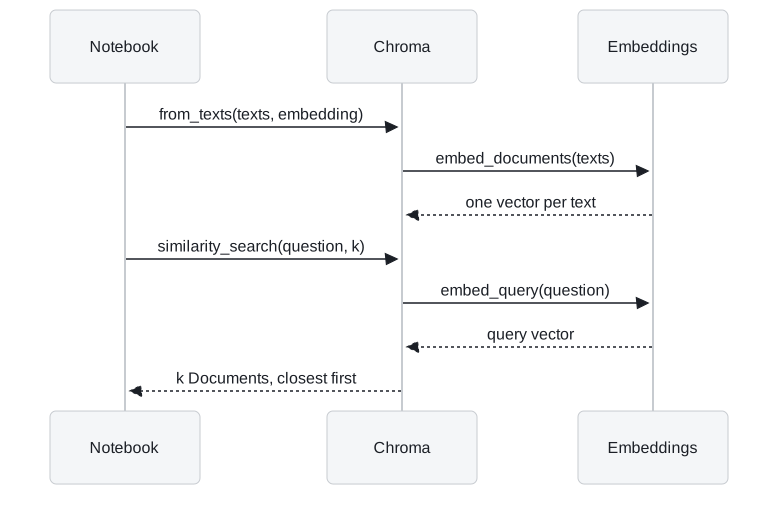
Figure 1: Building and querying a Chroma store. The store holds the embedding object and calls it on both sides.
Because the store keeps the embedding object, the question always goes through the same model as the chunks, and the space mismatch from lesson 3 of T5.1 cannot happen by accident. Embeddings has separate methods for documents and queries because some models encode questions and passages differently. For OpenAI's models the two do the same thing: the query method embeds a one-item list of documents.
Three defaults that change the results
Three defaults in notebook 04a surprise people the first time. Each one fails without an error:
| Default | What you see | Why | Guard |
|---|---|---|---|
k left unset |
Four chunks per question, whatever lesson 2 of T5.1 measured | similarity_search returns 4 when no k is given |
Set k explicitly, from the golden set |
| No collection name and no ids | 24 entries after two runs on 12 chunks; refund-timing twice in the refund question's top three |
from_texts adds to a default collection called langchain, on top of what is already there |
Pass ids= so a rerun overwrites, or give each experiment its own collection |
| No persist directory | An empty index after the kernel restarts | The collection lives in memory | Set persist_directory when the index must survive a restart |
Table 2: Three defaults and the failure each one causes.
The second row is silent duplication: every chunk counted twice, so duplicates crowd evidence out of the top k. It is the failure in the opening example.
The notebook imports Chroma from the community integrations package, which now warns that it is being sunset. This repo depends on langchain-chroma, which provides the same class.
Distance, not similarity
Chroma ranks by distance, and its default metric is squared Euclidean (L2) distance. Lower numbers from similarity_search_with_score mean closer chunks. For vectors of length 1 the two measures are tied by distance = 2 - 2 × cosine, so L2 and cosine rank chunks in the same order. On the 12 Larkspur chunks, embedded with all-MiniLM-L6-v2 as in lesson 3 of T5.1 (langchain-chroma 1.1.0, chromadb 1.5.9):
| Question | Chunk | Cosine (10.3) | similarity_search_with_score |
similarity_search_with_relevance_scores |
|---|---|---|---|---|
| How long does a refund take? | refund-timing (1st) |
0.766 | 0.469 | 0.668 |
| Can I export my data after I cancel my plan? | retention (1st) |
0.817 | 0.367 | 0.741 |
| What happens if my server goes down? | reboot (1st) |
0.394 | 1.212 | 0.143 |
| What happens if my server goes down? | sla (3rd, evidence) |
0.257 | 1.487 | -0.051 |
Table 3: The same chunks scored three ways under Chroma's default L2 space.
The relevance-score method converts L2 distance with 1 - distance / √2, which assumes a range the distances do not keep to:
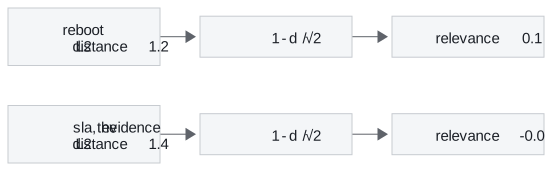
Figure 2: The relevance conversion on the outage question. Any distance above √2 becomes a negative score.
The sla chunk, which holds the evidence for the outage question, gets a negative relevance score, and LangChain warns that relevance scores must be between 0 and 1. A retriever with a similarity-score threshold of 0.2 returns no chunks at all for the outage question, although all three top chunks have a cosine above 0.25. We call this a metric mismatch: a threshold written for one scale applied to scores from another.
Pitfall: metric mismatch. Choose the metric when you create the collection, by setting its HNSW space to cosine in the collection metadata. Then
similarity_search_with_scorereturns 1 - cosine (0.606 forreboot), the relevance score is the cosine itself (0.394), and the same 0.2 threshold returnsreboot,incidentsandsla. The ranking does not change.
The metric is fixed when the collection is created. Changing it means building a new collection (T5.5).
In practice: a Larkspur index that reruns safely
For the handbook, each guard from this page becomes one decision made before the first run:
- Name the collection
handbookand pass each chunk's id (refund-timing,sla, and so on), so a rerun overwrites instead of duplicating. - Set the space to cosine at creation. Relevance scores are then cosines, and thresholds behave.
- Set a persist directory if the index must survive a kernel restart.
- Set
k = 2from lesson 2 of T5.1, and check that a 0.2 threshold still returns all three outage candidates.
Next: lesson 5 of T5.1 puts the store into the full lifecycle, adds the generation step, and records the baseline every later module must beat.
Run the notebooks
The code for this lesson is in these notebooks. Colab runs one in your browser: install the packages its first cell imports and set the API keys it reads. To run every notebook as written, clone the repository and use its uv environment.
| Notebook | GitHub | Colab |
|---|---|---|
| LangChain RAG quickstart | Open on GitHub | Open in Colab |
Key Takeaways
- A LangChain vector store keeps the embedding object and embeds the question for you, so both sides always use the same model.
- Set
kexplicitly, passids=so a rerun overwrites instead of duplicating, and setpersist_directoryif the index must survive a restart. - Chroma ranks by squared L2 distance by default, which breaks relevance-score thresholds. Create the collection with cosine space if you plan to filter on scores.
Check yourself
1. Chroma's default metric is squared L2 distance. Why does it rank unit-length vectors in the same order as cosine?
For vectors of length 1, distance = 2 - 2 × cosine, so a higher cosine always means a lower distance. The order is the same. Only the direction of the numbers flips: lower scores from similarity_search_with_score mean closer chunks.
2. You run the from_texts cell twice on the 12 Larkspur chunks. What does the refund question's top three look like, and how do you prevent it?
The default langchain collection now holds 24 entries, and refund-timing comes back twice in the top three. Pass ids= so a rerun overwrites the same entries, or give each experiment its own collection.
3. A retriever with score_threshold 0.2 returns nothing for the outage question, though its top three chunks have cosine above 0.25. Why, and what is the fix?
The relevance score converts L2 distance with 1 - distance / √2, which assumes a range the distances do not keep to: reboot gets 0.143 and the sla evidence chunk -0.051. Create the collection with its HNSW space set to cosine, so the relevance score is the cosine itself and the same threshold returns reboot, incidents and sla. The metric is fixed at creation, so this means a new collection (T5.5).