Semantic retrieval with embedding similarity
- Source
- From the RAG & Agents Engineering course
- By
- Sourav Banerjee
- Last updated
- 9 Nov 2026
Embedding similarity
What you'll learn
- Explain how an embedding model scores a chunk against a question by the angle between their vectors.
- Compare embeddings with TF-IDF on the three Larkspur golden questions.
- Diagnose why a semantic retriever can rank a related chunk above the one that holds the answer.
- Choose a score threshold from the golden set instead of a fixed number.
Lesson 2 of T5.1 left two questions that no k could fix. The refund-timing chunk scored zero because "Refunds" is a different token from "refund", and the outage evidence scored zero because the customer wrote "server goes down" where the handbook says "outage". Both are representation problems: TF-IDF vectors only count shared words.
An embedding model turns a text into a fixed-length list of numbers, a vector. Texts with similar meaning get vectors that point in similar directions, even when they share no words. Retrieval with embeddings has the same shape as the TF-IDF index; only the vectors change:
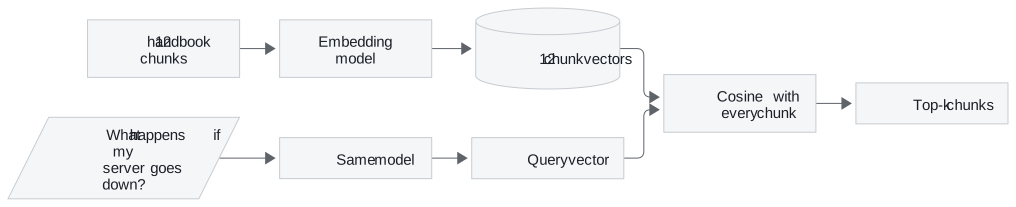
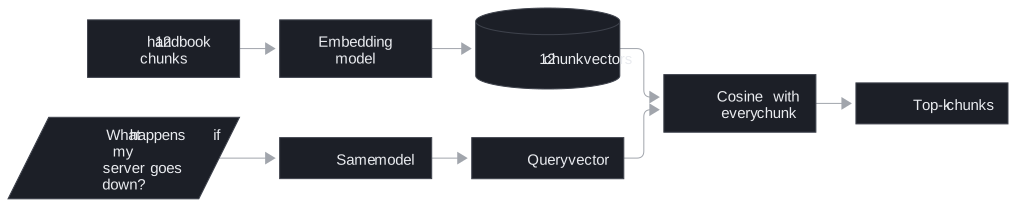
Figure 1: Semantic retrieval. Chunks are embedded once at indexing time. The question is embedded when it arrives.
Each chunk is scored by the cosine of the angle between its vector and the question's. Libraries report that comparison in one of two forms:
| Quantity | How it is computed | Range | Closer chunk |
|---|---|---|---|
| Cosine similarity | The dot product of the two vectors, divided by the product of their lengths | -1 to 1 | Higher number |
| Cosine distance | 1 minus the cosine similarity | 0 to 2 | Lower number |
Table 1: Two forms of the same comparison. Notebook 03a's nearest-neighbour search prints the distance.
When every vector has length 1, the cosine is the plain dot product. OpenAI's embeddings come normalised that way, and sentence-transformers returns them so when asked to normalise.
The question and the chunks must go through the same model. Two models produce vectors in different spaces, so the cosine between a vector from one and a vector from the other means nothing. We call that a space mismatch. Notebook 03a avoids it by sending both sides through one embedding function, and it follows that changing the embedding model means re-embedding the whole corpus (T5.4).
Embeddings against TF-IDF
The comparison below uses the 12 Larkspur chunks and three golden questions from the lesson 2 of T5.1 lab. It embeds every chunk and question with all-MiniLM-L6-v2, a small model (384 numbers per vector) that runs locally, so anyone can reproduce the scores. Notebook 03a uses OpenAI's text-embedding-3-small, whose scores will differ.
With two evidence chunks per question, recall moves in steps of 0.50:
| Question | TF-IDF R@2 | TF-IDF R@3 | Embeddings R@2 | Embeddings R@3 | Embedding top three (cosine) |
|---|---|---|---|---|---|
| How long does a refund take? | 0.50 | 0.50 | 1.00 | 1.00 | refund-timing 0.766, refund-window 0.608, support 0.297 |
| What happens if my server goes down? | 0.00 | 0.00 | 0.50 | 1.00 | reboot 0.394, incidents 0.314, sla 0.257 |
| Can I export my data after I cancel my plan? | 1.00 | 1.00 | 0.50 | 1.00 | retention 0.817, cancel 0.561, export 0.479 |
Table 2: Recall at k = 2 and k = 3 for TF-IDF and embeddings, with the embedding scores of the top three chunks.
The three questions move in three directions:
- Word-form miss, fixed (refund): the embedding model places "Refunds" and "refund" close together, and
refund-timing, which scored 0 under TF-IDF, ranks first. - Vocabulary gap, narrowed (outage): both evidence chunks now reach the top three, though
rebootstill ranks first because rebooting a server is close in meaning to a server going down. The top three scores sit within 0.137 of each other, so a small change to the question can reorder them. - Topic drift (export): embeddings lose a question TF-IDF answered. The question is half about cancelling, so the
cancelchunk (0.561) outranksexport(0.479). TF-IDF matched the literal word "export" and found both evidence chunks atk = 2.
Topic drift is the general weakness. Embeddings measure how close two texts are in topic, which is a different thing from whether a chunk contains the answer. The two retrievers suit different questions:
| The question shares with its evidence | Better retriever | Larkspur example |
|---|---|---|
| A rare exact word: a product name, an error code | TF-IDF | "export" |
| Meaning, in other words or word forms | Embeddings | "server goes down" for "outage", "refund" for "Refunds" |
| Some of each | Hybrid search (T6.1), then a reranker (T6.3) | The export question, half about cancelling |
Table 3: Which retriever wins, by what the question and the evidence have in common.
Hybrid search combines the two scores. A reranker reorders the candidates with a model that reads the question and each chunk together.
Pitfall: the fixed-threshold trap. Cosine scores are not probabilities. The best outage match scores 0.394, while the best export match scores 0.817 on the same model. A rule such as "drop chunks below 0.5" sends the outage question to the model with no context at all.
In practice: switching the Larkspur baseline to embeddings
Moving the handbook index from TF-IDF to embeddings takes four steps, and the last one decides whether the change stays:
- Re-embed all 12 chunks with one model, and send every question through the same model.
- Rerun the golden set at
k = 2. Mean recall@2 rises from 0.50 under TF-IDF to (1.00 + 0.50 + 0.50) / 3 = 0.67. Atk = 3it reaches 1.00, against 0.50 for TF-IDF. - Check every question, not only the mean. The export question fell from 1.00 to 0.50 at
k = 2. Lesson 5 of T5.1's rule keeps a change only when it breaks nothing. This one needsk = 3or hybrid search before it can become the baseline. - Set any score threshold from the golden set. It has to sit below 0.394, the outage question's best match, and it has to be re-checked whenever the model changes.
Next: lesson 4 of T5.1 replaces the hand-built index with a LangChain vector store, which keeps the embedding model and runs the search for you.
Run the notebooks
The code for this lesson is in these notebooks. Colab runs one in your browser: install the packages its first cell imports and set the API keys it reads. To run every notebook as written, clone the repository and use its uv environment.
| Notebook | GitHub | Colab |
|---|---|---|
| Retrieval strategies | Open on GitHub | Open in Colab |
Key Takeaways
- Embeddings score chunks by the cosine between their vectors, which lets paraphrases and word forms match. Embed questions and chunks with the same model. Changing it means re-embedding the corpus.
- Embeddings win on paraphrase and TF-IDF wins on rare exact words such as product names or error codes. Topic closeness is not the same as containing the answer.
- Cosine scores are not probabilities and vary by question. Set any threshold per corpus and model from the golden set.
Check yourself
1. Why must the question and the chunks be embedded with the same model?
Two models produce vectors in different spaces, so the cosine between a vector from one and a vector from the other means nothing. Notebook 03a sends both sides through one embedding function. It follows that changing the embedding model means re-embedding the whole corpus (T5.4).
2. With all-MiniLM-L6-v2, why does the export question fall from recall@2 of 1.00 under TF-IDF to 0.50?
Embeddings measure closeness in topic, and the question is half about cancelling. After retention (0.817), the cancel chunk (0.561) outranks the export evidence chunk (0.479). TF-IDF matched the literal word "export" and found both evidence chunks. Hybrid search (T6.1) combines the two scores.
3. A teammate drops every chunk whose cosine is below 0.5. What happens to the outage question?
It reaches the model with no context at all, because its best match, reboot, scores 0.394. The scores are not probabilities: the best export match scores 0.817 on the same model. Set any threshold per corpus and model from the golden set, and re-check it when the model changes.