The Tool-Calling Loop in LangGraph
By Sourav Banerjee · Last updated 5 Oct 2026 · Report an issue
7 min read
Expressing the agent loop as a graph gives native message shapes and free checkpointing, but the budget and the safety policy are still code the framework will never write.
The framework version of an agent is not a different algorithm. It is the same think, act and observe loop taught in T3.1 The tool-calling loop, mapped onto two nodes and one conditional edge, using the primitives from Modelling Workflows as State Graphs.
Objectives:
- map each part of a from-scratch agent loop onto a LangGraph node or edge;
- write the guard that ends the loop;
- keep tool failures inside the conversation, and bound a prebuilt agent with middleware.
Map the Loop Onto Two Nodes
The FDE Handbook builds one agent twice over the same tools, decision logic, robustness and observability code. Only orchestration differs, so every piece maps.
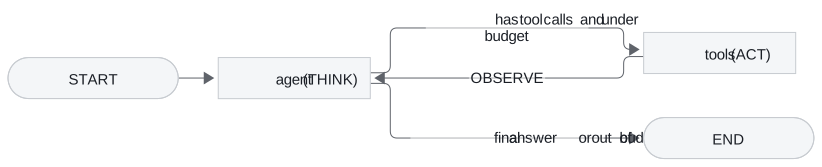
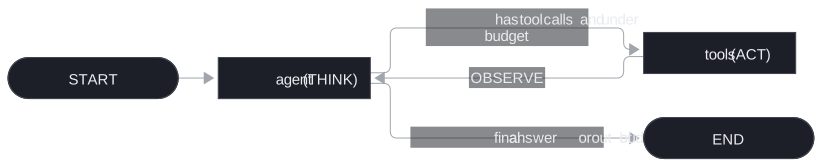
The agent node is THINK. The tools node is ACT. The edge from tools back to agent is OBSERVE. The conditional edge out of agent is the guard and the final-answer exit together.
| Concept | From scratch | LangGraph |
|---|---|---|
| Working memory within a run | A list of (tool, result) observations |
state["messages"]: human, AI and tool messages |
| Step counter | A local iterations |
state["iterations"], overwritten, no reducer |
| THINK | brain.decide(...) inside the while |
agent_node calls brain.decide(...) |
| Tool request | Decision(tool=..., args=...) |
AIMessage(tool_calls=[{name, args, id}]) |
| Final answer | Decision(final=...) |
AIMessage(content=...) with no tool calls |
| ACT | execute_tool(...) in the loop body |
tools_node calls execute_tool(...) |
| OBSERVE | Append to observations | ToolMessage appended through add_messages |
| Guard and exit | while iterations < max and if is_final |
should_continue returns "tools" or END |
| Confirmation needed | Raise and pause the run | ToolMessage saying needs_confirmation, and continue |
| Cross-turn state | Session |
Session, plus checkpointers for durability |
Speak the Model's Message Format
The graph carries a conversation, not a list of tuples. A HumanMessage holds the query. An AIMessage holds each decision. A ToolMessage holds each result. That is the shape a real model with bound tools produces natively.
So the agent node translates a decision into a message. A final answer becomes an AIMessage with content and no tool_calls. A tool request becomes an AIMessage with empty content and a tool_calls list. That is the exact shape a tool-bound chat model returns, which is why swapping the offline decision logic for a real model is a one-line change. The counter increments on the decision to call a tool, not on execution, which matches the from-scratch accounting.
The tools node loops over last.tool_calls, because a model can request several tools in one message. It runs each through the same safe executor, with the same confirmation gate, memo and retry, and returns one ToolMessage per call, matched by tool_call_id.
Write the Guard Yourself
def should_continue(state: AgentState) -> str:
    last = state["messages"][-1]
    has_calls = isinstance(last, AIMessage) and bool(getattr(last, "tool_calls", None))
    if has_calls and state["iterations"] < max_iterations:
        return "tools"
    return END          # final answer, or out of budget
This one function is the from-scratch while condition and its if is_final check combined. There are two ways to reach END: the last message has no tool calls, or the budget is spent. Delete the second clause and LangGraph will run forever.
g.add_conditional_edges("agent", should_continue, {"tools": "tools", END: END})
g.add_edge("tools", "agent")          # observe -> think again
Keep Tool Failures in the Conversation
A tool that raises kills the graph run. A tool that catches its own exception and returns a descriptive string turns the failure into one more message the model can react to. The LangGraph notebooks show this with a divide tool that returns "Error: division by zero" rather than raising.
The Handbook's graph does the same with risky tools. A ConfirmationRequired becomes a ToolMessage carrying an error, and the run continues; the model sees the refusal as an observation. The from-scratch loop instead pauses with blocked_on. Both designs are legitimate, and the Handbook names the explicit pause as the better production shape. LangGraph supports it through interrupt_before and a checkpointer, covered in Checkpoints, Interrupts, and Human Approval.
Warning: termination is the model's call unless you bound it. The loop ends when the model returns a message with no tool calls. Nothing stops a model that keeps calling tools. Bound it externally with a step budget in the guard, or a call-limit middleware on a prebuilt agent.
Bound a Prebuilt Agent With Middleware
LangChain's create_agent compiles this same loop as a prebuilt graph. It returns a compiled LangGraph runnable, not an object with a .middleware attribute; to see what is wired in, inspect agent.get_graph().nodes. Tool arguments are model-generated JSON driven by the tool schema. The notebooks prove it with the typo "New Yourk", which the model still resolves to the right city.
Middleware hooks run before or after each model call, which is where cross-cutting production controls belong.
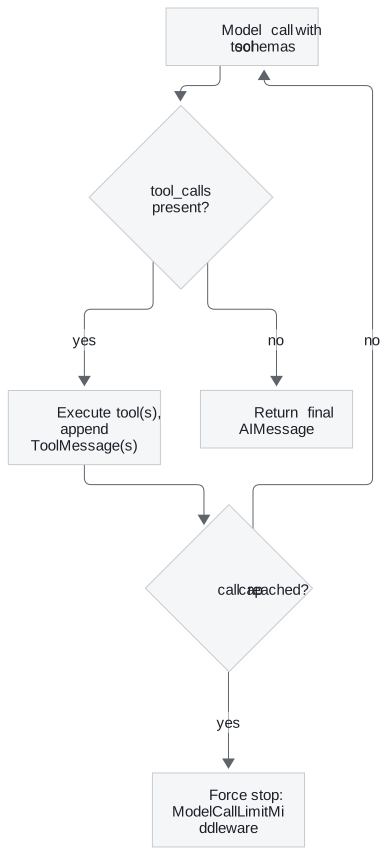
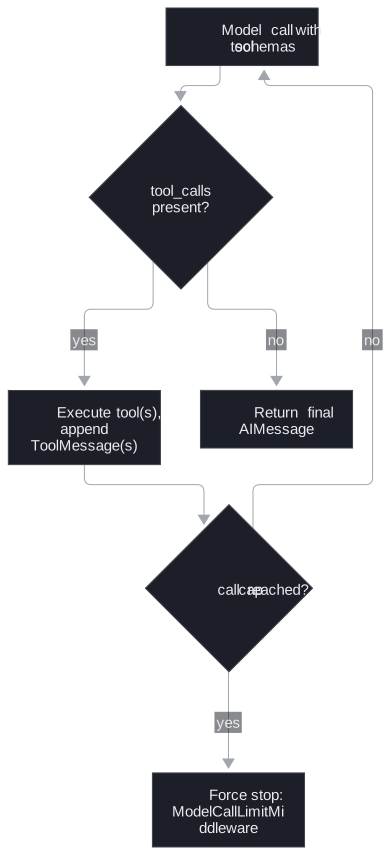
The call cap is the second exit; without it, the only exit is the model choosing to stop.
| Middleware | What it does | The trap |
|---|---|---|
ModelCallLimitMiddleware |
Caps model calls | run_limit caps one invocation; thread_limit caps a whole thread. Set both for multi-turn agents |
SummarizationMiddleware |
Compresses history when a trigger fires, keeping the most recent keep verbatim |
The only signal it fired is the message count dropping |
PIIMiddleware |
Redacts one PII type | Does nothing to model input unless apply_to_input=True |
HumanInTheLoopMiddleware |
Pauses before named tools for approve, edit or reject | Needs a checkpointer to resume |
Custom AgentMiddleware |
before_model and after_model hooks |
Write it for timing, logging or custom limits |
The summarisation trigger takes three units. A message count, such as ("messages", 10), is cheapest and blind to message length. A token count, such as ("tokens", 550), tracks real cost but needs a tokeniser. A context fraction, such as ("fraction", 0.005), about 640 tokens of a 128k window, is the only one that scales across models without re-tuning.
Worked Example: Answering "Why LangGraph?"
An interviewer has just watched the from-scratch loop and asks why anyone would use LangGraph. Walk the mapping table. The local observation list became state["messages"], so the graph already speaks the model's tool-call format. The while condition became should_continue. The counter became an overwrite field.
Then name what did not move. The step budget is still a clause in should_continue. The confirmation policy is still in execute_tool. The retry and fallback logic and the destructive flag are unchanged. What the graph added is declared state, the native message shape, and checkpointing for pause and resume. That answer shows the candidate knows exactly what the framework does, so it can never surprise them.
Key Takeaways
- The agent loop maps onto an
agentnode, atoolsnode, a back edge and one conditional edge that is both guard and exit. - Messages replace observations, so a real model with bound tools slots in with a one-line change.
should_continuemust check both "no tool calls" and "budget spent"; without the second, the graph never stops.- Tools should return errors as messages; risky tools are better paused with an interrupt than answered with a refusal.
create_agentcompiles the same loop; middleware adds call caps, summarisation, PII redaction and approval gates, each with a configuration trap.
Check Yourself
Where is the max-iteration guard in the graph version, and what happens without it? In
should_continue, as theiterations < max_iterationsclause. Without it the graph keeps routing totoolsfor as long as the model requests tools.Why does the
agentnode emit anAIMessagewithtool_callsinstead of returning the decision object? That is the shape a real tool-bound model returns, so the graph speaks the model's language and a real model can replace the offline logic in one line.An agent's per-call cap looks right, but one long conversation ran up a large bill. Why? Only
run_limitwas set. It caps one invocation;thread_limitcaps the cumulative calls across a thread.