Evaluation
- Source
- From the RAG & Agents Engineering course
- By
- Sourav Banerjee
- Last updated
- 9 Nov 2026
Evaluation
What you'll learn
- Compare exact match, a stored evaluation set and a general benchmark by what each one can and cannot tell you.
- Diagnose an evaluation that could not succeed: a generation limit shorter than the target.
- Read a stored evaluation set for the runaway answer that a missing end token causes.
- Design a comparison between a fine-tuned model and the T5.1 RAG baseline on the same questions.
Lesson 5 of T14.1 ended with a held-out loss, and a loss says the model fits unseen rows of the same kind. The Larkspur support lead asks a different question: does the fine-tuned assistant answer better than the one in production? A team that answers with "0 exact matches" has measured something, but not that. This page shows what each method measures, and why the first failure in this notebook is visible by reading one answer.
Evaluation asks whether the model does the job on rows it never saw, and whether it still does the jobs it could do before. The notebook tries three methods on lamini/lamini_docs_finetuned, from strictest to broadest:
| Method | What it compares | What it can tell you |
|---|---|---|
| Exact match | The stripped generated answer against the stripped target | Whether the model reproduces the target string |
| Stored evaluation set | 139 saved predictions against their targets | How the trained model behaves across many questions |
| Benchmark | Multiple-choice general questions (ARC Easy) | Whether fine-tuning cost the model general ability |
Table 1: The notebook's three evaluation methods.
Exact match, and a limit that blocks it
The exact-match function strips both strings and compares them. The notebook generates answers for the test split and counts matches. Two details limit what that count can say:
| Detail | Effect |
|---|---|
| The loop breaks once its counter passes 10 | It scores 12 of the 140 test questions |
Generation uses a max_length of 100, a limit on prompt plus answer |
For 42 of the 140 test pairs, question and target answer together exceed 100 tokens, 3 of them among the 12 scored |
Table 2: Why the notebook's exact-match count is bounded. Token counts measured with the Pythia tokenizer in the scratchpad.
For those 42 questions the model could not produce the target even if it knew it word for word. We call that an impossible target: a test the generation settings guarantee will fail. Set the limit on new tokens, not on the total, and check it against the longest target before you read any score.
The stored evaluation set
lamini/lamini_docs_evaluation holds 139 predicted answers next to their targets. We scored it the notebook's way in the scratchpad:
| Measure | Value |
|---|---|
| Exact matches | 0 of 139 |
| Predictions that repeat a sentence of more than 20 characters | 127 of 139 |
| Median prediction length | 5,128 characters |
| Median target length | 304 characters |
Table 3: The stored evaluation set, scored in the scratchpad.
The failure is visible in the text before any score. The first prediction says "Yes, Lamini can generate technical documentation or user manuals for software projects" and then repeats "Additionally, Lamini can be trained on specific technical questions…" until it is cut off. We call this the runaway answer. Its cause is upstream: the lamini/lamini_docs training rows carry no end token (lesson 4 of T14.1), so the model has no example of an answer stopping.
A benchmark
The last cell runs ARC Easy through EleutherAI's evaluation harness. A benchmark of general questions does not measure the fine-tuned task. It checks that fine-tuning did not cost the model what it could already do. Run it on the base and the fine-tuned model and compare the two. The cell expects a local checkout of the harness that the course does not include; install the harness first.
Picking the method
Pick the method by what a correct answer looks like:
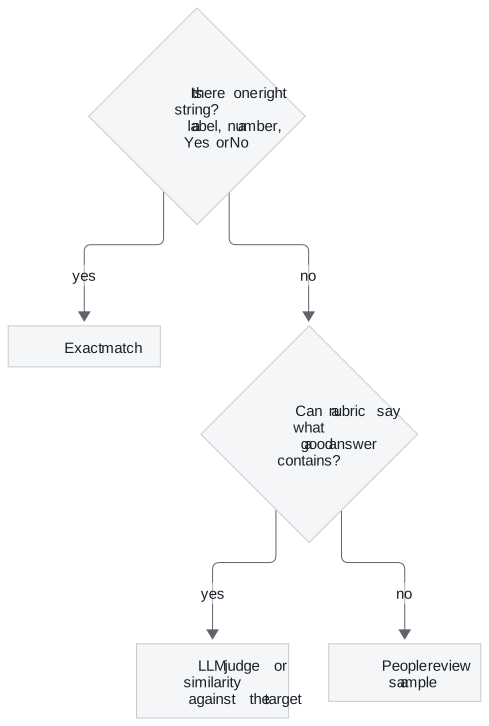
Figure 1: Choose the metric from the shape of a correct answer.
Most fine-tunes need more than one. For the Larkspur assistant, whether an answer opens with Yes or No is a string check. Whether its policy sentence matches the handbook needs a judge or a reviewer, and a benchmark run before and after guards general ability. Whatever the metric, read the failures by hand: the runaway answer shows up in the first prediction, long before any score.
Each of these measures the fine-tuned model alone. The decision the support lead needs is a comparison.
Against the RAG baseline
The module lab asks for one comparison: the T5.1 RAG baseline and a small fine-tuned model, on the same questions. Run both on T5.1's golden questions plus the off-topic probe, and record for each answer:
| Column | Measured by | Which side it tends to favour |
|---|---|---|
| Correct and current fact | Judge or reviewer against the handbook | RAG, which reads the current policy |
| Cites its source | Presence of a chunk id | RAG; a fine-tuned model has nothing to cite |
| Opens with Yes or No | String check | Fine-tuning, if the training answers do |
| Declines What do you think of Mars? | String check or judge | Fine-tuning, if the data has refusal rows |
| Latency and cost per call | Timer and token count | Fine-tuning: a short prompt and a small model |
Table 4: The comparison sheet for the T14.1 lab, one row per column to record.
Then plant the failure that separates the two. Change one handbook fact, say the refund window, and run both again without retraining:
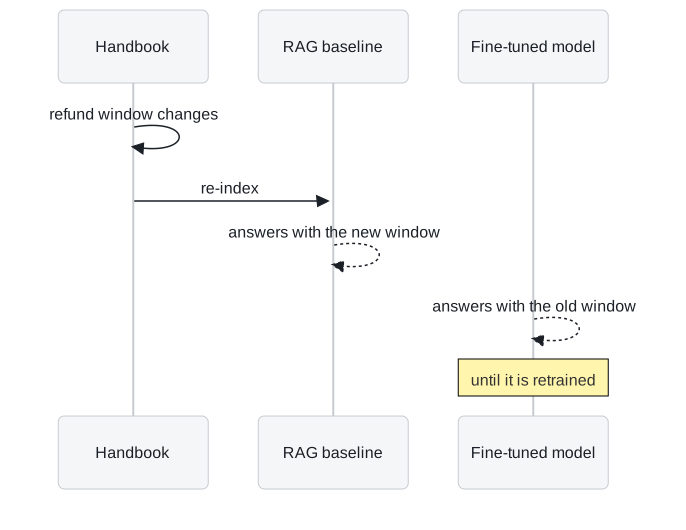
Figure 2: One changed fact. RAG follows the handbook after a re-index; the fine-tuned model keeps its baked-in answer.
This is the baked-in staleness from lesson 1 of T14.1, measured instead of argued. For Larkspur the sheet points to both: fine-tune for the style and the refusals, retrieve the facts, and evaluate the combination against the same baseline. Lesson 7 of T14.1 shows how to run that fine-tune on a model large enough to serve.
Run the notebooks
The code for this lesson is in these notebooks. Colab runs one in your browser: install the packages its first cell imports and set the API keys it reads. To run every notebook as written, clone the repository and use its uv environment.
| Notebook | GitHub | Colab |
|---|---|---|
| Evaluation lab | Open on GitHub | Open in Colab |
| Evaluation lecture (optional) | Open on GitHub | Open in Colab |
Key Takeaways
- Pick the metric by what a correct answer looks like: exact match for one right string, a judge or similarity for a rubric, people for the rest. Most fine-tunes need more than one.
- Check that generation limits leave room for the target, and read failures by hand. Repetition from missing end tokens shows in the first prediction, long before any score.
- Run a general benchmark on the base and fine-tuned models to catch lost ability, and compare against the RAG baseline on the same questions, including after a fact changes.
Check yourself
1. What does running ARC Easy after fine-tuning tell you, and how do you use it?
It does not measure the fine-tuned task. It checks that fine-tuning did not cost the model what it could already do. Run it on the base model and the fine-tuned model and compare the two.
2. The stored evaluation set scores 0 exact matches in 139. What do the predictions show, and what caused it?
Runaway answers: 127 of the 139 predictions repeat a sentence of more than 20 characters, and the median prediction is 5,128 characters against a median target of 304. The lamini/lamini_docs training rows carry no end token, so the model never saw an answer stop.
3. You change the Larkspur refund window and rerun the RAG baseline and the fine-tuned model without retraining. What happens, and what design does that suggest?
RAG gives the new window after a re-index; the fine-tuned model keeps answering with the old one until it is trained again. Fine-tune for the style and the refusals, retrieve the facts, and evaluate the combination against the same baseline.