Concurrency: threads, processes, the GIL and asyncio (22 runnable scripts)
- Source
- From the RAG & Agents Engineering course
- By
- Sourav Banerjee
- Last updated
- 9 Nov 2026
asyncio
A coroutine, written async def, is a function that can pause. Each await is a pause point: while one coroutine waits for a network reply, the event loop runs another. One thread and one loop can keep many waits overlapping. Scripts 13 to 18 build this up:
- 13:
asyncio.run(brew_chai())starts an event loop and runs one coroutine to completion. - 14:
asyncio.gatherruns three coroutines that eachawait asyncio.sleep(3); the waits overlap, so the three take about 3 s instead of 9. - 15: the same pattern with real HTTP: three
aiohttprequests to an endpoint that delays 2 s overlap in oneClientSession. - 16 and 17:
loop.run_in_executorhands a blocking function to aThreadPoolExecutor, or CPU-bound work to aProcessPoolExecutor, and awaits the result without stopping the loop. - 18: a daemon thread keeps logging while the loop runs a coroutine.
A model call is a network wait of a second or more, and RAG work is full of independent ones: a golden-set evaluation, a batch of embedding requests, one question sent to several retrievers. gather starts them together. A Semaphore caps how many are in flight, because every provider enforces a rate limit:
sem = asyncio.Semaphore(2)

async def ask(question):
    async with sem:                          # waits here while two calls are in flight
        return await llm.ainvoke(question)

async def main(questions):
    return await asyncio.gather(*(ask(q) for q in questions))
With eight Larkspur handbook questions and a semaphore of 2, each queued call starts the moment a slot frees up:
- gather creates eight tasks. The semaphore lets two in: refund time and annual billing are sent; six wait.
- Annual billing returns and frees a slot. Server down, the slowest call, is sent.
- Refund time returns. Export after cancel takes its slot.
- Export after cancel returns. Support speed is sent.
- Server down returns after 2.6 s in flight. Reboot and IP is sent.
- Support speed returns. Server size is sent; it will end last.
- Reboot and IP returns. Promo credits, the last in the queue, is sent after waiting 4.3 s.
- Server size returns and gather hands back all eight answers: 5.6 s, against 11.0 s one at a time.
The call times are representative; the schedule is what asyncio does with them. The interactive lab runs that schedule for every limit from 1 to 8. Its JavaScript scheduler matches real asyncio.gather with asyncio.Semaphore (Python 3.12, on a virtual clock) on all 128 call intervals (eight calls at eight limits, with each client), start and end within 1e-15 s:
| Semaphore limit | Wall time | Faster than one at a time |
|---|---|---|
| 1 | 11.0 s | 1.0× |
| 2 | 5.6 s | 2.0× |
| 3 | 4.5 s | 2.4× |
| 4 | 3.1 s | 3.5× |
| 7 or 8 | 2.6 s | 4.2× |
| Any, with a sync client | 11.0 s | 1.0× |
Three things follow from the table:
- A semaphore of 1 is a for loop. The wall time is the sum of the calls, 11.0 s.
- The slowest call sets the floor. What happens if my server goes down? takes 2.6 s, so no limit beats 2.6 s, and from 7 on a higher limit changes nothing. Going from 4 to 8 saves 0.5 s; going from 1 to 2 saved 5.4 s. Pick the limit from the provider's rate limit, then measure.
- A call that never awaits blocks everything.
llm.invoke,requests.getandtime.sleepinsideasync defhold the event loop until they return, so no other coroutine starts and the eight calls run one after another at any limit. Use the async method (ainvoke,aiohttp), or move the sync call to a thread withawait asyncio.to_thread(llm.invoke, question), which is what script 16 does withrun_in_executor.
Two more rules for production runs. gather raises the first exception to the caller while the other calls keep running; pass return_exceptions=True to get every result and every error back in order, so one failed question does not hide the other seven. And in a Jupyter notebook an event loop is already running, so asyncio.run(main()) raises RuntimeError; write await main() in the cell instead.
Threads, processes and the GIL
CPython's global interpreter lock (GIL) lets one thread execute Python bytecode at a time. A thread gives up the GIL while it sleeps or waits on I/O, so threads overlap waiting (scripts 01 and 05 to 07: brewing, toasting, three downloads) but not pure-Python computation. Script 03 runs two threads that each count to 100 million and script 04 runs the same count in two processes; time both on your machine. Each process has its own interpreter and its own GIL, so the processes can use two cores.
Processes cost more. Each starts a new interpreter, its arguments are pickled across, and it shares no memory by default: script 11 sends a result back through a multiprocessing.Queue, and script 12 shares one counter through a Value. On macOS and Windows a new process imports your script again, which is why scripts 02, 04 and 10 put their start-up code under if __name__ == "__main__":.
Scripts 09 and 10 make the same comparison, but 10 counts to a billion per process against 10 million per thread in 09, a hundred times the work. Compare 03 with 04 instead.
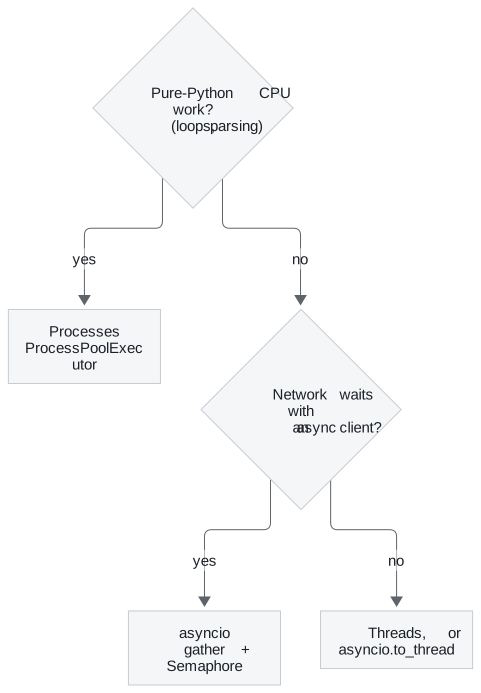
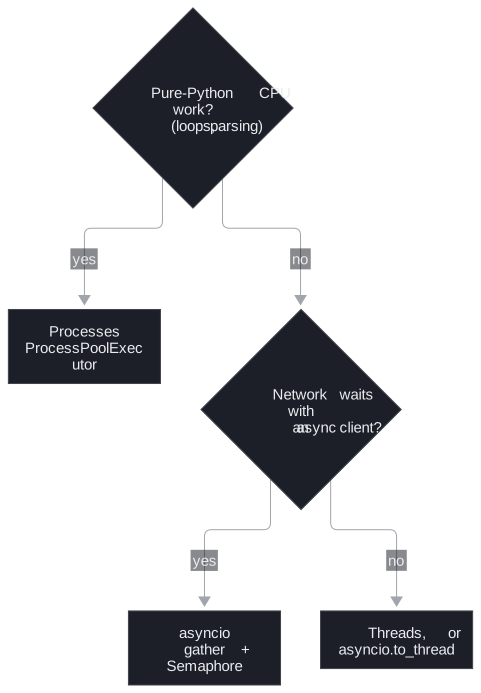
Daemon threads (script 19) are killed when the main program exits, which suits a background logger; a regular thread (script 20) keeps the process alive until it returns, so one stuck in a loop keeps the program from ever exiting.
Races and deadlocks
A race happens when two flows of control read shared state, one changes it, and the other writes back a value computed from the stale read. Script 21 has two threads each run chai_stock += 1 100,000 times. On CPython 3.12 it printed 200,000 in all three runs on the machine these pages were written on: the interpreter rarely switches threads inside +=, which hides the race without removing it. Put time.sleep(0) between the read and the write and two threads of 1,000 increments ended at 1,075 and 1,030 of 2,000.
asyncio has the same bug in a form that never hides. Code between two awaits runs without interruption, so a race needs an await between the read and the write, and a model call is exactly that:
spent = 0

async def ask(cost):
    global spent
    v = spent
    await asyncio.sleep(0.01)                # the model call
    spent = v + cost                         # writes back a stale total
Eight of these under gather leave spent at 1, not 8, on every run: all eight read 0 before any of them writes. Updating after the await (spent += cost on one line) gives 8; an asyncio.Lock around the read and the write also works.
For threads the fix is a lock around the read-modify-write. Script 08 wraps the increment in with lock: and ten threads of 100,000 reach exactly 1,000,000; script 12 does the same across four processes with counter.get_lock() and reaches 400,000.
Locks bring the opposite failure. In script 22, task 1 holds lock A and waits for B while task 2 holds B and waits for A, so both wait forever:


Acquire locks in one fixed order everywhere (A before B), hold one lock at a time where you can, or use lock.acquire(timeout=5) so a thread fails with a visible error instead of hanging.
Run the notebooks
The code for this lesson is in these notebooks. Colab runs one in your browser: install the packages its first cell imports and set the API keys it reads. To run every notebook as written, clone the repository and use its uv environment.
| Notebook | GitHub | Colab |
|---|---|---|
| Concurrency scripts (optional) | Open on GitHub | Run locally |
Key Takeaways
- Run independent model calls with
gatherand cap them with aSemaphore. The slowest call sets the floor, so pick the limit from the provider's rate limit, then measure. - A sync call inside
async defholds the event loop and turns any limit into a for loop. Useainvokeorasyncio.to_thread, and use processes for pure-Python CPU work, since the GIL runs one thread at a time. - A race needs a read, a switch and a stale write-back; in asyncio one
awaitbetween them is enough. Lock the read-modify-write, and acquire locks in one fixed order to avoid deadlock.
Check yourself
1. Two threads each count to 100 million in pure Python. Why can they not use two cores, and what can?
CPython's GIL lets one thread execute Python bytecode at a time, so threads overlap waiting but not pure-Python computation. Processes can, because each has its own interpreter and its own GIL (script 04, or a ProcessPoolExecutor). They cost more: a new interpreter per process, pickled arguments and no shared memory by default.
2. The eight Larkspur calls run under Semaphore(4), but the code calls llm.invoke inside async def. What wall time do you expect, and what is the fix?
About 11.0 s, the same as one call at a time. A call that never awaits holds the event loop until it returns, so the calls run one after another at any limit. Use the async method (ainvoke) or await asyncio.to_thread(llm.invoke, question); with an async client, a limit of 4 gives 3.1 s.
3. Eight coroutines under gather each add 1 to a shared spent total around an awaited model call, and spent ends at 1. What went wrong?
Each coroutine read spent into v, awaited the model call, then wrote v + cost. All eight read 0 before any of them wrote, so every write was 0 + 1. Do the update after the await in one line (spent += cost), or hold an asyncio.Lock around the read and the write.