Inference and GPU infrastructure: learn and design
- Source
- From the Staff AI System Design course
- By
- Sourav Banerjee
- Last updated
- 8 Nov 2026
Keep Gateway Policy Separate From the Serving Engine
The gateway binds trusted principal, operation key, current source policy, approved bundle and provider profile. The serving engine runs generation for a specific model revision. A production profile must identify supported context/output bounds, model/engine versions, readiness, approved network/data path, credential reference and quota scope. An unregistered or unapproved route must not become a destination from user/model-supplied text.
For Tenant A the fixture requires a private-approved profile as trusted configuration, not a request flag the caller can downgrade. The boolean tests policy composition only; it does not prove any network endpoint is private. The same current T18.7 retrieval/audit gate runs before new disclosure, and secret references/provider allowlists remain scoped. The gateway accepts a supplied token estimate to demonstrate budgeting; real adapters must count/tokenise under the actual model/provider rules.
Validate input plus requested output against model context, and requested output against the profile's output maximum. Reserve shared request/token/concurrency budgets before transport. App replicas, ready GPU processes and an approved model do not eliminate those budgets. Only a fresh grant permits a new provider attempt; a duplicate grant is inspection/replay, not permission to call again.
For a completed same-key operation, return the original saved result and bundle after checking its original source references under current access. Do not select a new model just because the release pointer changed. The fixture refuses replay if the original evidence is now forbidden; this is an explicit protected-grounded-result choice, not a new rule for the separate general drafting endpoint. Conflicting input/output parameters require a deliberate new operation identity.
If a transport outcome is unknown, persist uncertainty and retain the conservative reservation rather than auto-fallback. A final write failure cannot return completed success. Claim/grant/dispatch/result/settlement are still separate boundaries: an incomplete prepared/dispatching record requires inspection, and can strand capacity until reconciliation. The fixture's typed unknown response is handled explicitly; other transport/storage failures propagate with durable incomplete evidence, never an automatic second route.
Choose Hosted Versus Self-Hosted for a Reason
| Design | Benefit | Operational cost or failure | Decision criterion |
|---|---|---|---|
| Approved hosted model | Managed engine/hardware operations, quick capacity access | Provider quotas, data/network constraints, usage price and opaque performance changes | Retain when approved policy and measured service meet needs |
| Self-hosted approved model | Control model/engine/placement and potentially data path | GPU idle cost, capacity/availability, warmup, patching, model quality and on-call burden | Add only with quality, policy and utilisation evidence |
| Multiple approved providers | Dependency diversity and workload routing options | Semantic/version differences, duplicated budgets and uncertainty on fallback | Select before dispatch under explicit policy; no blind retry after unknown effects |
| One replica per model on a single GPU | Simpler serving when peak memory fits | One failure domain and finite active context | Useful baseline to profile, not a throughput guarantee |
| Model sharded over several GPUs | Fit larger models or change execution profile | Communication/topology, rollout and failure coordination | Use only after model/engine support and profiling justify it |
A lower per-token price is not enough to justify migration. Include quality/refusal behaviour, source handling, tenant policy, burst headroom, staff operations and actual utilisation. A self-hosted route is a new evaluated bundle, not a drop-in endpoint alias. T18.9 gates still apply, and an older hosted result remains its original operation.
Understand Execution Without Studying Kernels
Prefill consumes the supplied input tokens and establishes attention state. Decode generates tokens incrementally and reuses key/value state. A long retrieved context can increase prefill work and KV memory; long output grows cached sequence length and occupies a slot longer. The model's context window is an upper interface bound, not a performance promise at that limit.
TTFT includes queue/scheduling and prefill before the first output; ITL describes subsequent token timing. Total user latency also includes verification/retrieval, queueing, generation and final save/audit. Streaming can improve perceived progress while leaving commit-before-saved-success unchanged. A disconnected stream still needs stable operation inspection; it does not prove generation stopped.
Batching combines eligible work for engine efficiency. Static batches can make short requests wait for long ones; continuous batching can admit/remove sequences as others finish, but engine policy and memory constraints matter. Larger batches may improve throughput while worsening user latency. Prefix/KV reuse requires compatible model/tokenisation/engine state and an approved isolation policy; it is not T18.5's immutable-body cache and never grants document access. vLLM's paged-attention design is a primary implementation reference, not an installed dependency.
At explain depth optimisation depth, know the decision boundaries: weight quantisation may reduce weight memory while changing quality and hardware compatibility; KV quantisation is a separate choice; cache management/batching can reduce waste but cannot create physical bandwidth or unlimited active context. Transformers optimisation guidance gives implementation examples. Profile the approved model/dtype/engine/workload instead of copying a speed claim from another setup.
GPU Memory, Parallelism and Placement
VRAM holds weights, KV state, activations/workspaces and runtime allocations. Memory capacity determines whether a configuration may fit; memory bandwidth, compute, scheduling and communication affect speed. A capacity calculation cannot establish achieved FLOPS, tokens/second, TTFT or p95. Keep decimal bytes versus binary GiB explicit.
A data-parallel serving replica usually loads another copy of the model to serve independent work. Tensor parallelism splits selected tensor computation/storage across devices and adds communication; pipeline parallelism places layer stages on different devices and adds stage/queue coordination. Actual KV partitioning depends on model attention layout and engine implementation. Do not divide every memory component by GPU count automatically. vLLM parallelism/scaling documentation describes concrete serving choices.
Placement must account for model/dtype compatibility, peak memory, interconnect/topology when sharded, ready warm capacity and tenant/workload isolation. Time-sharing or a shared process is not automatically strong isolation. Hardware partitioning/virtualisation may offer different boundaries depending on the platform; neither is demonstrated here. T18.6 admission/fair queues still limit active work and service shares before device scheduling.
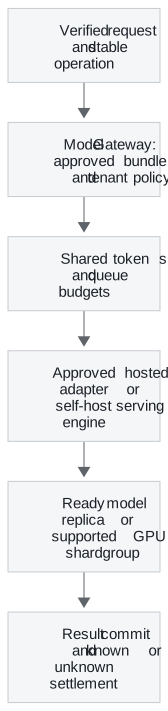
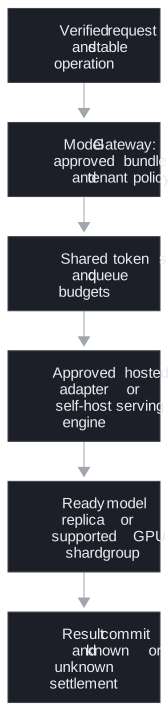
After diagram. Self-hosting is a proposed serving option behind existing protected gates, not a new permission authority. The executable replaces both hosted/self-host transport with a fixture and performs no GPU allocation.
Checkpoint 1: Weight Fit Is Not Request Fit
The raw FP16 weights fit in an assumed 24 GiB allocation. Can you admit any number of 8,192-token active sequences?
Answer before revealing
No. KV state grows with total cached tokens and active sequences, and workspaces/runtime also need memory. Bound the context/output envelope and concurrency using the actual model/engine layout, then profile. Weight fit alone proves neither full-request memory fit nor useful latency.
Container and Serving Lifecycle at design depth
Package the tested engine/runtime and pin model artefact identity; do not fetch an arbitrary mutable model revision at startup. Resolve secrets through runtime identity, restrict artefact/egress access and validate driver/runtime compatibility. Container resource declarations must match schedulable devices and placement constraints. Kubernetes GPU scheduling documentation is an orchestration example, not a requirement or a deployment made here.
Startup is not readiness. Weights may be loading, kernels/cache warming or dependencies unavailable after a process starts. A readiness check should reflect the intended model revision and supported request envelope before the gateway routes work; liveness should not repeatedly kill a healthy but slow model load. Use a startup budget and admission headroom for cold replicas.
On replacement/scale-in, stop new routing, drain bounded active requests and preserve unknown external outcomes. A new warm replica needs its own capacity and cached-state assumptions. Multi-device groups require compatible versions and coordinated readiness; one missing shard can make the logical model unavailable. The deployment exercise is to specify image/model IDs, device limits, startup/readiness/drain conditions, network/secret policy and a canary plan, not to run an unreviewed cluster manifest.
Key Takeaways
- The gateway binds trusted principal, operation key, source policy, approved bundle and provider profile before dispatch. The serving engine only runs generation, and an unregistered route never becomes a destination from user or model text.
- Validate input plus requested output against the model context and the profile's output maximum, then reserve shared token, request and concurrency budgets before transport. Only a fresh grant permits a new provider attempt.
- A lower per-token price does not justify self-hosting. Weigh quality, tenant policy, burst headroom, operations and actual utilisation, and treat a self-hosted route as a new evaluated bundle rather than an endpoint alias.
- Weight fit is not request fit, because KV state grows with cached tokens and active sequences. A started process is not ready until the intended model revision and supported request envelope are, so route work only then.