Cross-encoder reranking in a RAG chain
- Source
- From the RAG & Agents Engineering course
- By
- Sourav Banerjee
- Last updated
- 9 Nov 2026
Bi-encoder vs cross-encoder
What you'll learn
- Explain why reading question and chunk together judges relevance better than comparing two vectors.
- Trace the Larkspur export question as a cross-encoder demotes a distractor that shares its words.
- Place a reranker in a LangChain chain as a document compressor.
- Diagnose three production mistakes: a tiny candidate list, a model loaded per question, and a threshold on uncalibrated scores.
Lesson 1 of T6.3 treated the reranker as a box that lifts evidence from rank 9 to rank 3. This lesson opens it. Both stages read text with a transformer encoder; they differ in what goes into the encoder together:
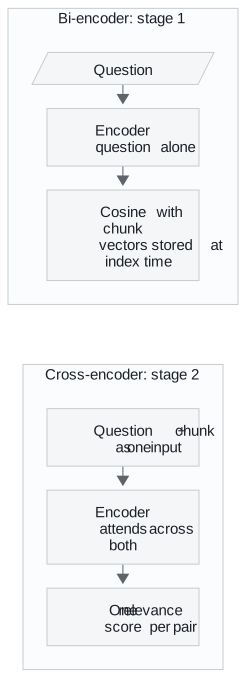
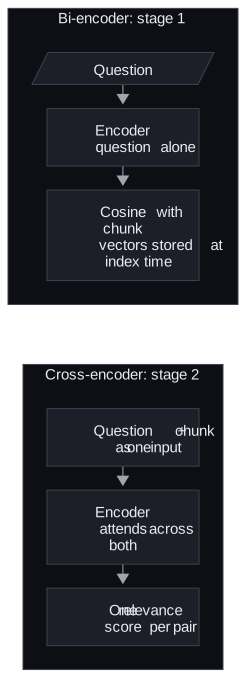
Figure 1: A bi-encoder encodes each text alone; a cross-encoder encodes the pair.
A bi-encoder turns the question and each chunk into vectors separately and compares them with cosine similarity. The chunk vectors are computed once, when the index is built, so answering a question costs one embedding and a nearest-neighbour search however large the index is. all-MiniLM-L6-v2, the first stage in lesson 1 of T6.3, has about 22M parameters and 384-dimensional vectors.
The price is that each chunk is summarised into one vector before any question exists, and that one vector serves every question. We call the result a near miss: a chunk that shares the question's words and not its answer.
A cross-encoder reads the question and one chunk as a single input, so every question token can attend to every chunk token, and it outputs one relevance score. Nothing can be computed ahead of time, because the input depends on the question: scoring 50 candidates means 50 forward passes. That is why it runs only on the short list.
The near miss, traced
Can I export my data after I cancel my plan? has a near miss in the lab's handbook: the cancel chunk ("You can cancel any plan from the Billing page. Cancelling stops the next charge…") shares "cancel" and "plan" with the question and says nothing about data. Here are the bi-encoder's top five and what the larger cross-encoder makes of them:
| Chunk | Bi-encoder similarity (rank) | Cross-encoder score (rank) | Evidence |
|---|---|---|---|
retention |
0.817 (1) | 0.993 (1) | ✓ |
cancel-access |
0.628 (2) | 0.907 (2) | ✓ |
cancel |
0.561 (3) | 0.001 (5) | |
refund-monthly |
0.502 (4) | below 0.001 (7 or lower) | |
export |
0.479 (5) | 0.064 (3) | ✓ |
Table 1: The export question's top five, before and after BAAI/bge-reranker-v2-m3 over 10 candidates (the module's rerank precision lab).
The bi-encoder puts cancel 3rd on shared vocabulary. The cross-encoder gives it 0.001 and lifts export, which says how to download the data, into 3rd place. Precision@5 is 0.60 either way here, because export was already 5th; the change is that the top 3 is now all evidence.
The two models compare like this:
| Bi-encoder | Cross-encoder | |
|---|---|---|
| Input | Question or chunk, alone | Question and chunk together |
| Output | A vector | A relevance score |
| Work at index time | Embed every chunk once | None |
| Work per question | One embedding, one index search | One forward pass per candidate |
| Used for | Stage 1 over the whole index | Stage 2 over the candidates |
| In these notebooks | all-MiniLM-L6-v2, OpenAI embeddings |
BAAI/bge-reranker-base, ms-marco-MiniLM-L-6-v2; Cohere's hosted reranker in 18.6 |
Table 2: Bi-encoder against cross-encoder.
Wiring it into a chain
The two notebooks put the cross-encoder into a chain in different ways:
02auses LangChain's wrapper. A Hugging Face cross-encoder loadsBAAI/bge-reranker-base, a cross-encoder reranker scores the candidates and keeps the top 3, and a contextual compression retriever runs it after the base retriever. In LangChain a reranker is a document compressor: it takes the retrieved documents and the question and returns fewer documents. Lesson 4 of T6.3 plugs an extractor into the same slot.02bwrites the step by hand. It builds question-and-chunk pairs, scores the whole list in one call, sorts by score and inserts the result into the chain as a plain function.
Three details in that code matter in production:
| Mistake | Where | Effect | Fix |
|---|---|---|---|
| Token rerank | 02a keeps LangChain's default k for the base retriever |
The reranker picks 3 from a list barely longer than 3 | Raise the base retriever's k to where stage-1 recall flattens (18.1) |
| Per-question load | 02b creates the cross-encoder inside its rerank function |
The model loads again on every question | Load it once at start-up |
| Reorder without a cut | 02b's chain version returns all 10 reranked chunks |
The step reorders but never narrows | Slice to the top few, as 02b's earlier cell does with the first two |
Table 3: Three wiring mistakes in the notebooks, and their fixes.
Scores rank; they do not measure
Look at the raw scores for the same export question from the two lab rerankers. The larger model gives retention 0.993 and cancel 0.001; the smaller one gives them 7.769 and minus 0.964. One outputs something like a probability, the other an unbounded logit. Both put the chunks in nearly the same order.
Cross-encoder scores rank the candidates for one question. Nothing guarantees that a score means the same thing across questions or across models. The 18.6 notebook notes that Cohere's reranker returns values "very close to 0 or 1" and spreads them with a beta transform before using them.
Pitfall: a fixed threshold on reranker scores. A cut at 0.5 means something for the larger lab model and nothing for the smaller. Before you drop chunks below a score, check the score distribution on your golden set, for the exact model you run.
In practice: a cross-encoder for Larkspur
- Rerank 20 candidates from the hybrid first stage (T6.1), as lesson 1 of T6.3's depth curve suggested.
- Load the model once, score all pairs in one batch, and keep the top 5.
- Rank, then cut by count, not by a score threshold, until the golden set shows a threshold that holds.
- Log both ranks for every cited chunk, so the near misses the reranker demotes are visible.
Lesson 3 of T6.3 asks whether an LLM can do the same job better, and what it costs to ask.
Run the notebooks
The code for this lesson is in these notebooks. Colab runs one in your browser: install the packages its first cell imports and set the API keys it reads. To run every notebook as written, clone the repository and use its uv environment.
| Notebook | GitHub | Colab |
|---|---|---|
| Cross encoder reranking | Open on GitHub | Open in Colab |
| Reranking cross encoder walkthrough (optional) | Open on GitHub | Open in Colab |
Key Takeaways
- A bi-encoder embeds chunks once and scales to the whole index; a cross-encoder reads question and chunk together and needs one forward pass per candidate, so it runs on the short list.
- Reading the pair demotes near misses: for the export question the
cancelchunk drops from bi-encoder rank 3 to cross-encoder 0.001, andexportrises to 3rd. - In LangChain a reranker is a document compressor. Raise the base
k, load the model once, cut to the top few, and never reuse a score threshold across models.
Check yourself
1. For the export question, why does the bi-encoder rank the cancel chunk 3rd while the cross-encoder gives it 0.001?
The bi-encoder summarises cancel into one vector before any question exists, and that vector sits near the question because both mention cancelling a plan. The cross-encoder reads the question and the chunk as one input and can see that the chunk says nothing about data, so it scores it near zero and lifts export instead.
2. Notebook 02b's rerank step is slow on every question and passes all 10 chunks to the model. What two changes fix it?
Load the cross-encoder once at start-up instead of inside the rerank function, where it loads again on every question. Then slice the sorted list to the top few, so the step narrows as well as reorders.
3. A teammate drops every chunk with a reranker score below 0.5, then swaps in a smaller cross-encoder. What breaks, and what should they do instead?
The two lab rerankers score on different scales: the larger one outputs values like 0.993 and 0.001, the smaller one logits like 7.769 and minus 0.964. A 0.5 cut means something for one and nothing for the other. Cut by count, or set any threshold from the score distribution of the exact model on the golden set.