The Security-First Query Graph
By Sourav Banerjee · Last updated 12 Oct 2026 · Report an issue
8 min read
A pipeline that relies on developers remembering the order of checks is fragile, so the order is encoded in the graph's edges at the price of a stricter structure.
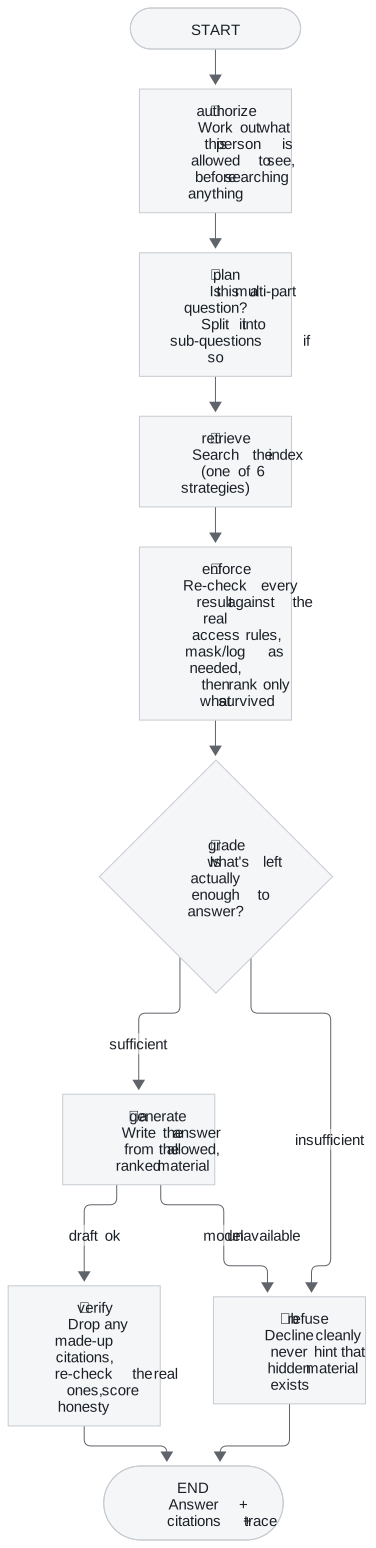
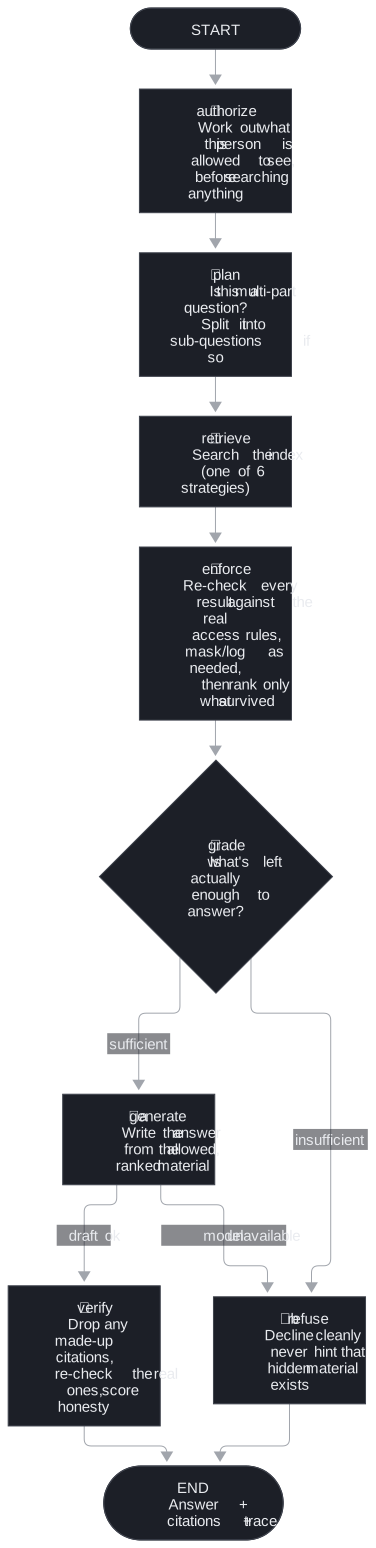
The per-request pipeline is not a chain of helper calls but a state machine whose edges enforce security. Draw its nodes from memory, then learn how each failure degrades rather than crashes.
Objectives:
- draw the query graph and say what each node does;
- explain why access enforcement runs before reranking and why the response-cache key includes surviving chunk ids;
- recite the degradation table, including the one failure that fails closed.
Encode the Order in the Edges
Everything from the earlier lessons assembles into one per-request pipeline: a LangGraph state machine. Its defining property comes from the node module's docstring: "authorize runs first, enforce runs before anything reaches the model — that ordering is encoded in the graph edges, not left to a convention someone can forget." A convention can be forgotten; an edge cannot be skipped.
Know What Each Node Guarantees
| # | Node | What it does | The detail that matters |
|---|---|---|---|
| ① | authorise | Compiles the principal's policy into a Chroma where clause (Layer 1), then ANDs on any optional caller filter such as source, type or recency |
merge_filters is safe by construction: $and can only narrow a result set, so a caller's filter can never see past the access clause |
| ② | plan | A cheap regex for "and", "also" or ";" decides whether the question looks multi-hop; only then, and only under the enterprise strategy, does an LLM decompose it |
Saves a model call on the common single-hop path |
| ③ | retrieve | Runs the selected strategy; every store call carries the compiled filter | If expansion fails with LLMUnavailable, it falls back to dense and marks the run degraded |
| ④ | enforce | Re-runs the full policy on every candidate against the fresh catalog (Layer 2), applies redaction and audit obligations, then reranks survivors to rerank_k |
Denied chunks are dropped and logged and never reach the reranker; disagreements with Layer 1 become security events |
| ⑤ | grade | Insufficient at once if there is no context or the best rerank score is below threshold; otherwise an LLM judges sufficient, partial or insufficient |
partial proceeds with a coverage note; on grader failure, it trusts the reranker score |
| ⑥a | generate | Checks spend against a cost ceiling, checks a response cache, otherwise writes the answer with inline citations | The cache key is described below |
| ⑥b | refuse | The clean no-answer path with a role-appropriate next step | Never reveals that a withheld document exists |
| ⑦ | verify | Drops cited ids that were not in context or fail a live policy re-check, strips their markers, scores groundedness | A citation is a disclosure, so it gets its own catalog lookup |
Output Guardrails and Refusals covers nodes ⑤ to ⑦ in depth.
Enforce Before Reranking
Retrieval hands back 20 to 50 unchecked, unranked chunks. Enforcement runs first, obligations next, and the reranker scores only the survivors from 0 to 10. The top rerank_k, which is 6, is what the model sees.
The order matters because a reranker cannot rank fairly among chunks the user will never see. If forbidden chunks reached it, the "best" answer could be shaped by hidden content. Top-k slots would also be spent scoring material that is about to be thrown away.
The graph has four security checkpoints. The tenant collection is the physical wall. authorize is Layer 1, built from the cached rule copy. enforce is Layer 2, reading the catalog fresh. verify makes one last fresh catalog check on anything cited by name. No model is an enforcement point anywhere in that list.
Key the Cache on What Was Enforced
The response-cache key combines the question, the compiled filter, the exact chunk ids that survived enforcement this request, and the coverage note. A hit is served only for a genuinely identical, freshly enforced situation.
That is worth volunteering in an interview. A revoked document changes which chunks survive, so it changes the key. A stale cache entry is therefore structurally unreachable, not merely avoided by convention.
Enter Through One Method
RAGPlatform.ask(question, principal, strategy="enterprise", as_of=None, filters=None, history=None) is the single public method. It checks a per-tenant rate limit first, using a fixed-window counter. A denied request returns a refusal before an LLM client even exists, so it costs nothing; the trace shows cost_usd == 0.0. Otherwise it builds a fresh LLM client, usage tracker and trace, seeds the state, runs the graph and returns {"answer", "trace", "state"}.
The state is one TypedDict, RAGState, that flows through every node. It holds the request, infrastructure handles, authorisation output, plan, retrieval and enforcement results and the generation outcome. Any node can be tested alone, and the trace can be rebuilt from state.
Version Every Prompt
graph/prompts.py holds every template as a named constant, and PROMPT_VERSION is stamped on every trace. The synthesis prompt enforces citation format, no guessing, partial-answer behaviour and a conflict rule. When two passages disagree on a fact, it prefers higher authority, then the more recent update, and names the conflict.
Live testing found an honest gap. The model reliably picks the right value. It reliably names the conflict only when the question hints that one exists. The project records that gap rather than hiding it.
Worked Example: One Question Through the Graph
Marco, the EU Tier-3 engineer, runs python scripts/ask.py --user u_marco_t3 "Why did EU ingest degrade on 14 March?".
The rate limit passes. authorize compiles his tenant, clearance, region, external flag and groups into a filter. plan sees no "and" and skips decomposition. retrieve searches only Meridian's collection with that filter. enforce re-reads the catalog, keeps the EU post-mortem PM-2026-03-14, attaches audit_access, and reranks the survivors. grade finds them sufficient. generate misses the cache and writes a cited answer. verify re-checks each cited id against the catalog and scores groundedness.
At no step could a forbidden chunk reach the model, because every step that touches text runs after enforce. That is what "security-first" means for a graph.
Key Takeaways
- The graph encodes
authorizefirst andenforcebefore the model in its edges, so the order cannot be forgotten. - Each node has one guarantee, from a caller filter that can only narrow to a verify step that treats citations as disclosures.
- Enforcement runs before reranking, so ranking only ever considers what the user may read.
- The response-cache key includes the chunk ids that survived enforcement, so a revocation makes stale entries unreachable.
- A single entry point rate-limits per tenant before spending anything and carries one state object through the graph.
- Every failure degrades to a weaker answer or a refusal, except the policy engine, which fails closed.
- Prompts are versioned constants stamped on every trace, and known gaps are recorded rather than hidden.
Check Yourself
Why is
merge_filterssafe by construction? It joins the caller's filter to the access clause with$and, which can only narrow results. No caller filter can widen what the access clause allows.Which failure fails closed, and why is it different from the others? An unavailable policy engine refuses the request. Every other failure trades quality for availability, but answering without an access decision would mean answering without access control.
How does the client treat a 4xx differently from a 5xx? A 5xx is transient: retry with backoff and jitter, and count it toward the circuit breaker. A 4xx is a request bug: raise immediately and never trip the breaker.