Five practical agent patterns, side by side
- Source
- From the RAG & Agents Engineering course
- By
- Sourav Banerjee
- Last updated
- 13 Nov 2026
Start with one message that asks for two things
What you'll learn
- Explain who decides the next step in each of five patterns: the graph, a supervisor, a join, a loop rule or the agent holding the conversation.
- Trace one Larkspur request through all five and see what each does with its second question.
- Diagnose the failure each pattern invites, from a dropped question to an endless handoff.
- Choose the simplest pattern that fits a task, and the cap that keeps it bounded.
Lessons 1 to 4 of T11.3 built whole systems. This lesson steps back to the five coordination patterns they are made from, one notebook each, every agent a prebuilt create_agent.
Priya's team bought a Larkspur annual plan 20 days ago and has used 40 GB of outbound traffic. She writes one message: "We're cancelling. Please refund the annual plan, and tell us how to export our database before you delete anything." The handbook answers both halves. A full refund is allowed within 30 days of purchase under 100 GB, and takes 5 to 10 business days to appear. Exports run from Settings, then Data, and a cancelled plan's data is kept for 30 days. The question for this lesson is what each pattern does with the second half.
Priya and her message are a scripted example; the mechanisms come from the notebooks.
Who decides the next step
Every pattern here calls a model several times. They differ in who chooses what runs next:
| Pattern | Who picks the next step | Notebook's example |
|---|---|---|
| Sequential / conditional workflow | The graph you wrote: edges and branch functions | Research, draft, review; a ticket router |
| Supervisor, agents as tools | A supervisor model, through tool calls | A trip planner over flight and hotel agents |
| Parallel fan-out / fan-in | Nobody: every worker runs, then a join | Three product analysts and a lead |
| Generator–critic loop | A rule in code reading the critic's verdict | A 50-word charger description |
| Handoffs | The agent that holds the conversation | A storage company's support desk |
Table 1: The five patterns and their deciders.
The more of that choice a model makes, the more paths the system can take, and the more it needs a cap.
Sequential and conditional workflows
A sequential workflow is plain add_edge calls: research, then draft, then review, for every input. Stages pass work through typed state fields (notes, draft, final), never through each other's messages. Two different topics in notebook 05a both print the path research → draft → review; the content changes, the path cannot.
A conditional workflow adds a fork. The notebook splits the decision in two: a classifier agent with response_format=ToolStrategy(TicketRoute) returns a validated category, one of three Literal values, and route_ticket, plain code, maps it to a node listed in advance in add_conditional_edges. The agent can pick a branch; it cannot invent a fourth.
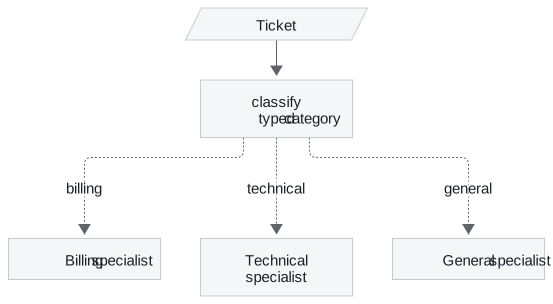
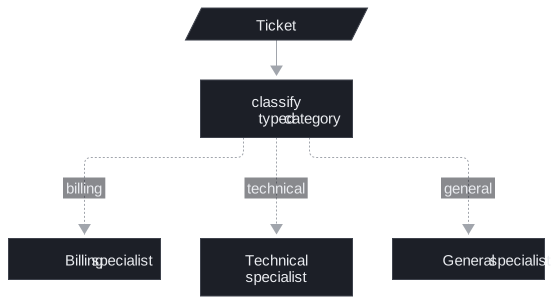
Figure 1: The conditional workflow. Exactly one dotted edge fires per run, so each ticket runs two nodes.
A branch condition can also be plain code. The notebook's length gate counts the draft's words and sends it to shorten only when it is over the limit: a 90-word draft takes research → draft → review at a limit of 150 and research → draft → shorten → review at 40.
The cost of a fixed fork is the input it did not plan for. TicketRoute holds one category: Priya's message reaches billing or technical, never both. We call this the single-label drop: the reply is correct and answers half the request.
Supervisor with agents as tools
A supervisor is a create_agent agent whose tools are other agents. Notebook 05b wraps each specialist in a @tool that runs it and returns its last message as a string. A delegation is then an ordinary tool call and the answer comes back as a ToolMessage. Two details carry the design:
- The tool's docstring is the routing rule. "Ask the flight specialist about flights" is the only routing logic the supervisor reads.
- The specialist sees only the request the supervisor writes. This context isolation keeps each specialist's prompt short, but the supervisor must pass every detail: cities, budget, or for Priya, plan type, purchase date and traffic.
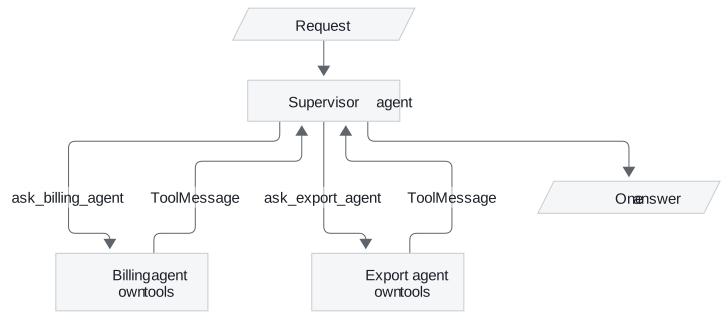
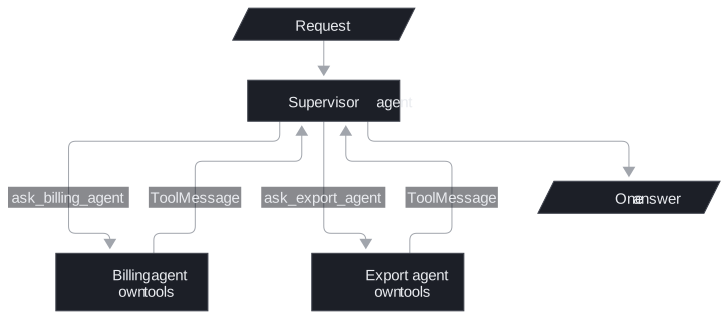
Figure 2: Supervisor with agents as tools. Control returns to the supervisor after every specialist.
The notebook's three requests call both specialists, only the hotel agent, or none. No branch function decided that; the supervisor's tool calls did. The cap is recursion_limit in the run config. We replayed the supervisor with a scripted model: answering with no specialist needs a limit of 2, and one round of delegation runs three node steps (model, tools, model) and needs a limit of 4. The notebook's recursion_limit=2 therefore stops the full-trip request with GraphRecursionError.
Parallel fan-out and fan-in
When the pieces of work do not need each other, run them at the same time. Notebook 05c sends one product idea to three analysts: three edges leave START, and add_edge([...three analysts...], "product_lead") is a join that runs the lead once, after all three. Our replay of its graph with stubbed agents puts all three analysts in super-step 1 and the lead in super-step 2.
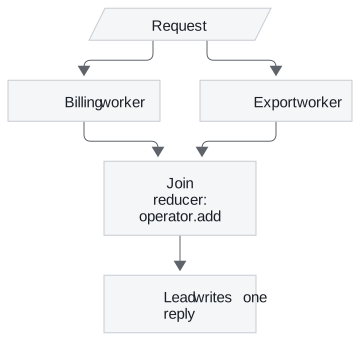
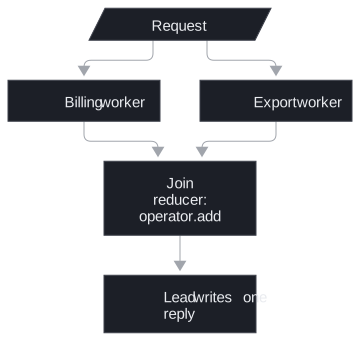
Figure 3: Fan-out and fan-in. Workers share a super-step; the lead runs once after every worker.
Parallel writes to one field need a reducer. With Annotated[list, operator.add] the two writes concatenate; without one, LangGraph raises InvalidUpdateError: At key 'results': Can receive only one value per step. The notebook proves this with two plain functions and no model.
When the number of workers depends on the input, a fan-out function returns one Send("summarize", payload) per item: five reviews start five summarise tasks, two start two, and the graph does not change. Parallelism saves wall-clock time, roughly the slowest worker plus the lead. It does not save model calls: every worker pays for its own, even on a request that needed only one of them.
Generator–critic loop
A generator writes, a critic judges, and the draft is revised until it passes or a cap is reached. Notebook 05d starts from the acceptance criteria and splits them. Rules code can check (at most 50 words, the exact price ₹2,499, no exclamation marks) run first; only a draft that passes all of them reaches the critic agent, which returns a validated Review with an approved: bool. should_continue is plain code with three exits: accept, revise, or stop at MAX_REVISIONS = 3.
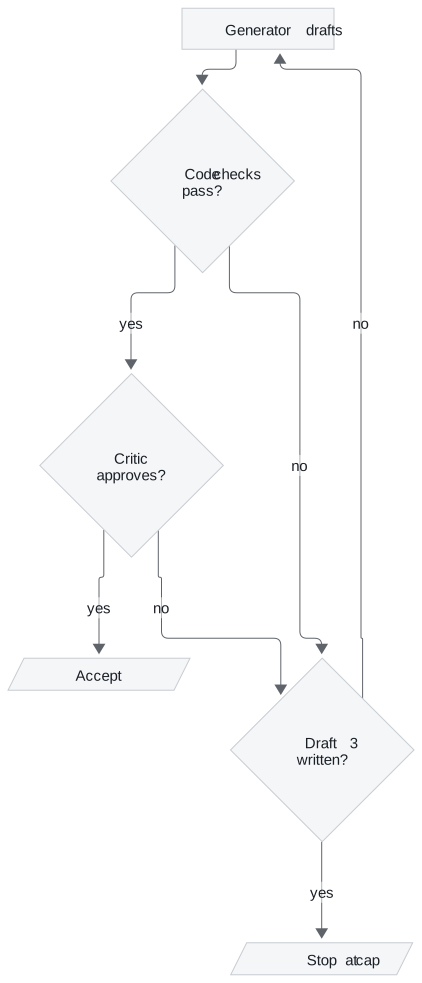
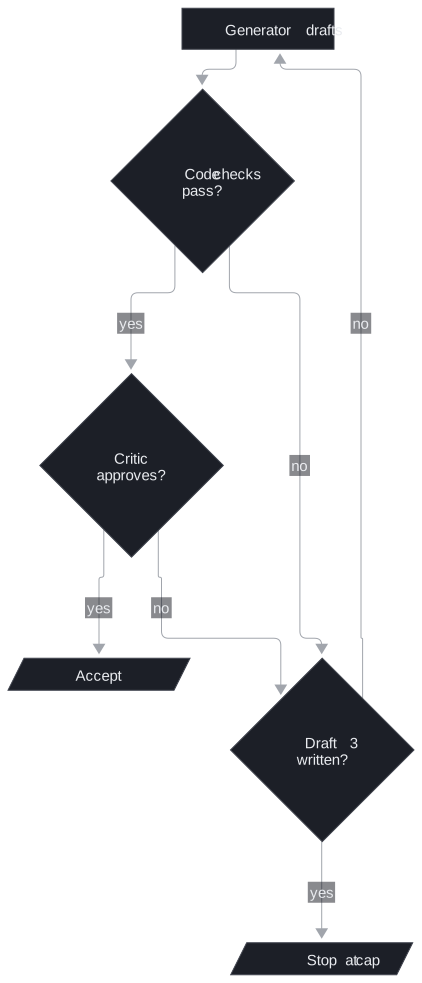
Figure 4: The refinement loop. A draft that breaks a code rule never costs a critic call.
For Priya, the loop wraps the reply rather than routing it. Step through a run with code checks for the handbook's facts (the scripted drafts are ours; the loop is the notebook's):
We replayed both paths with the notebook's own critique and should_continue. A run that ends at the cap returns its last draft, which was never approved.
Handoffs
In a handoff, the agent holding the conversation passes it on, and the receiver keeps it. Notebook 05e uses langgraph-swarm: create_handoff_tool(agent_name="billing_agent") builds a transfer_to_billing_agent tool that returns Command(goto=..., graph=Command.PARENT) and sets active_agent, and create_swarm(..., default_active_agent="triage_agent") routes every new message to whoever is active.
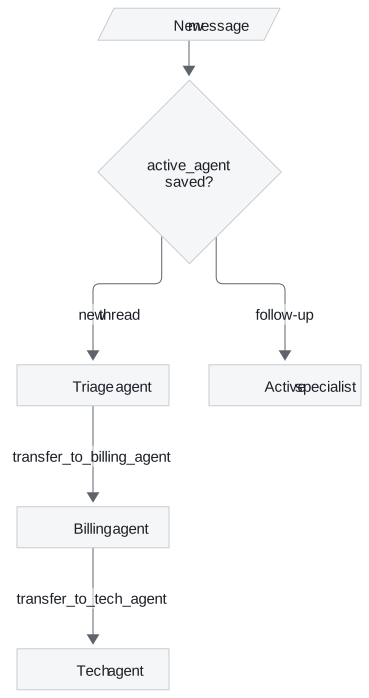
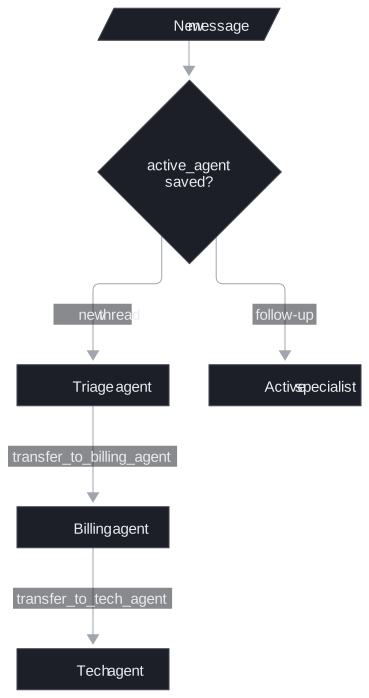
Figure 5: Handoffs in a swarm. The receiver becomes the active agent, and a checkpointer remembers it.
Compiled with InMemorySaver, the swarm saves active_agent per thread. We replayed the notebook's three-turn script with a scripted model: turn 1 runs triage then billing, turn 2 starts at billing with no triage, and turn 3 hands off sideways to tech. Unlike the supervisor's tool call, a handoff forwards the whole conversation: billing never asks for the invoice number again.
No node in a swarm can say stop. If agents keep transferring to each other, only recursion_limit ends it: the notebook's scripted triage, billing, tech cycle raises GraphRecursionError after 10 handoffs at a limit of 10. We call this the handoff ping-pong.
Priya's message through all five
The same request, five deciders. Pick a pattern to see what happens to the export question:
Choosing a pattern
Start with the most fixed pattern that covers the task, and move control toward a model only when the steps cannot be listed in advance:
- Workflow when the stages and branches are known before the run. For Priya's desk, let the classifier return a list of categories and fan out over it, which fixes the single-label drop without giving up a fixed graph.
- Supervisor when a request may need any subset of specialists, and one place should write the answer.
- Fan-out when the work is independent and the merge rule is clear. Use
Sendwhen the worker count follows the input. - Generator–critic when "done" can be written down and feedback can improve a draft. Put every rule code can check in code.
- Handoffs when a specialist should own the rest of the conversation, as in support triage.
The patterns combine: lesson 4 of T11.3's research team is a supervisor whose workers fan out and whose report passes a capped review loop. Give each model-driven choice a cap in code.
Limits of this evidence
- No notebook run is recorded. Notebooks ship without outputs. Paths, steps, reducer errors, loop exits, active agents and handoff counts come from replaying the notebooks' own graph code with stubbed agents or a scripted model (langgraph 1.2.18, langchain 1.4.7, langgraph-swarm 0.1.0). What gpt-4o-mini writes, and whether it calls the right specialists, is not measured.
- Priya's request is scripted. Its call counts follow each graph with one tool call per specialist; a live run can make more.
- The examples are small. Two or three specialists over in-memory data; production versions add retries, timeouts and tracing.
References
- Anthropic (2024). Building effective agents: sequential workflows, parallelisation, orchestrator-workers and evaluator-optimizer.
- LangChain, Multi-agent: subagents called as tools and handoffs.
- LangGraph, Graph API: reducers,
Send,Commandandrecursion_limit. - LangChain, langgraph-swarm:
create_handoff_toolandcreate_swarm.
Run the notebooks
The code for this lesson is in these notebooks. Colab runs one in your browser: install the packages its first cell imports and set the API keys it reads. To run every notebook as written, clone the repository and use its uv environment.
| Notebook | GitHub | Colab |
|---|---|---|
| Sequential and conditional workflows (optional) | Open on GitHub | Open in Colab |
| Supervisor agents as tools (optional) | Open on GitHub | Open in Colab |
| Parallel fan out fan in (optional) | Open on GitHub | Open in Colab |
| Generator critic loop (optional) | Open on GitHub | Open in Colab |
| Handoffs with swarm (optional) | Open on GitHub | Open in Colab |
Key Takeaways
- The five patterns differ in who picks the next step: the graph, a supervisor's tool calls, a join, a rule reading a critic's verdict, or the agent holding the conversation.
- Each has a typical failure: the single-label drop, a supervisor request missing the facts a specialist needs, fan-out paying every worker, an uncapped loop, and handoff ping-pong.
- Prefer the most fixed pattern that fits, check in code whatever code can check, and cap every model-driven choice:
recursion_limitstopped the scripted handoff cycle after 10 handoffs and the stuck generator after 3 drafts.
Check yourself
1. What is the difference between a supervisor calling a specialist as a tool and an agent handing off to a specialist?
After a tool call, control returns to the supervisor, and the specialist saw only the request the supervisor wrote. After a handoff, the specialist becomes the active agent, sees the whole conversation and receives the user's next message. A checkpointer is what keeps active_agent between turns.
2. Priya asks for a refund and an export in one message, and the ticket router answers only the refund. Why, and what is the smallest fix?
TicketRoute holds one Literal category, so the conditional edge fires exactly one branch: the single-label drop. Let the classifier return a list of categories and fan out to one specialist per category, joining their answers in one reply. The graph stays fixed, and the second question gets an answer.
3. A generator–critic loop sometimes runs forever on hard tasks. Which part of the notebook's design prevents that, and what does a capped run return?
should_continue is plain code with a stop exit at MAX_REVISIONS = 3, so the loop ends even if the critic never approves; the stuck-generator proof stops after three drafts. A capped run returns the last draft, which was never approved, so the caller should treat it as unapproved.