Parent-document retrieval, in memory and on Postgres
- Source
- From the RAG & Agents Engineering course
- By
- Sourav Banerjee
- Last updated
- 9 Nov 2026
Docstore
What you'll learn
- Explain how a parent-document retriever links small search chunks to the larger text it returns.
- Diagnose an empty result after a restart, a misordered parent and a duplicated index.
- Measure child and parent sizes by whole answers and tokens per question.
- Choose a child size near the evidence and a parent size near a section.
Lesson 1 of T5.6 wrote a summary to serve as the search key. Parent-document retrieval gets a sharp key with no LLM call, by cutting the text into pieces of two sizes.
At a child size of 150 characters, the best match for the Larkspur refund question is a child that ends at "…as long as the account has used less". Sent to the model alone, it gives the 30-day rule without the 100 GB condition. Parent-document retrieval keeps that sharp child as the key and sends its parent instead.
Parent-document retrieval splits along size instead of meaning. Small child chunks are the search keys; the larger parent each child was cut from is the payload. The vector store holds the children. The docstore holds the parents, keyed by id, and each child carries its parent's id in its metadata (doc_id by default).
ParentDocumentRetriever.add_documents does the splitting and the bookkeeping:
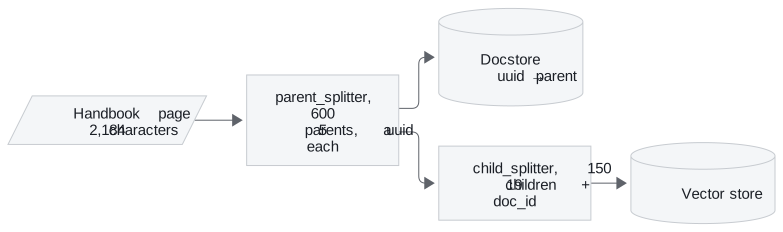
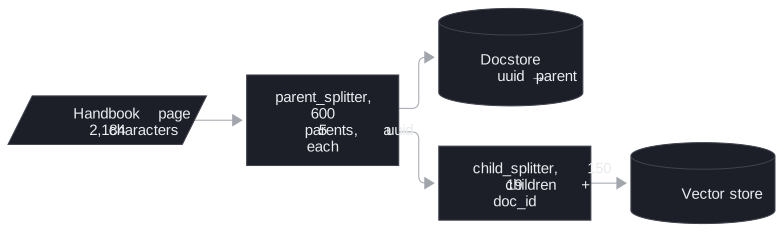
Figure 1: Indexing the Larkspur page with parent-document retrieval, at child 150 and parent 600.
The counts are the lab's at child 150 and parent 600. Without a parent_splitter, each original document is the parent. At query time invoke runs a similarity search over the children, collects their parent ids in rank order without repeats, fetches those parents with docstore.mget, and drops any id the docstore does not return.
Notebook 02a runs both shapes on two LangChain blog posts. With only child_splitter at 400, the parents are the two whole posts: the docstore lists two keys and every answer arrives as a full post. With parent_splitter at 2000 and child_splitter at 400 the parents are 2,000-character sections (ten of them for these two posts), and the retriever is wired into a RetrievalQA "stuff" chain.
The docstore is any BaseStore: four methods, mget, mset, mdelete and yield_keys. The notebooks use InMemoryStore, which disappears when the process stops, while a vector store such as Chroma can persist on disk. A restart then leaves children whose parents are gone, and invoke returns nothing for them, without an error. We call these orphaned children. Optional notebook 02b moves both halves into Postgres: PGVector for the children and a custom PostgresStore that keeps each parent as JSONB in a docstore table.
Check three details in 02b's store before you copy it:
- Unordered
mget. TheBaseStorecontract saysmgetreturns one value per key, in key order, withNonefor a missing key. 02b'smgetreturns whatever rows the query yields, in database order, and skips missing keys.MultiVectorRetrieverrelies on that order to keep the parents ranked, so the best parent can arrive second. - Silent store error. Every method logs exceptions and carries on;
mgetthen returns an empty list. A database outage looks like a question with no context. - Run-minted ids, as in T5.5.
add_documents(docs, ids=None)gives every parent a freshuuid4on each call. Running ingestion twice stores every parent and child twice. Pass stable ids (one per parent, after the parent splitter) and delete a document's children and parents together when it changes.
Choosing child and parent sizes
The child size decides what can be matched. The parent size decides what the model reads and what each question costs. The interactive lab runs a port of ParentDocumentRetriever on the Larkspur page with TF-IDF standing in for embeddings and the top 2 children per question, as in the T5.1 baseline. On all 242 slider settings and all three golden questions it returns the same children, scores and parents as the real retriever (InMemoryVectorStore with scikit-learn TF-IDF vectors): 0 mismatches, scores within 2e-16.
| Child / parent | Children, parents | Answers whole: children only | Answers whole: parents | Mean tokens: children / parents |
|---|---|---|---|---|
| 150 / 600 | 19, 5 | 0 of 3 | 3 of 3 | 53 / 206 |
| 150 / 400 | 19, 8 | 0 of 3 | 2 of 3 | 53 / 155 |
| 200 / 800 | 16, 4 | 1 of 3 | 3 of 3 | 79 / 182 |
| 400 / 2000, notebook 02a | 9, 2 | 2 of 3 | 3 of 3 | 165 / 478 |
| 400 / whole page | 8, 1 | 2 of 3 | 3 of 3 | 164 / 546 |
| 400 / 400 | 8, 8 | 2 of 3 | 2 of 3 | 164 / 164 |
Table 1: Six child and parent sizes on the Larkspur page, from the lab.
"Children only" is plain chunking at the child size: the same two matches sent as they are. Tokens use the four-characters-per-token rule.
- Small children match sharply and cut answers. At 150, child #5 is the best match for the refund question and ends at "…as long as the account has used less". Sent alone it gives the 30-day rule without the 100 GB condition. Its parent holds the whole sentence.
- Parent-boundary cut. A parent boundary can cut an answer too. With parents of 400 characters, the outage answer ("The credits are not added automatically. You claim them…") falls across two parents, and no child size gets it back whole.
- Parents cost tokens on every question. The notebook's 2,000-character parents return most of this short page: 478 tokens on average against 165 for the children. With no parent splitter, every question costs 546 tokens, the whole page.
- Children from one parent return it once. At 200 / 800 both outage matches come from the same parent, and the model reads it once, at 196 tokens.
- A parent no larger than its child is plain chunking. At 400 / 400 each parent yields one child identical to itself, and the two columns match.
Across the 217 settings where parents are larger than children, the children alone contain the whole answer in 394 of the 651 question and setting pairs; their parents contain it in 613. Size the child near the length of the evidence your questions need (the refund sentence is 141 characters) and the parent near a section, then check on the golden set that no parent boundary cuts an answer.
In practice: sizing the Larkspur parents
Table 1 gives the handbook's settings directly:
- Children near the evidence: the refund sentence is 141 characters, and children of 150 to 200 match it sharply.
- Parents near a section: 600 or 800 keeps all three golden answers whole; 400 cuts the outage answer.
- Persist both halves, and if you write your own docstore, return parents in key order and raise on errors.
- Give parents stable ids, and delete a page's children and parents together when it changes.
Next: lesson 3 of T5.6 uses a larger unit earlier, to decide where to search before any chunk competes.
Run the notebooks
The code for this lesson is in these notebooks. Colab runs one in your browser: install the packages its first cell imports and set the API keys it reads. To run every notebook as written, clone the repository and use its uv environment.
| Notebook | GitHub | Colab |
|---|---|---|
| Parent document retrieval | Open on GitHub | Open in Colab |
| Parent document retriever postgres (optional) | Open on GitHub | Open in Colab |
Key Takeaways
- Parent-document retrieval searches small children and returns their larger parents from a docstore. Persist the docstore with the vectors, or a restart silently returns nothing.
- Before copying a custom docstore, check that
mgetkeeps key order, surfaces errors and uses stable ids, so ingestion does not duplicate every chunk. - Size the child near the length of the evidence and the parent near a section. Parents cost tokens on every question, and a parent boundary can still cut an answer.
Check yourself
1. At query time, how does the parent-document retriever turn matching children into the text the model reads?
It runs a similarity search over the children, collects their parent ids in rank order without repeats, fetches those parents with docstore.mget, and drops any id the docstore does not return. Children from one parent therefore return it once: at 200 / 800 both outage matches come from the same parent, and the model reads it once.
2. At child size 150 and parent size 600, what does the model get for the refund question from the children alone, and what from their parents?
The best child ends at "…as long as the account has used less", so sent alone it gives the 30-day rule without the 100 GB condition. Its parent holds the whole sentence. In the lab table the children answer 0 of 3 questions whole and the parents 3 of 3, at 53 against 206 tokens on average.
3. After a restart, the retriever returns nothing for questions it answered before, and raises no error. What happened?
The docstore was an InMemoryStore, which disappears when the process stops, while the vector store persisted the children. invoke drops parent ids the docstore does not return, so every hit vanishes silently. Persist both halves, as notebook 02b does with PGVector and a Postgres docstore, after checking its mget order, error handling and ids.