LCEL deep dive
- Source
- From the RAG & Agents Engineering course
- By
- Sourav Banerjee
- Last updated
- 9 Nov 2026
Pipe composition
What you'll learn
- Explain what Python does when two Runnables are joined with
|, and what object comes back.- Predict the output of a dict placed inside a pipe, including nested pipes and plain lambdas.
- Choose between
RunnableParalleland.assign()when a later step still needs the original input.- Trace the Larkspur RAG chain from question string to prompt variables.
Lesson 1 of T4.2 made every step a Runnable with one input and one output. A chain is several of them joined with |, and the Larkspur team's RAG chain looks harmless: a dict that fetches context and keeps the question, then a prompt, a model and a parser. Then someone adds a step that computes a confidence score as a RunnableParallel, and the next step fails with a KeyError for question. The question was there one step earlier. This page explains where it went, starting with what | actually does.
The pipe is a Python operator
The | in prompt | model | parser is ordinary Python. a | b calls a.__or__(b), the same way 2 + 4 calls (2).__add__(4). A class decides what its operators mean: notebook 02a's toy StupidAdder makes 5 + 10 return 57 by adding 42 on every sum. LangChain's Runnable.__or__ returns a RunnableSequence that holds both sides, and the sequence's invoke runs the first step and feeds its output to the next.
Notebook 02a proves this by building the mechanism from scratch. Its CRunnable.__or__ returns a CRunnableSequence holding the two sides, and the sequence's invoke hands the first step's result to the second. Three small steps piped together give:


Figure 1: The notebook's hand-built pipe. Each arrow carries the previous step's output; running it prints 10, 20 and 40 before returning "Result: 40".
LangChain's real RunnableSequence works the same way and adds what the toy lacks:
| Capability | Toy CRunnableSequence |
LangChain RunnableSequence |
|---|---|---|
invoke feeds each output forward |
✓ | ✓ |
batch, stream and async on the whole pipe |
✗ | ✓ |
| A traced child run per step | ✗ | ✓ |
Flattening: (a | b) | c is one sequence of three steps |
✗, it nests | ✓, we checked: 3 steps |
Table 1: What the library sequence adds to the bare operator.
Flattening matters when you read traces. A chain assembled from smaller chains still shows one flat list of steps, and each step keeps its own latency.
A dict in a pipe runs in parallel
When the left side of | is a plain dict, Python asks the Runnable on the right through __ror__, and LangChain turns the dict into a RunnableParallel. A dict on the right side is converted the same way. Each value runs on the same input, and the output is a dict with the same keys. We reran notebook 02a's cells, which need no API key:
| Chain | Input | Output |
|---|---|---|
x and y both RunnablePassthrough() |
"hello" |
{'x': 'hello', 'y': 'hello'} |
same, with y a plain lambda reading input2 |
{"input": "hello", "input2": "goodbye"} |
{'x': {'input': 'hello', 'input2': 'goodbye'}, 'y': 'goodbye'} |
x becomes a pipe: passthrough, then a function that upper-cases input |
the same dict | {'x': 'HELLO', 'y': 'goodbye'} |
x a passthrough, then .assign(extra=...) returning 100 |
the same dict | {'x': {'input': 'hello', 'input2': 'goodbye'}, 'extra': 100} |
Table 2: The notebook's RunnableParallel runs, reproduced offline.
Two rules follow from the table. A plain lambda in a dict is wrapped in a RunnableLambda for you. A branch can be a pipe of its own, which means pipes nest inside dicts and dicts inside pipes.
Adding a key, keeping the rest
Here is the bug from the opening. A RunnableParallel replaces its input with the dict it builds. .assign(key=runnable), on RunnablePassthrough or on a parallel, computes the new key from the current dict and returns the old keys with it. On the input {"q": "refund?"} with a branch that counts characters:
| Step | Output |
|---|---|
RunnableParallel(n=...) |
{'n': 7} |
RunnablePassthrough.assign(n=...) |
{'q': 'refund?', 'n': 7} |
Table 3: Parallel replaces the input; assign extends it. Both runs are from the installed library.
We call the parallel case the lost question: a key that a later step needs is dropped because an intermediate step rebuilt the dict from scratch. .assign() is how a pipe carries the question forward while later steps add context, then answer, then sources.
Finished chains compose like any step. Notebook 02a pipes the .assign() chain from Table 2 into a second chain that reads extra and upper-cases it as text; the result is the string '100'. Optional notebook 02b applies the same pieces to a RAG chain over a vector store.
In practice: the Larkspur RAG chain
The Larkspur RAG chain from lesson 4 of T4.2 is the dict rule in action. It starts with a dict of two branches, then a prompt, a model and a string parser:
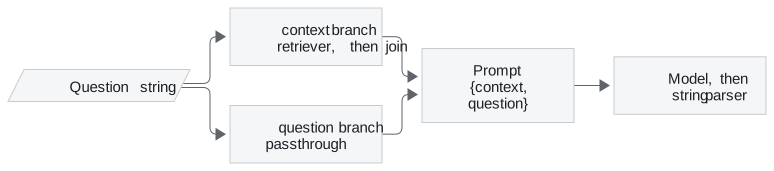
Figure 2: The question fans out to two branches, which meet again as the prompt's two variables.
We traced it with a stub retriever over two sentences of the Larkspur refunds section and a fake model (Illustrative):
| Step | Receives | Returns |
|---|---|---|
Dict (a RunnableParallel) |
"How long does a refund take?" | {context: ..., question: ...} |
| Context branch | the same string | the retrieved paragraphs joined with blank lines into one string |
| Question branch | the same string | the string unchanged |
| Prompt | that dict | one message with the context and the question filled in |
| Model and parser | that message | the answer as a string |
Table 4: The Larkspur RAG chain traced step by step.
The prompt receives exactly the two variables it declares. Lesson 3 of T4.2 builds the shapes that come next: pipelines that keep every intermediate key, fan-outs that merge, and routers.
Run the notebooks
The code for this lesson is in these notebooks. Colab runs one in your browser: install the packages its first cell imports and set the API keys it reads. To run every notebook as written, clone the repository and use its uv environment.
| Notebook | GitHub | Colab |
|---|---|---|
| LCEL Deepdive | Open on GitHub | Open in Colab |
| LCEL and Runnables (optional) | Open on GitHub | Open in Colab |
Key Takeaways
- The
|operator calls__or__, which returns a flattenedRunnableSequencethat feeds each step's output to the next and adds batch, streaming, async and tracing. - A plain dict in a pipe becomes a
RunnableParallel: every value runs on the same input, and lambdas are wrapped for you. Pipes nest inside dicts and dicts inside pipes. RunnableParallelreplaces its input. Use.assign()to add a key while keeping the rest, or a later step meets the lost question.
Check yourself
1. What does Python actually do when you join two Runnables with the pipe operator, and what object comes back?
a | b calls a.__or__(b), the same way 2 + 4 calls (2).__add__(4). LangChain's Runnable.__or__ returns a RunnableSequence holding both sides, whose invoke runs the first step and feeds its output to the next. It also flattens, so (a | b) | c is one sequence of three steps.
2. The Larkspur RAG chain starts with a plain dict of context and question. What does each value receive, and what reaches the prompt?
The dict becomes a RunnableParallel, and the question string goes to both values. The retriever turns it into documents that are joined into one string, while the passthrough keeps the question as it is. The prompt receives a dict with context and question, exactly the two variables it declares.
3. A later step needs the original question, but the RunnableParallel before it replaced its input. What should you use instead?
.assign(). RunnableParallel replaces its input with the new dict, while .assign(key=runnable) computes the new key from the current dict and returns the old keys with it. That is how a pipe carries the question forward while later steps add context, then answer, then sources.