Interrupts and human-in-the-loop
- Source
- From the RAG & Agents Engineering course
- By
- Sourav Banerjee
- Last updated
- 9 Nov 2026
A refund that must wait for billing
What you'll learn
- Explain what
interrupt()saves, what it returns to the caller, and what runs again on resume.- Trace a high-risk refund from the first call, through the pause, to the approval.
- Compare
interrupt()inside a node withinterrupt_beforeandinterrupt_afterat compile time.- Choose among approve or reject, edit then continue, edit state while paused, and tool-call review.
- Diagnose a gate that approves whatever the reviewer types.
Lesson 1 of T4.4 gave every refund a thread and a saved snapshot after each step. This lesson uses that saved state to stop a run on purpose.
refund-99 is a prorated annual refund, and Larkspur's policy says a person in billing approves every high-risk refund. The approval can take two days. A worker that blocks inside invoke for two days is a worker serving nobody else, and a deploy in the meantime kills the run. The graph has to do three jobs: stop at the gate and show the reviewer what to decide, give the worker back while it waits, and continue from the gate with the reviewer's answer, on whichever worker picks it up.
interrupt()
interrupt(payload) called inside a node stops the run at that line, saves the state through the checkpointer, and returns the payload to the caller under the __interrupt__ key. The thread now waits at that node. Later, any process calls invoke with Command(resume=value) on the same thread, and inside the node interrupt() returns that value.
The whole exchange takes two calls with a gap between them:
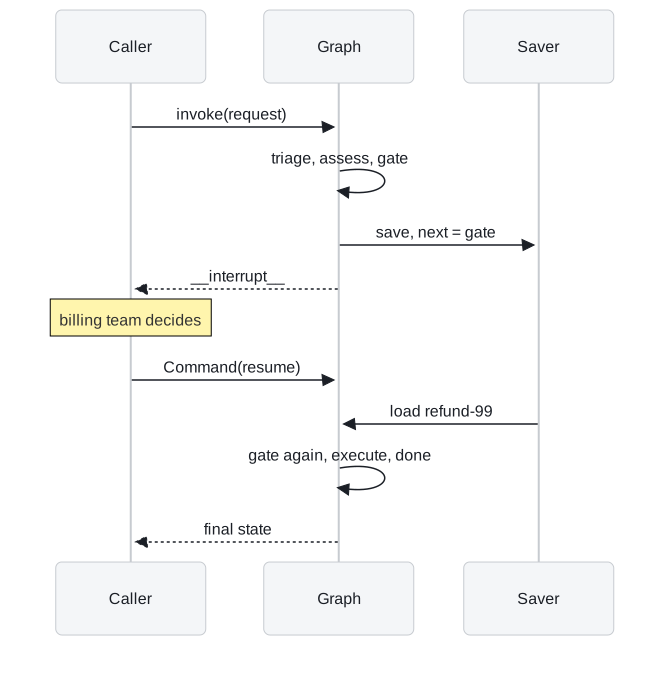
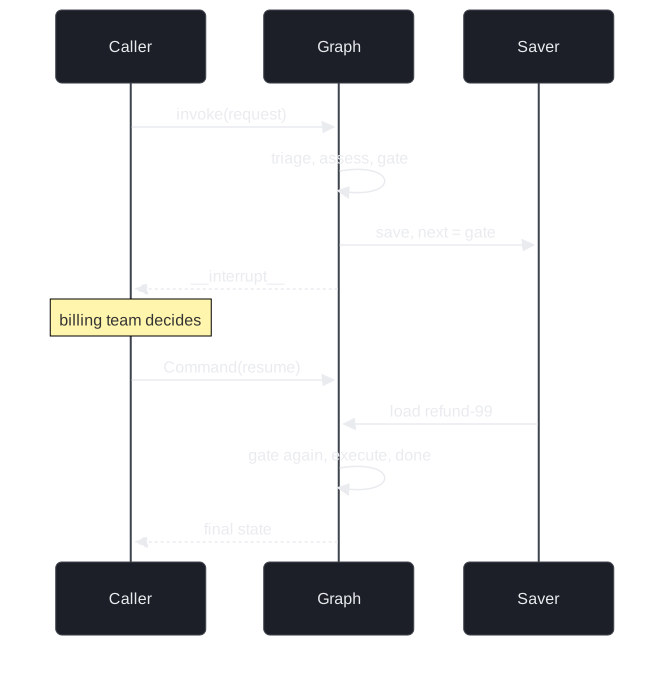
Figure 1: The two calls of an approved refund. Between them the run exists only as saved state.
We ran the refund graph offline with stub nodes and an InMemorySaver to watch each call:
| Call | What the caller sent | Nodes that ran | Returned | Thread after the call |
|---|---|---|---|---|
| 1 | the refund request | triage, assess, human_gate (stops at interrupt()) |
__interrupt__ with the question |
4 checkpoints, next = human_gate |
| 2 | Command(resume="approve") |
human_gate again, execute, done |
final state | 7 checkpoints, finished |
Table 1: refund-99 across the pause (offline run, LangGraph 1.2.18).
A dashboard finds parked refunds by reading next: a thread whose next is ("human_gate",) is waiting for billing.
Three rules that follow
The mechanism has consequences that catch teams the first time:
- A checkpointer is required. Without one, the first call still returns
__interrupt__, but nothing was saved. The resume call then raisesRuntimeError: Cannot use Command(resume=...) without checkpointer. We reproduced both halves offline. - The node runs again from the top. On resume LangGraph does not continue mid-function. It calls the node again, and this time
interrupt()returns the resume value instead of stopping. The HITL mechanics notebook prints "Node execution started" twice for one resume. In the refund graphhuman_gateran 2 times for one approval (Table 1). Anything above theinterrupt()call (a notification, a counter, a model call) happens twice. We call this the double-run gate. - The resume value is yours to define. It can be a string, a dict with an
edited_plan, or a list in the Agent Inbox format.interrupt()returns whatever the caller passes, so the node has to check it.
The mechanics notebook checks it with a loop. Its node asks for an age and calls interrupt() again until the answer parses as a non-negative integer:
| Resume value | What the node did |
|---|---|
| (first call) | paused with "Please enter your age…" |
| "not a number" | paused again, quoting the bad value |
| "-10" | paused again |
| "25" | stored age 25 and moved on |
Table 2: The validation loop over four calls (offline replay of the notebook's node).
Each bad answer costs one more round trip and nothing else. The checkpointer holds the thread between them.
Pausing at compile time instead
The notebooks also pause without touching node code. Compiling with interrupt_before=["assistant"] stops the run before that node, and interrupt_after stops it right after. You continue with invoke and no input. The two forms differ in who decides to stop:
interrupt() in a node |
interrupt_before / interrupt_after |
|
|---|---|---|
| Where it is declared | inside the node | at compile() |
| What the caller gets | __interrupt__ with your payload |
the state so far, with no __interrupt__ key in our run |
| How to continue | Command(resume=value) |
invoke with no input |
| What the reviewer can return | any value the node reads | nothing, unless you call update_state first |
| Suits | approvals, questions, validation | debugging and step-through review |
Table 3: Runtime and compile-time pauses compared.
The second row matters for clients: after a compile-time pause, the caller learns the run stopped by reading next from get_state. With the gate's decision settled as a mechanism, the next section is about what the gate does with it.
Approval patterns
The interrupt-primitive and HITL-patterns notebooks build four shapes on the same primitive. On the Larkspur refund desk they look like this:
- Approve or reject: the gate returns
Command(goto="execute")orCommand(goto="cancel")depending on the decision, with anupdatethat records it. The return type is annotated as aCommandover the two target names, so the graph knows where the gate can go. - Edit then continue: the gate shows the draft reply to the customer and resumes with an
edited_summary. The node writes the edited text to state and the graph follows its one path. - Edit state while paused: with
interrupt_before, the caller runsupdate_stateon the parked thread and then continues with no input. The patterns notebook swaps "Multiply 2 and 3" for "No, please multiply 15 and 6" this way, and the agent multiplies the new numbers. - Review a tool call:
interrupt()inside a sensitive tool, or a wrapper such as the notebook'sadd_human_in_the_loop, lets a person accept the call, edit its arguments, or answer instead of running it.HumanInTheLoopMiddlewarein T7.2 packages the same idea forcreate_agent.
The approve-or-reject shape is the one the refund desk needs:
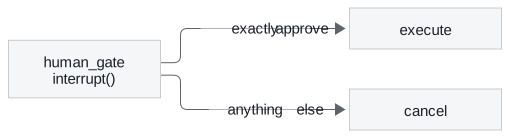
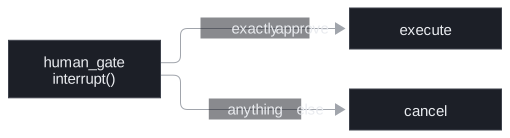
Figure 2: A fail-closed approval gate. Only one exact value reaches the payment step.
Planted failure: the rubber-stamp gate
The state-management notebook's gate stores decision = "approved" whatever the resume value is. It records the reviewer's words in the event log and then approves anyway. We call that the rubber-stamp gate. The patterns notebook's gate compares the value with "approve" and sends everything else to the reject path. We resumed a copy of that gate with the first three values below, and "no" takes the same reject branch:
| Resume value | Rubber-stamp gate | Exact-match gate |
|---|---|---|
| "approve" | execute | execute |
| "Approve" | execute | cancel |
| "yes" | execute | cancel |
| "no" | execute | cancel |
Table 4: Four reviewer answers through two gates (exact-match column from an offline run; rubber-stamp column read from the notebook's node, which never reads the value).
The exact-match gate rejects "Approve" and "yes", which annoys reviewers once and costs nothing. The rubber-stamp gate pays out on "no". Approve on an exact value and treat anything else as no. T8.3 builds that fail-closed gate, with a fingerprint that catches edits made after the review.
In practice: refund-99 at the gate
Put together, the high-risk path through the desk runs like this:
- The first call runs
triageandassess, reacheshuman_gate, and returns the question under__interrupt__. The worker is free. - The billing dashboard lists threads whose
nextishuman_gateand shows the payload: the request, the risk and the prorated amount rule (unused whole months, minus the 15% early-termination fee). - Two days later a reviewer clicks approve. Any worker calls invoke with
Command(resume="approve")onrefund-99. human_gateruns again from its first line, reads "approve", and routes toexecute. Any notice sent aboveinterrupt()goes out a second time.
Key distinction: the checkpointer makes the wait safe for the state. It does nothing for code that runs twice. Step 4 is why the approval notice belongs in its own node before the gate.
What else runs twice around the gate, and how to count it, is the subject of the lab in lesson 6 of T4.4. Lesson 3 of T4.4 first moves the gate into a graph of its own.
Run the notebooks
The code for this lesson is in these notebooks. Colab runs one in your browser: install the packages its first cell imports and set the API keys it reads. To run every notebook as written, clone the repository and use its uv environment.
| Notebook | GitHub | Colab |
|---|---|---|
| HITL Mechanics | Open on GitHub | Open in Colab |
| LangGraph Interrupt Primitive | Open on GitHub | Open in Colab |
| HITL Patterns | Open on GitHub | Open in Colab |
Key Takeaways
interrupt()saves the state and parks the thread, andCommand(resume=value)continues it from any process. It needs a checkpointer, or the resume call fails.- On resume the node runs again from its first line. Keep notifications, counters and model calls out of the code above
interrupt(). - The resume value is whatever the caller passes. Validate it, approve only on an exact value, and treat anything else as no.
Check yourself
1. Why does anything written above the interrupt call in human_gate happen twice for one approval?
On resume, LangGraph does not continue mid-function. It calls the node again from the top, and this time interrupt() returns the resume value. In the refund graph human_gate runs 2 times per approval, and a notification, a counter or a model call above the interrupt() line repeats.
2. A teammate runs the refund graph without a checkpointer. The first call returns an interrupt payload. What happens when they resume?
The resume call raises RuntimeError: Cannot use Command(resume=...) without checkpointer. The first call still returned __interrupt__, but nothing was saved, and there is no parked thread to continue.
3. A reviewer resumes refund-99 with the word no, and the refund is paid. What is wrong with the gate, and how should it treat the resume value?
It is a rubber-stamp gate: it sets the decision to approved whatever value comes back. interrupt() returns whatever the caller passes, so the gate must compare it with one exact value, route that to execute with Command(goto=...), and send everything else to the reject path. That fail-closed rule is the gate T8.3 builds.