Canonical Events and Routing
By Sourav Banerjee · Last updated 5 Oct 2026 · Report an issue
6 min read
Every channel wants its own logic, but letting that logic travel past the first layer makes every later component learn every channel forever.
Channel handling is not a feature to spread through the system; it is a translation to finish at the edge. Normalise each payload into one event, then choose exactly one workflow with two independent checks, building on the layers named in Why Workflow Automation Is a Trust Problem.
Objectives:
- name the fields of the canonical event and what each one is for;
- explain how matching, priority, and the entity lock choose one workflow;
- argue why priority and the lock are two mechanisms, not one.
Follow One Event Through the Platform
The same logical workflow must fire from email, chat, Slack, a web form, and a webhook. Each has a different payload shape and a different notion of "what is this about". The platform handles them in one pass.
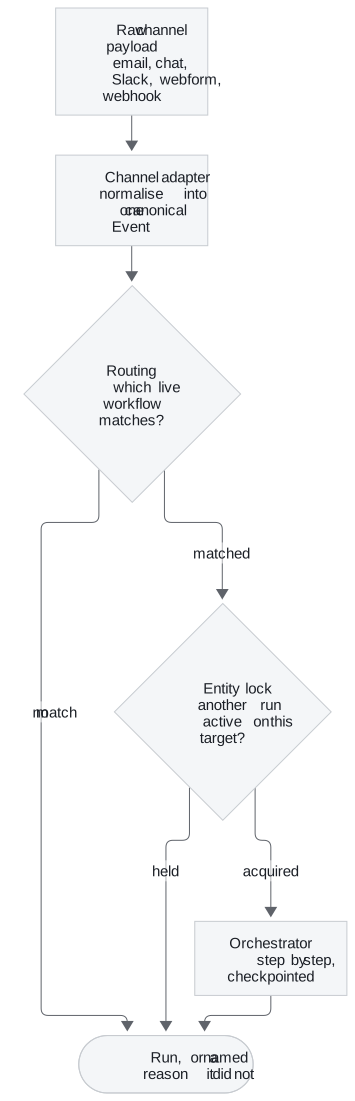
This lesson covers the first three boxes. The orchestrator is in Durability and Idempotency, and the per-step guardrail is in Approvals and Spend Caps.
Normalise Into One Event Shape
The canonical event has six fields, and five of them carry the design.
@dataclass
class Event:
    channel: Channel          # email | chat | slack | web_form | webhook
    event_type: str           # e.g. "ticket.created", "urgent_message"
    tenant_id: str
    target_entity_id: str     # the ticket, order, account this is about
    payload: dict             # the normalised content
    raw_ref: str              # pointer back to the original, for audit
channel and event_type are what triggers match on. tenant_id scopes everything downstream. target_entity_id is what the entity lock keys on. raw_ref keeps a pointer to the original, so normalisation is not destruction.
Translate Once, at the Edge
Each channel gets one adapter function that produces an Event. The project builds three. The webhook adapter maps a Zendesk-shaped ticket. The Slack adapter maps message fields and classifies urgent_message against plain message from a raw flag. The email adapter maps sender, subject, and body.
Downstream of those three functions, nothing knows which channel an event came from except by reading event.channel. A component cannot depend on a payload shape it never sees. Routing, guardrails, the orchestrator, and the trace all work on one shape. Adding a sixth channel is one new adapter and no change anywhere else.
Choose One Workflow in Three Steps
Routing turns one event into exactly one run, or none with a reason.
- Match. Find every workflow whose tenant, status, and trigger fit. A trigger is
(channel, event_type, priority). Status matters: aDRAFTworkflow never matches a real event, which is what makes drafts safe to author. - Prioritise. If several match, the highest priority wins. This is a design-time choice an admin makes on purpose: if two workflows both want this event, which is right?
- Lock. Refuse if another run is already active on the same
target_entity_id. This is a run-time safety property: can two workflows ever mutate the same ticket at once?
When nothing runs, routing returns a named reason, no_trigger_match or entity_locked. It never returns a silent no-op. An operator can always see why a message did not trigger anything.
Keep Priority and the Lock Independent
Priority ordering and the entity lock answer different questions, so they are separate checks. Priority is configuration; the lock is safety.
The lock holds even if priority was misconfigured, or two workflows were given the same priority by accident. With only priority, a configuration mistake becomes a concurrent-mutation bug. With only the lock, nothing says which workflow should win. Build both, always. This is the same defence-in-depth instinct as the RAG platform's tenant partition plus pre-filter: a correctness mechanism and a safety mechanism that do not depend on each other.
Warning: a configuration setting is not a safety property. If the only thing preventing two runs on one ticket is that an admin chose different priorities, one typo produces a double refund. Put the run-time lock underneath the design-time choice.
Worked Example: Two Workflows Want the Same Ticket
A ticket.created event arrives on ticket TCK-5510 through the webhook adapter. Two live workflows trigger on ticket.created for this tenant: a triage workflow and a tagging workflow.
Matching returns both. A third workflow, still in DRAFT, also triggers on the same event type, but status excludes it. Priority picks triage, because the admin gave it the higher priority. Routing then tries the entity lock on TCK-5510.
Suppose a triage run from an earlier event is still active on TCK-5510. The lock is held, so routing returns entity_locked, and no second run starts. Without the lock, two triage runs could both reach the refund step on one ticket. The design-time choice picked the right workflow; the run-time check stopped it running twice at once.
Key Takeaways
- One event passes through adapter, routing, and lock before any step runs.
- The canonical event's channel, event type, tenant, target entity, and raw reference each serve one downstream job.
- Adapters translate once at the edge, so nothing downstream knows about channels and a new channel is one new function.
- Routing matches live workflows only, picks the highest priority, then takes an entity lock, and names the reason when nothing runs.
- Priority is a design-time choice and the lock is a run-time safety property; the lock holds even when priority is wrong.
- Two workflows on one ticket resolve to one run, and a second concurrent run is refused with
entity_locked. - The authoring surface, a builder or natural-language compiler, is the honest gap at this layer.
Check Yourself
Why does a
DRAFTworkflow never match a real event? Matching filters on status, and drafts are excluded. That rule is what makes it safe to author and edit a workflow without it acting on live traffic.Distinguish priority ordering from the entity lock in one sentence each. Priority is a design-time choice about which matching workflow should run. The entity lock is a run-time guarantee that no two runs mutate the same target at once.
What does routing return when nothing runs, and why does it matter? A named reason,
no_trigger_matchorentity_locked. A silent no-op would leave operators unable to explain why a message did nothing.