Interview Guide · 7 min — Start here. The answer you would talk through in the interview, readable on its own.
Exception handling is: a shipment should have moved, it didn’t, ops must tell the customer or the carrier. Customs is not a chatbot decision.
G17 covers one slice: watch feeds, detect a hold/miss/weather, draft or auto-resolve only what policy allows. Humans always own customs.
End to end, as a missed scan in Frankfurt:
- Carrier webhook or batch file becomes one event.
- We detect the exception and pull shipment value, route, freeze rules.
- Policy gate: weather delay with a known playbook might auto-message; customs always queues a human.
- Ops sees a draft — next scan, customer text, proposed carrier call — not a silent write.
- Allowed auto-resolve runs once through a gateway with an audit row.
- SAP/weather variants add more signals; the gate does not get looser.
That’s it: feed → detect → policy → draft or narrow auto → audit. “Just ping the carrier for every blip” stays out.
Source: Sources and Full Design, especially §§1–10. Use the Deep Dive for gate, reliability and evaluation detail and the Cheat Sheet for rehearsal.
Questions to ask the interviewer
| Ask | Design consequence |
|---|---|
| How fresh is each carrier feed and at what peak rate? | Webhook and batch ingestion need different adapters and latency promises. |
| Who acts on a draft, and how many cases arrive per shift? | Sizes the human queue and its SLA. |
| Which cases may auto-resolve, and which are always human? | Defines the policy gate before any carrier write. |
| What are the shipment-value and confidence rules? | Sets the narrow auto path and calibration work. |
| Which regions may store or access shipment data? | Determines regional data planes and application access. |
Requirements: Functional + Non-Functional
The easiest way to frame requirements in an interview is:
Functional = what the system does. Non-functional = how well it does it and what constraints it must satisfy.
Functional requirements — what the system must do
- Ingest webhooks and CSV/EDI drops.
- Normalise and deduplicate.
- Detect disruptions.
- Propose a resolution with signals and confidence.
- Enforce customs-first, value, and confidence policy.
- Auto-execute only eligible actions, idempotently.
- Let agents approve / edit / reject all others.
- Audit every verdict and action. New carriers are adapters, not core rewrites.
Non-functional requirements — how well / under what constraints
| Requirement | Example target / constraint |
|---|---|
| Safety | Zero customs holds auto-resolved; missing type/value/confidence → human. |
| Residency | EU data stays in EU (the customer's rule; GDPR itself allows transfers with safeguards). |
| Reliability | No silently lost exception or double action. |
| Freshness | Separate metrics for real-time vs batch feeds. |
| Latency / cost | Low time-to-draft; cost per resolved exception. |
| Security | Least-privilege carrier credentials. |
| Load (illustrative) | ~60% carriers webhooks, ~200 events/s combined peak; 40% files every 2–6 h. ~150 agents, ~40 concurrent, 30–50 cases/day. Upper bound ~17.3M events/day vs ~4,500–7,500 human cases/day. Detect cheaply on all events; model only exceptions. |
Interview shortcut
If asked “What are the requirements?”, say:
“Functionally, ingest feeds, detect, draft, then a policy gate — customs always human. Non-functionally, no double actions, EU stays in EU, and we don’t call the model on every webhook.”
Architecture
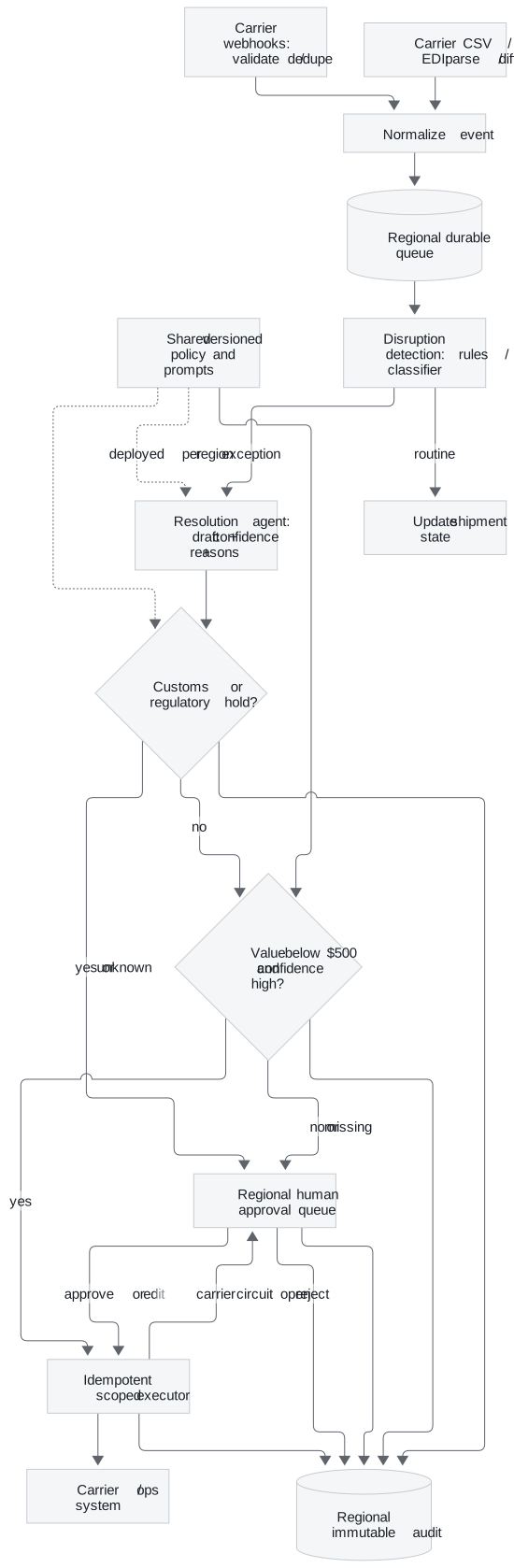
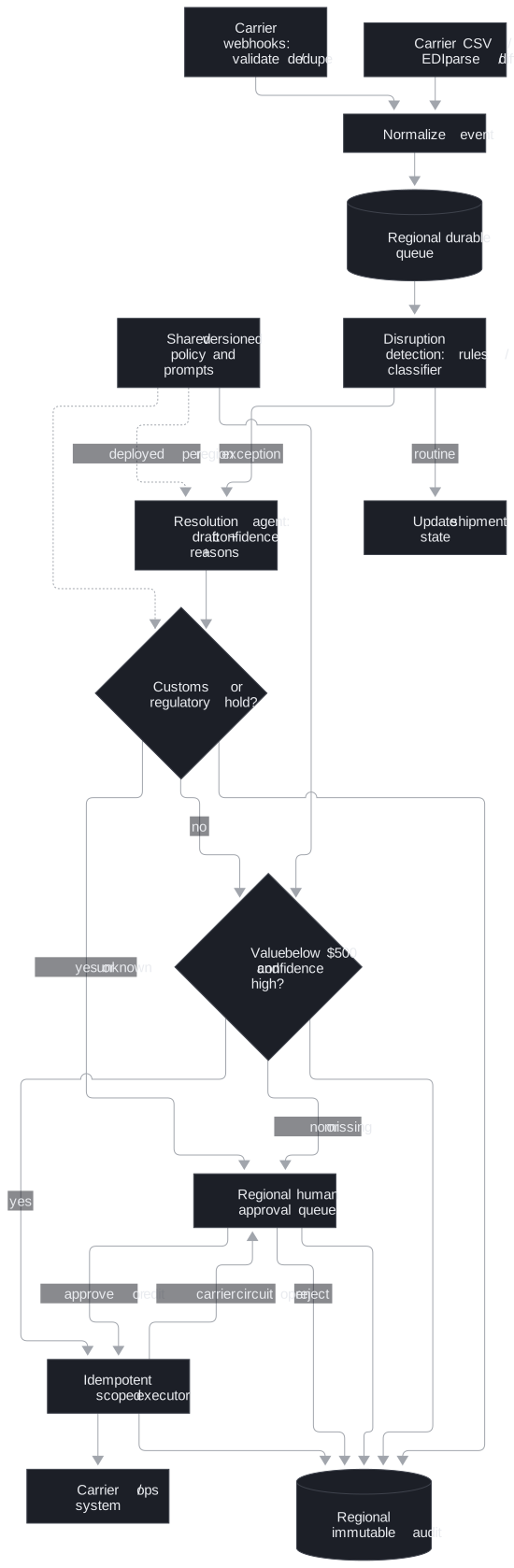
The resolution agent/model drafts an action and confidence; a separate deterministic policy gate decides whether execution is permitted. Shared versioned logic is deployed into US, EU and APAC regional data planes. EU records and audit data do not replicate out of the EU.
Step-by-step architecture
- Validate and deduplicate webhook events; parse scheduled files and emit only shipment-state differences. Both paths become one regional event schema, with batch detection lag visible.
- Queue normalised events to absorb storms, then use rules or a small classifier to find customs, missed-scan and weather exceptions. Routine scans only update state.
- Send exceptions to the resolution agent for an action draft, confidence and supporting signals. The agent cannot call carrier write APIs directly.
- The independent gate checks customs/regulatory status first, using detection's type rather than the agent's label. Any customs or unknown case goes to a human.
- For non-customs cases, only shipment value under $500 and confidence above the agreed threshold may auto-resolve; all others enter the regional approval queue.
- An approved or eligible action uses scoped carrier credentials, an idempotency key and a circuit breaker. A flaky or non-idempotent carrier falls back to human handling.
- Log every verdict, draft, approval/edit/rejection and execution in the regional audit store; keep EU data and access within the EU.
Decisions, failures and evaluation
Customs is an invariant, not a threshold. A high-confidence model cannot override it. A missing field fails to the human queue, and an unavailable audit store blocks action. A legacy carrier that cannot honor an idempotency key may need human-only handling because a timeout can otherwise cause double booking. A circuit breaker moves carrier failures to human review rather than retrying into a storm.
Two feed clocks: polling a batch-only carrier every few seconds cannot make its 2–6-hour file arrive sooner. Keep separate time-to-detect p50/p95 for webhook and batch feeds. Show lateness on the draft. Queue depth and approval age are separate operational SLOs (service level objectives).
Release evidence: replay labelled historical exceptions for recall and precision per type; adversarial customs cases must produce zero auto-resolutions; calibrate confidence above the auto threshold; test duplicate execution, EU-to-US access denial and audit completeness. Start offline, then shadow with all human actions, then one region/one integrated carrier for known-route missed scans. For rerouting benefit, use a matched holdout: the route not taken is not directly observable.
Cost and latency: keep model calls behind detection; template common missed-scan rebooks; cap agent steps, carrier calls and retries; route difficult human-read drafts to a stronger model only when useful. Cost scales with exceptions, not routine scan volume. During a weather burst, prioritise backlog by value and deadline and scale stateless detection; the human approval queue may become the real bottleneck.
Two-minute interview answer
“I would ask about feed freshness, the human boundary, shipment value rules and regional residency first. Webhook and batch carriers get different adapters but converge on one normalised, regional queue; batch changes are diffed and their lateness is surfaced. Cheap detection finds exceptions, and only then does a resolution agent draft an action with confidence and reasons. An independent gate checks customs first and always sends it to a human. For other cases, only under-$500, high-confidence actions may auto-resolve. Execution is idempotent, scoped and circuit-broken, with every verdict and action audited in-region. I would prove the customs invariant offline, shadow all actions, then enable one narrow auto-resolve cohort while watching outcome, delay and reversal rates.”
Technical Deep Dive · 4 min — Read after the Interview Guide. The detail behind each component, for follow-up questions.
Read with the unchanged source. The Main guide gives the interview flow; the Cheat Sheet is the recall card.
1. Event rate, exception rate and feed freshness
The approximately 200 webhook events/s at peak are not 200 agent decisions/s. A peak sustained for 24 hours would be 17.3M events, an upper bound. The approximately 150 agents each handle 30–50 cases daily, or 4,500–7,500 cases in the simple sizing estimate. Put cheap detection before the model so inference spend follows disruptions. The 40 concurrent agents at shift handoff size review UX and queue SLA (service level agreement), not stream ingestion. Batch-only carriers report every 2–6 hours; no polling trick removes that upstream delay.
Webhook ingest validates payload and deduplicates carrier retries. File ingest parses CSV/EDI and diffs the latest shipment state, emitting only changes. Both use the same regional event schema. Include source timestamp, ingest timestamp and detection timestamp to expose freshness. A regional queue absorbs weather bursts; monitor oldest-event age and detection recall rather than only queue depth.
2. Gate, identity and execution
Detection supplies the exception type. The model/agent supplies a proposed action, confidence and reasons but does not have carrier-write credentials. The gate checks customs/regulatory first; then only a non-customs shipment below $500 with calibrated high confidence can enter auto-execution. Missing type, value, confidence or policy version means human review. Keep the policy version with the decision and test forced-high-confidence customs examples on every release.
Each carrier action needs an idempotency key tied to the specific shipment and resolution version. A timed-out rebook could have succeeded, so blind retry risks a second booking. Carrier APIs without idempotent semantics may remain human-only. Limit retries and use a circuit breaker to send work to review when a carrier is unhealthy. Audit both automated and human decisions, including original draft, agent edit/reject and action result. If the audit store is unavailable, do not perform an unaudited action.
3. Residency and stakeholder surface
One versioned control plane distributes prompts, model routes, policy definitions and UI logic, but US, EU and APAC data planes hold their own event stores, model inputs and audit logs. EU data never leaves EU, because the customer requires it; GDPR (General Data Protection Regulation) alone would allow transfers with safeguards. Application sessions must enforce region access too; isolated storage alone does not prevent a cross-region query. Cross-region reporting can use approved aggregate metrics rather than raw shipment records.
In the #66 rerouting variant, SAP is authoritative shipment state and a possible write target; weather is a predictive signal stamped with freshness; 500 warehouse managers are distributed approvers. Regional system differences belong in adapters. A walking skeleton should take one SAP extract and one weather feed to one regional manager, even with a mocked agent, before broad integration work. If weather disappears, scan-driven detection still works and the draft states the missing signal.
4. Evaluation and rollout
Replay historical shipments with labels for detection recall and false alarms per exception type. Calibrate confidence, then inspect approve-unedited, approve-edited and reject rates. Join outcome to delivery against revised ETA (estimated time of arrival) days later. Test executor crash/replay for duplicate booking and every region-to-region access denial. Compare rerouted shipments with matched holdouts because one shipment cannot reveal the alternative route's outcome.
First run offline with no carrier writes, then shadow live traffic while humans act, then enable low-value, high-confidence known-route missed scans for one carrier and region. Release gates: customs auto-resolve count zero on adversarial cases, detection recall not worse, residency tests passing and audit complete. Monitor cost/resolved exception, model calls/exception, time-to-draft by feed, queue age and reversal rate. A quality gain in draft fluency does not compensate for a customs gate failure.
Quick Review · 1 min — The whole case on one page, for recall before an interview. Assumes the guide.
Ask first
Feed freshness/rate? Who approves? Which cases may auto-resolve? Shipment value/confidence rule? Residency?
Whiteboard path
Webhooks + batch diff → regional normalized queue → cheap detection → agent draft → customs-first policy gate → auto executor or human queue → carrier action → regional audit
Agent proposes; gate decides. Exception type comes from detection, never from the agent's self-label.
Numbers and rules
~200 webhook events/s peak; files every 2–6 hours; ~150 agents/~40 concurrent. Auto only when non-customs, value < $500, confidence above threshold. Missing field → human. EU data stays EU (customer rule, not GDPR (General Data Protection Regulation)). Batch lateness is visible.
Failure and proof
Idempotency key per carrier action; circuit-breaker fallback to human; no unaudited action. Legacy non-idempotent carrier may be human-only. Offline replay → shadow → one carrier/region auto pilot. Zero customs auto-resolves is a release invariant; measure detection recall and outcomes with a matched rerouting holdout.
60-second close: “Two ingestion paths converge after ingestion. The model only drafts on detected exceptions. An independent customs-first gate and safe executor keep automated actions narrow, auditable and regional.”
Full Design 1 · 11 min — The complete, referenced write-up behind the other tabs. The sources for every tab live here.
The agent has to act fast enough to unstick a shipment, and never act at all on the one class of case the customer will be held accountable for.
This is a low-scale, high-stakes design, not a traffic problem. Only 150 people use it, and the engineering bar is correctness at one decision boundary. This page consolidates the group's prompts into one read for the day before. It reuses the deny-first gate from G03 and the tenancy ladder from G07, and names them rather than repeating them.
| Case in the group | What it contributes here |
|---|---|
| #5 AI Logistics Exception-Handling Assistant, the FDE round (anchor) | Sections 1 to 9, 12 and 13: the four questions, the gate, both ingestion paths, regional planes, reliability, governance, trade-offs |
| #66 OpenAI FDE prompt: shipment rerouting over SAP, weather APIs and 500 warehouse managers | Section 10, the evaluation plan the prompt demands; section 11, the stakeholder and data-unification delta; follow-ups in section 13 |
| Self-drill on #5 (written for this page) | Section 14 |
Sections and tables marked (own construction) were built for this page from the sources' arguments and are not in the sources verbatim. The group has no playbook cost drill, so the whole of section 14 is own construction.
1. Ask the Four Questions That Decide the Design
This case is framed as an FDE round, and it runs in interview order. Clarifying questions come first, each answer is recorded, and each answer's implication is drawn out. In this format the questions are the design.
The prompt: the FDE is embedded with a mid-size logistics customer. They want an AI exception-handling assistant that watches their shipment pipeline and detects disruptions: customs holds, missed carrier scans, weather delays. It either auto-resolves them or drafts a resolution for a human ops agent to approve. It works across multiple carriers and a mix of real-time and batch feeds.
| Asked | Answer | Implication |
|---|---|---|
| Data volume and freshness per carrier? | Mixed. ~60% of carriers push real-time webhooks — scan events, status changes — ~200 events/s combined at peak. ~40%, mostly smaller regional carriers, provide batch file drops (CSV/EDI) every 2–6 hours, a few thousand records each | Ingestion needs both a streaming path and a scheduled batch path feeding the same pipeline — not a single uniform interface |
| Who are the users, and what scale? | Internal only — the customer's ops team. ~150 agents across three shifts, ~40 concurrent at peak during shift handoff, each handling 30–50 cases a day | Low-DAU, high-stakes-per-interaction. Scale pressure comes from event throughput, not concurrent users — a very different sizing profile from a consumer assistant |
| What is the auto-resolve vs human-approval boundary? | Value- and confidence-based: under $500 shipment value + high confidence → auto-resolve. Customs/regulatory holds → always human, regardless of confidence. Over $500, or below the confidence threshold → always human | The core risk-boundary decision. It defines a policy layer in front of every auto-resolution, with customs as a distinct always-gated path — not just a low-confidence case |
| Regional or multi-tenant topology? | One customer, one assistant experience, operating across US, EU and APAC with different carriers per region — and the customer requires that EU data stays in the EU (their requirement; GDPR itself allows transfers with safeguards) | Rules out a single global deployment or data store. Regional data isolation behind one coherent experience |
Each answer moved a box. That adaptation is the signal the round scores. The example the source gives for auto-resolve is concrete: rebooking a missed scan on a known route.
The mock session in the source folder ran exactly these four questions. It ended on the architecture prompt below, which is the place to practise picking up from:
"Walk me through your high-level architecture. What are the major components, and how does an event — say, a missed carrier scan — flow through the system from ingestion to either auto-resolution or a human agent's queue?"
Section 4 is the model answer to that prompt.
2. State Requirements as Testable Constraints
A requirement that cannot fail a test is a preference. "Reliable" is a preference. "Zero customs holds auto-resolved, ever" is a constraint, and it is the one that shapes the architecture.
The functional list is the source's. The priority split and the acceptance column are own construction.
| Priority | Functional requirement | Accepted when |
|---|---|---|
| Must | Ingest shipment events from carriers, real-time and batch | Both paths write the same normalised schema; a batch diff emits only changed shipments |
| Must | Detect disruptions: customs holds, missed scans, weather delays | Recall per exception type measured on a labelled replay set (section 10) |
| Must | Classify each exception by type, value and confidence | Every exception reaching the gate carries all three fields; a missing field routes to a human |
| Must | Auto-resolve low-risk, low-value, high-confidence cases | Only under $500, only above the threshold, never customs |
| Must | Draft a proposed resolution for everything else and route it to a human ops agent | The draft shows the action, the signals and the confidence |
| Must | Let an ops agent approve, edit or reject a drafted resolution | Each choice is logged with the agent's identity and the original draft |
| Must | Maintain a full audit trail of every decision, automated or human | Any resolution can be reconstructed from the audit log alone |
| Should | Extend to new carriers without redeploying the core pipeline | A new carrier is an adapter plus config, no pipeline release |
The non-functional list is the source's. The measurable targets in the right column are own construction.
| Quality | Source requirement | Testable form (own construction) |
|---|---|---|
| Residency | EU data never leaves the EU | A cross-region query from a US session is refused; replication config has no EU→non-EU path |
| Reliability | A missed exception is a real shipment sitting stuck | Detection recall per type tracked daily; zero dropped events on the queue |
| Latency | Low latency from disruption detection to draft resolution | Time-to-draft p95 tracked separately for real-time and batch carriers |
| Auditability | Every auto-resolution and every human decision traceable | 100% of gate verdicts and agent actions in the immutable log |
| Cost | Cost-efficient at a modest, bounded user scale (150 agents, not millions of consumers) | Cost per resolved exception, with the model called only on detected exceptions |
| Extensibility | New carriers without a redeploy of the core | Adapter contract test passes before a carrier goes live |
The constraint that dominates the rest is the customs rule. It is not a threshold to tune. It is an invariant the gate must hold for every input, including a model that is wrong and confident.
3. Size by Event Throughput, Not by Users
This system is not scale-constrained by users. It is constrained by event throughput and correctness. I'd treat forty concurrent agents as a single-server load. Two hundred events a second, bursting during a regional storm, is the real sizing problem.
The arithmetic below is own construction from the source's figures. Say it aloud, because it decides where the model sits.
| Quantity | Figure | Consequence |
|---|---|---|
| Real-time events at peak | ~200 events/s | The stream and detection must absorb bursts; a queue sits in front |
| Upper bound per day at the peak rate | 200 × 86,400 ≈ 17.3M events | Far too many to send to an LLM; detection must be cheap |
| Human-handled cases per day | 150 agents × 30–50 ≈ 4,500–7,500 | The model drafts thousands of cases a day, not millions |
| Concurrent approvers at peak | ~40, during shift handoff | The approval queue, not the model, is the human bottleneck |
| Batch drops | every 2–6 hours, a few thousand records each | Batch exceptions surface hours late by design |
The gap between the first two rows and the third is the design. Most events are routine scans. Detection is a rules-and-classifier layer on the stream, and the resolution model runs only on the small fraction that is actually an exception. Put the model on the event stream and cost and latency scale with every scan. Put it behind detection and they scale with disruptions.
4. Draw the Architecture End to End
Two ingestion paths, one exception pipeline, a policy gate before anything acts. That sentence is the whole design, and the diagram should say it before any box is explained.
The source's own diagram, kept verbatim:
Carriers (60% real-time, 40% batch)
        │
   ┌────┴────┐
Webhook   Batch File
Ingest    Ingest (EDI/CSV, scheduled)
   │         │
   └────┬────┘
        │
Event Normalization & Stream
        │
Disruption Detection Service
   (customs hold · missed scan · weather delay)
        │
Resolution Agent
 (drafts action + confidence score)
        │
   Policy Gate
 (value + confidence + always-human customs rule)
   │            │
Auto-Resolve   Human Approval Queue
   │            │  (ops agent: approve / edit / reject)
   └─────┬──────┘
         │
   Carrier / Ops Systems (execute the resolution)
         │
   Audit Log (every decision, automated or human)
The same system drawn with its planes and trust boundaries (own construction). The control plane is shared and versioned identically everywhere. The data plane is one copy per region.
 ╔═══════════════════ SHARED CONTROL PLANE (versioned identically in every region) ═══════════════════╗
 ║  agent prompts + tools · model routing · POLICY DEFINITIONS (customs rule, $500, threshold) · UI     ║
 ║  carrier adapter registry · confidence threshold · eval gates · release versions                      ║
 ╚══════════════════════════════════════════════╤═════════════════════════════════════════════════════╝
                                                │ deploys the same logic into each region
 ┌──────────────────────────────── ONE REGIONAL DATA PLANE (US | EU | APAC) ─────────────────────────────┐
 │                                                                                                        │
 │  webhook carriers ─► [Webhook ingest: validate, dedupe] ─┐                                             │
 │                                                          ├─► [Normalise] ─► [Queue] ─► [Detection]     │
 │  batch carriers ──► [Batch ingest: parse, DIFF vs last] ─┘                   (rules + classifier)      │
 │                       state; tag "detected late"                                  │ exceptions only    │
 │                                                                                   ▼                    │
 │                                            [Resolution Agent: draft action + confidence + reasons]     │
 │                                                                                   │                    │
 │  ════════════════════════ TRUST BOUNDARY 1: nothing acts without the gate ═══════╪══════════════════  │
 │                                                                                   ▼                    │
 │                               [POLICY GATE]  1. customs/regulatory? → HUMAN, stop                      │
 │                                              2. value < $500 AND confidence ≥ threshold? → AUTO        │
 │                                              3. otherwise → HUMAN                                      │
 │                                    AUTO │                         │ HUMAN                              │
 │                                         ▼                         ▼                                    │
 │  ═══ TRUST BOUNDARY 2: least-privilege  [Execute]         [Approval queue] ◄── ops agents, this region │
 │      carrier scopes, idempotency key ══  │ circuit breaker    │ approve / edit / reject                │
 │                                          ▼                    ▼                                        │
 │                                  [Carrier / ops systems] ◄────┘                                        │
 │                                                                                                        │
 │  [Event store]   [Audit log: every verdict + action + confidence + reasoning, immutable]               │
 │  ═══ TRUST BOUNDARY 3: no replication out of the region; EU data never leaves the EU ═══               │
 └────────────────────────────────────────────────────────────────────────────────────────────────────────┘
The same flow in Mermaid (own construction), with the gate's ordering visible:
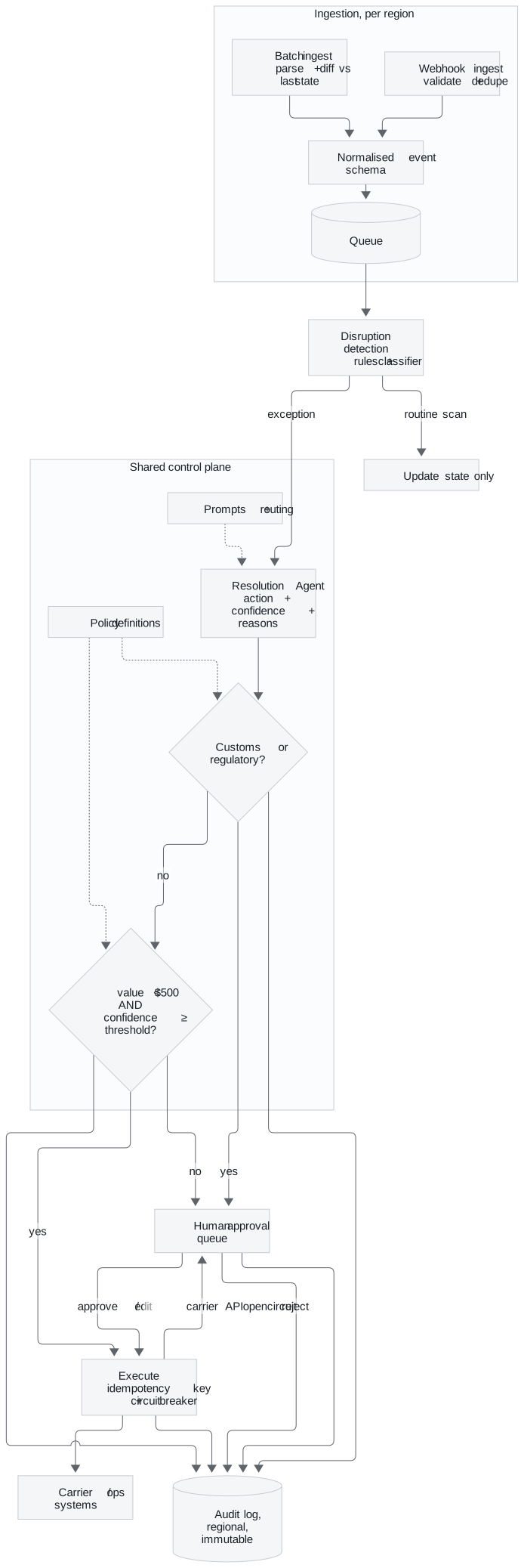
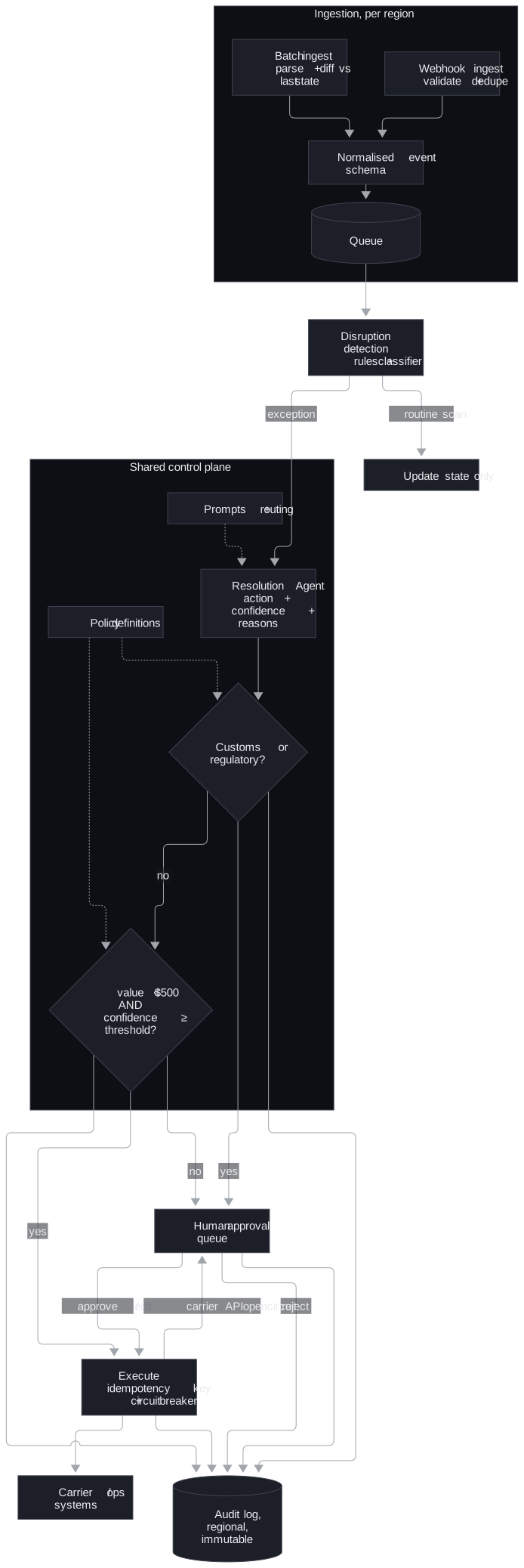
Read the components in the order an event meets them. The component names and responsibilities are the source's. The failure column is own construction.
| # | Component | Responsibility | Fails how |
|---|---|---|---|
| 01 | Webhook ingest | Validates, deduplicates and pushes real-time carrier events onto the stream immediately | Closed on a bad payload; events buffer at the carrier's retry |
| 02 | Batch file ingest | Picks up EDI/CSV drops on schedule, parses, diffs against last known state per shipment | Degrades: a late drop is flagged, not silently skipped |
| 03 | Event normalisation and stream | One schema for both paths, queue-backed | Degrades to backlog; alert on depth |
| 04 | Disruption detection | Classifies events into customs hold, missed scan, weather delay | Degrades: an unclassifiable event routes to a human |
| 05 | Resolution Agent | Drafts an action with a confidence score and reasons; never executes | Degrades: no draft, case goes to the queue bare |
| 06 | Policy Gate | Customs first, then value and confidence; the auto-versus-human verdict | Closed: any missing field or error means human |
| 07 | Auto-resolve executor | Executes the resolution with an idempotency key behind a circuit breaker | Degrades to the human queue when the carrier API is flaky |
| 08 | Human approval queue | Ops agents approve, edit or reject drafted resolutions | Alerts on depth during shift handoff |
| 09 | Carrier / ops systems | The systems of record that actually move the shipment | Outside the design; guarded by least-privilege scopes |
| 10 | Audit log | Every gate verdict and every action, with confidence and reasoning | Closed: an action that cannot be logged does not run |
| 11 | Shared control plane | Logic, routing, policy definitions, UI, versioned identically per region | A bad release rolls back everywhere at once |
| 12 | Regional data plane | Event store, any vector store, audit log; never replicates across regions | Closed at the region boundary |
Point at three things while the diagram is up (own construction). The gate is its own box, not a check inside the agent. Both ingestion paths converge after ingestion, not before. And the region boundary cuts through storage, not through logic.
5. Unify Streaming and Batch After Ingestion, Not Before
Forcing the 40% batch-only carriers onto a fake "real-time" interface buys nothing. It means polling a file drop every few seconds. The data does not get fresher, and only the infrastructure gets more complex. A poll cannot make a carrier report sooner than it reports.
Both paths converge after ingestion instead. Webhook ingest validates and deduplicates, then pushes onto the stream immediately. Detection must be genuinely low-latency on this path. Batch ingest picks up the carrier's drop on its schedule, every 2–6 hours. It parses the drop and diffs it against the last known state per shipment, so only changes enter the stream. Both paths write the same normalised event schema. Detection never needs to know which path an event came from.
A missed scan on a batch carrier is inherently detected late. Surface that latency to agents rather than hide it. It changes how urgently they should act. Tag every batch-sourced exception with its detection lag, and show it on the draft.
The same idea appears as channel adapters in G15. Here the channels are carrier feeds.
Full Design 2 · 11 min — The complete, referenced write-up behind the other tabs. The sources for every tab live here.
6. Put Customs First in the Policy Gate
The gate is drawn as a first-class component, not a side-check inside the Resolution Agent. It is the one piece the customer said must never be bypassed for customs. So it must be independently testable and auditable.
Resolution Agent output (action + confidence + shipment value + exception type)
            │
   Is exception type = customs/regulatory?
     │ Yes                    │ No
     ↓                        ↓
 Human Approval        value < $500 AND confidence ≥ threshold?
 Queue (always)          │ Yes                  │ No
                          ↓                      ↓
                     Auto-Resolve          Human Approval Queue
The customs check runs first and short-circuits everything else. A confidence score cannot outvote a rule it is never compared with. This mirrors the customer's own framing. Customs is a hard compliance boundary, not something that competes with a confidence score. Only after that check does the value-and-confidence rule apply.
State the ordering out loud. A candidate who checks confidence before the customs carve-out has built a system where a high-confidence model could, in principle, auto-resolve a customs hold. That is exactly what the customer ruled out. It is the same structure as deny-rules-first in the G03 tool gateway, and the same short-circuit logic.
Three details make the gate trustworthy (own construction). Take the exception type from the detection service, not from the agent's own output. An agent that mislabels a customs hold as a weather delay must not be able to talk its way past the gate. Fail closed on any missing field: no value, no type or no confidence routes to a human. And keep the policy definitions in the control plane under version control, so a threshold change is a release with an audit entry, not a config edit.
8. Make Every Action Safe to Retry and Every Carrier Safe to Lose
Reliability here means two things. A missed exception is a shipment sitting stuck. A duplicated action is a double-booking or a double refund. The design guards against both.
Keep detection and resolution stateless behind a queue, with state in the event store and audit log. Put a queue in front of detection. A regional weather event that disrupts many shipments at once then smooths into backlog instead of overwhelming detection.
Give every auto-resolve action an idempotency key. A client that times out cannot tell a failed rebooking from a slow one, so it retries. The key lets the retry return the first result instead of booking twice. Legacy carrier APIs that cannot honour a key cost something real. Those carriers may be forced into human-only handling regardless of confidence.
Wrap carrier API calls in circuit breakers. A flaky carrier should degrade to "route to human", not pile up retries that delay every other exception behind it.
Track time-to-detect separately for real-time and batch carriers. An average hides that a meaningful share of exceptions are detected hours late by design, not by failure.
Put SLAs (service level agreements) on the approval queue. With 40 concurrent agents, a queue that grows faster than agents clear it during shift handoff is a capacity problem. The AI cannot solve it. Alert on queue depth, not just event latency.
9. Audit Every Decision and Explain Every Draft
This customer's compliance posture depends on traceability. Every auto-resolved action and every human decision must be reconstructable.
Treat the audit log as a first-class store, not a side effect. It records every gate verdict, whether customs to human or value-and-confidence to auto or human. It records every ops agent action: approve, edit or reject. Each entry is immutable and carries the model's confidence and reasoning trace.
Hold least-privilege carrier credentials. The execution path holds only the scopes needed to rebook or reschedule, never broad account-level credentials.
Enforce regional access control at the application layer, as section 7 describes.
Require explainability at the point of approval. The draft shown to an ops agent must say why the model proposed it: which signals, which confidence. An agent approving a black box under time pressure is how a wrong suggestion becomes a wrong human decision too. Human review is a control only when the human can see what they are reviewing.
10. Evaluate It Before Anyone Asks
The #66 prompt ends "how do you build it, and how do you evaluate it?" The source bank names hand-waved evaluation as the second failure mode of the round, and says most candidates fumble "how do you know your AI system is actually working well?" Tie every design choice back to how it would be evaluated, and raise the plan unprompted.
The plan below is own construction, built on the anchor's components. Each layer of the design gets one question and one instrument.
| What could go wrong | First evaluator |
|---|---|
| Did detection catch the disruption at all? | Recall per exception type on a labelled replay of historical shipments |
| Did it flag routine scans as disruptions? | Precision per type; false-alarm rate per agent shift |
| Would the gate ever auto-resolve a customs hold? | Invariant test: adversarial customs cases with forced high confidence; required result zero |
| Is the confidence score honest? | Calibration curve on the replay set; error rate of auto-resolved cases above the threshold |
| Are drafts good enough to approve? | Approve-unedited, approve-edited and reject rates per exception type |
| Did the resolution actually unstick the shipment? | Outcome join: delivered within the revised ETA, from SAP, days later |
| Does a retry ever double-book? | Fault-injection test: kill the executor mid-call, replay, count bookings |
| Can an EU record reach a US session? | Residency test from every region's session, on every release |
| Is batch lateness hidden? | Time-to-detect p50/p95 split by feed type |
Run it in three stages (own construction). Offline first. Replay months of historical shipment and weather data through detection and the agent. Compare against what the ops team actually did. This builds the golden set and calibrates the threshold before anything touches a carrier.
Shadow second. The agent drafts for live exceptions, but humans act on everything. Compare its draft with the human decision per exception type. Auto-resolve is not switched on until the agreement rate on sub-$500 cases clears a target agreed with the ops lead.
Staged auto-resolve third. Enable it for one region and one well-integrated carrier first, on missed scans on known routes, the source's own example. Watch outcome and reversal rates. Then widen.
Rerouting has one evaluation trap worth naming. The route not taken is never observed, so "the reroute helped" cannot be read off a single shipment. Measure it against a matched holdout of comparable exceptions handled the old way, on delay hours and cost per exception.
Gate every release on the same suite. Detection recall must not drop, the customs invariant must hold at zero, and the residency test must pass. Fluency of the drafts is not on the list.
11. Map the Stakeholder Surface for the Rerouting Variant
The #66 prompt is the same system with three different nouns. It says: "A logistics firm wants an AI agent to handle automated shipment rerouting. They have SAP data, real-time weather APIs, and 500 warehouse managers on different regional systems." The source bank says it tests three things: multi-system data unification, stakeholder surface area, and whether evaluation is first-class. Section 10 covers the last. This section covers the first two.
Map the anchor onto the prompt before drawing anything new (own construction).
| #66 noun | Where it lands in the anchor | What changes |
|---|---|---|
| SAP data | The system of record behind "carrier / ops systems" and the event store | SAP becomes an ingestion source and an execution target; changes arrive by change feed or batch extract, so the batch-diff path applies |
| Real-time weather APIs | A detection signal for "weather delay", on the streaming path | Weather is predictive, so detection can flag a shipment before a scan is missed; forecasts need a freshness stamp |
| 500 warehouse managers | The human approval surface, larger than the anchor's 150 agents | Still low-DAU; the approvers sit in different tools, so the draft must reach them where they work |
| Different regional systems | The regional data planes of section 7 | One adapter per regional system, behind one normalised schema |
| Automated rerouting | The auto-resolve action | A reroute is a side effect: idempotency key, least-privilege scope, gate before execution |
Narrate the source's six-step framework over it, because the round scores the narration.
- Clarify the mission. Is the goal on-time delivery, cost, or fewer manual touches? Who is the primary user: the warehouse manager or a central ops desk?
- Name stakeholders and success metrics. Warehouse managers approve reroutes. Central logistics owns the SAP integration. Regional IT owns each regional system. Customs and compliance own the always-human rule. Each group calls success by a different number, and the metrics must be agreed before the build.
- Map the inputs. What data exists, what shape, who owns it, how fresh? SAP is authoritative but batchy. Weather is fresh but probabilistic. Regional systems differ in schema and in whether they accept writes at all.
- Decompose into workstreams and sequence them by risk. Data ingestion and quality comes first, because a reroute on a wrong shipment state is the worst failure. The agent and gate come second. The manager-facing surface comes third.
- Ship a walking skeleton. Build the thinnest path from one SAP extract and one weather feed to one region's managers, even with a mocked agent. It proves the integration story before the model matters.
- Adapt live. Expect "you lost access to the weather feed". Re-derive without defending the old plan. Weather-driven detection falls back to scan-driven detection, and the draft says weather data was unavailable.
The data-unification probe from the same bank asks how to unify customer data split across SAP, Salesforce and Postgres for an agent. Give the anchor's answer. Normalise into one event schema per region at ingestion, and never let the agent query three systems of record live.
12. Weigh the Trade-offs Out Loud
Every decision in the design costs something, and naming the cost is what separates a design from a diagram.
| Decision | Advantage | Trade-off |
|---|---|---|
| Unified stream (webhook + batch) | One detection code path; simpler to add carriers | Batch exceptions detected late by design — must be surfaced |
| Policy Gate as a separate component | Independently testable; customs rule cannot be bypassed by a confidence-score bug | Extra hop in the critical path |
| Regional data planes, shared control plane | Compliant by construction; consistent UX and policy | Cross-region reporting needs an aggregation layer that respects residency |
| Queue-backed ingestion | Absorbs bursts | Latency under normal load; backlog needs monitoring |
| Idempotent auto-resolve | Safe to retry | Every carrier integration must support idempotency keys — legacy ones may not, forcing some carriers to human-only |
The summary line from the source carries the whole table. The design centres on one non-negotiable: the Policy Gate. Everything else feeds it correctly and acts on its verdict safely.
Full Design 3 · 12 min — The complete, referenced write-up behind the other tabs. The sources for every tab live here.
13. Deliver It in Sixty Minutes
Spend the hour on the four questions, the gate and the evaluation plan. The ingestion split and the regional planes are shorter. The queue technology is a sentence.
| Minutes | Phase |
|---|---|
| 0–8 | Clarify: the four questions and each one's implication (section 1) |
| 8–12 | Requirements and the throughput arithmetic (sections 2 and 3) |
| 12–22 | The diagram and the missed-scan walk from ingestion to verdict (section 4) |
| 22–35 | Deep dives: ingestion, the gate ordering, regional planes (sections 5 to 7) |
| 35–45 | Reliability and governance (sections 8 and 9) |
| 45–55 | Evaluation plan and staged rollout (section 10) |
| 55–60 | Close: trade-offs and the one non-negotiable (section 12) |
The two-minute spoken answer (own construction from the source's summary):
This is a modest-scale, high-stakes system: 150 ops agents, not millions of users, so the pressure comes from event throughput and correctness. Carriers report two ways, about 60% by real-time webhook at around 200 events a second and 40% by batch drops every two to six hours, so I ingest both and converge them after ingestion into one normalised stream, diffing batch drops against last known state and surfacing their lateness instead of hiding it. Detection classifies customs holds, missed scans and weather delays, and only exceptions reach the Resolution Agent, which drafts an action with a confidence score and reasons but never executes anything. That decision belongs to the Policy Gate, a separate component: customs and regulatory holds go to a human first and always, and only then does the rule apply that under $500 and above the threshold auto-resolves. Auto-resolve actions carry idempotency keys and sit behind circuit breakers that fall back to a human. The customer requires EU data to stay in the EU, which is stricter than GDPR (General Data Protection Regulation), so I run a shared control plane with regional data planes. Every verdict and action goes to an immutable audit log, and every draft shows why. I would prove it offline on replayed history, then in shadow mode, then with staged auto-resolve, with a zero on customs auto-resolutions as a release gate.
The lines that carry the round (own construction from the source's arguments):
- "The questions are the design. Each answer moved a box."
- "Scale comes from event throughput, not users."
- "The agent proposes. The gate decides."
- "Customs first. A confidence score cannot outvote a rule it is never compared with."
- "Converge after ingestion, and surface batch lateness instead of averaging it away."
- "Shared logic, isolated data."
- "A flaky carrier degrades to a human, not a retry storm."
- "Tie every choice to how I would evaluate it."
The follow-ups arrive in a predictable order. Several are the source bank's Tier 2 probes.
| Follow-up | Answer |
|---|---|
| Why not embed the customs check in the Resolution Agent? | Then a confidence-score bug or a mislabelled type can bypass it. A separate gate is independently testable and auditable, and it takes the type from detection, not from the agent |
| Why not poll batch carriers every few seconds? | The data gets no fresher, only the infrastructure more complex. Converge after ingestion and surface the lateness |
| A storm disrupts thousands of shipments at once. What happens? | The queue absorbs the burst into backlog; detection scales out statelessly; queue-depth alerts fire; the approval queue is the human bottleneck, so prioritise by value and deadline |
| How do you handle tool failures, retries and idempotency? | Idempotency key on every side effect; retry budgets with backoff; circuit breaker to a human fallback |
| When do you route to a human? | Customs always; over $500; below the threshold; any missing field; any open circuit |
| How does auditing drive HITL decisions? | Edit and reject rates per type from the audit log decide where the threshold sits and which types stay human-only |
| How do you report across regions? | An aggregation layer that ships metrics, not raw EU records |
| A legacy carrier cannot accept idempotency keys. | That carrier goes human-only regardless of confidence. Say the cost plainly |
| How do you know it is working? | Section 10: recall per type, the customs invariant at zero, calibration, draft acceptance, outcome joins, a holdout for reroutes |
| Agentic or deterministic workflow? | Deterministic for the pipeline and the gate; the model only drafts. The agent is an execution graph with a budget, not an open loop |
Repair the common weak answers on the spot. "The model decides whether to auto-resolve" becomes the agent proposes and the gate decides. "Check confidence, and customs is just low confidence" becomes customs first, as a rule. "One global deployment with an EU flag" becomes regional data planes. "Average time-to-detect" becomes split by feed type. "We'll monitor it" becomes the evaluation plan with a release gate.
14. Answer the Cost Pivot in Ten Minutes
This group has no playbook drill, so the card below is own construction. It is grounded in the throughput arithmetic of section 3 and in the agent-steps and retries drivers of the cost playbook. The pivot to expect is "the bill is climbing, and drafts are taking too long during a storm."
| Dominant driver | Agent steps and carrier tool calls per exception, multiplied by retries against flaky carrier APIs during a disruption burst — plus any model call placed on routine scan events |
| Cheapest lever first | Keep the model off the event stream: rules and a small classifier for detection, the Resolution Agent only on detected exceptions. Cache shipment and route lookups within a case; cap agent steps and carrier calls per exception; retry budgets with circuit breakers; deterministic templates for the common missed-scan rebook; small model for routine drafts, strong model only for over-$500 and customs drafts a human will read |
| Metric that proves it | Model calls per detected exception; cost per resolved exception by type; carrier calls and retries per case; time-to-draft p95 split by feed type; approval-queue depth |
| Do not | Send every carrier event to the LLM, or retry a flaky carrier API until the storm passes |
| 60-second line | Most events are routine scans, so the model belongs behind detection, not on the stream. Cost should scale with disruptions, not with events. Bound each exception's steps and carrier calls, template the common rebook, cap retries with a breaker that falls back to a human, and spend the strong model only on drafts a human will actually read. |
The latency face of the same card matters during a storm. The batch path is slow by design, and no model choice changes that. Latency on the real-time path is detection plus drafting plus the queue. The queue is where a burst lands. So the latency answer is backlog prioritisation by value and deadline, plus stateless scale-out of detection, not a faster model.
Every strong cost answer is generated by four verbs in order. Measure, by tracing model calls, carrier calls and retries per exception first. Route, sending detection to rules, routine drafts to a small model, and high-stakes drafts to a strong one. Bound, with step caps, carrier-call budgets, retry budgets and breakers. Cache safely, with shipment state keyed on the event version so a stale lookup never drives a reroute.
Level calibration
Every level can draw the agent and the approval queue; the level shows in where the customs rule lives and how far the answer reaches across regions, carriers and approvers.
| Level | Sounds like | Missing |
|---|---|---|
| Senior | Converges webhook and batch feeds after ingestion, keeps the model behind cheap detection, and puts an independent gate before every action: customs first, then under $500 and above the confidence threshold. Executes with idempotency keys and circuit breakers that fall back to a human. | Approval-queue SLAs at shift handoff, drafts that explain themselves, and an evaluation plan with release gates. |
| Staff | Adds the operational layer: regional data planes behind one shared control plane, residency enforced in the application too, queue-depth alerts for about 40 concurrent agents, and offline, shadow, then staged rollout with zero customs auto-resolves as a release gate. Says plainly that a carrier without idempotency goes human-only. | The stakeholder map when SAP, weather and 500 regional managers join, and how audit data should move the threshold over time. |
| Principal | Owns the gate as a versioned control-plane asset, so a threshold change is a release with an audit entry, and lets edit and reject rates from the audit log decide which exception types ever earn auto-resolve. Sequences the rerouting expansion by risk, data quality first, with success metrics agreed with each owning group before the build. | The confidence threshold and the shadow agreement target, which need replayed history and the ops lead's sign-off; reroute benefit needs a matched holdout. |
Key Takeaways
- The four clarifying answers are the design, and each one moved a box.
- Requirements are stated so a test can fail them, and the customs rule is an invariant, not a threshold.
- The system is sized by event throughput, so the model sits behind detection and scales with disruptions, not scans.
- One diagram shows two ingestion paths, one pipeline, and a gate before anything acts.
- Batch and streaming converge after ingestion, and batch lateness is surfaced rather than averaged away.
- The Policy Gate is its own component and checks customs first, before value and confidence.
- A shared control plane with regional data planes keeps EU data in the EU behind one experience.
- Idempotency keys, circuit breakers, split time-to-detect and queue SLAs make actions safe and failures visible.
- The audit log is a first-class store, and every draft explains itself at the point of approval.
- Evaluation is raised unprompted: replay offline, shadow, then staged auto-resolve, with the customs invariant as a release gate.
- The rerouting variant is the same system: SAP, weather and 500 managers map onto ingestion, detection and the approval surface.
- Every decision carries a named trade-off, and the Policy Gate is the one non-negotiable.
- The hour goes to the questions, the gate and the evaluation plan.
- The cost pivot is answered by keeping the model off the stream and bounding each exception's steps, calls and retries.
Check Yourself
- For each of the four clarifying answers, which box did it move? Mixed feeds moved ingestion to two paths; low DAU (daily active users) moved sizing to event throughput; the auto-versus-human rule created the Policy Gate with a customs path; EU residency created regional data planes.
- Why is the Policy Gate a separate component, and what is the ordering inside it? A separate gate is independently testable and auditable and cannot be bypassed by a confidence-score bug. Customs runs first and short-circuits; only then does under $500 and above the threshold auto-resolve.
- Why does the gate take the exception type from detection, not from the agent? An agent that mislabels a customs hold as a weather delay could otherwise route itself around the customs rule.
- Why not force batch carriers onto a real-time interface? Polling a file drop does not make the carrier report sooner; it only adds infrastructure. Converge after ingestion and surface the lateness.
- What does the shared-control-plane, regional-data-plane pattern cost? Cross-region reporting needs an aggregation layer that ships metrics, not raw EU records.
- Why track time-to-detect separately for batch carriers? An average hides that a meaningful share of exceptions are detected hours late by design, not by failure.
- What happens when a carrier API turns flaky mid-storm? The circuit breaker opens and those cases route to a human instead of piling up retries behind every other exception.
- What is the release-gating evaluation for this system? Detection recall per type must not drop, customs auto-resolutions must stay at zero on adversarial cases, and the residency test must pass.
- Why does a reroute need a holdout to evaluate? The route not taken is never observed, so benefit is measured against comparable exceptions handled the old way.
- How do SAP, weather APIs and 500 warehouse managers map onto the anchor? SAP is the system of record and a batch-style source; weather is a streaming detection signal; the managers are the approval surface, reached in their own regional systems.
- What is the sixty-second cost answer? Keep the model behind detection so cost scales with disruptions, bound steps, carrier calls and retries per exception, template the common rebook, and spend the strong model only on drafts a human reads.
References
Fact-check sources (checked 27 Sep 2026)
- European Commission: Rules on international data transfers — GDPR allows transfers out of the EU with safeguards, so "EU data stays in the EU" is the customer's rule