Interview Guide · 8 min — Start here. The answer you would talk through in the interview, readable on its own.
No-code agent process is: a support lead draws a workflow — reply, tag, refund — without writing Python. The hard part is a real refund happening once, and stopping if the box crashes.
G15 covers one slice: events in, versioned spec, guardrails, durable steps. A future LLM (large language model) may draft a spec; the demo engine is deterministic.
End to end, as Cascade’s “small refunds without a human”:
- Email/Slack becomes a canonical event with tenant id.
- One live workflow matches, or we record why none did. Entity lock so two copies don’t double-pay.
- Each step checkpoints. Arguments must match the schema.
- A $500 refund hits a $50 cap — refuse, don’t clamp to $50.
- Approval pause or allow-list. Then one idempotent write.
- Crash mid-way resumes from the checkpoint, not from “guess we should refund again.”
That’s it: event → one spec → guardrail → execute once → recover. Authors cannot secretly approve their own live refunds.
Full source: Sources and Full Design, especially §§1–12 for the anchor and §13 for Cascade Robotics. Use the Deep Dive for guardrail and recovery mechanics and the Cheat Sheet for rehearsal.
Questions to ask the interviewer
| Question to ask | What it's really asking | What you then decide |
|---|---|---|
| How non-technical is the author: forms, templates or plain-English creation? | Do they pick a template, fill a form, or type “refund angry VIP emails”? | Authoring UI and the reviewable spec. |
| Which channels and who owns their integrations? | Is Slack ours, and if two copies of the same email arrive, who dedups? | Adapters, threading, and dedup. |
| Are actions read-only, reversible or destructive? | Tag a ticket, or refund $500? | Approval, spend caps, and audit. |
| What is the blast radius of a bad workflow? | If someone publishes a loop, can it refund every customer tonight? | Default budgets and rollout gates. |
| Is multi-tenancy required from day one? | Can Acme’s workflow accidentally run on Globex’s tickets? | Tenant ID on every event, spec, lock, and policy. |
Requirements: Functional + Non-Functional
The easiest way to frame requirements in an interview is:
Functional = what the system does. Non-functional = how well it does it and what constraints it must satisfy.
Functional requirements — what the system must do
- Normalise channels into a canonical event with tenant id.
- Choose one live workflow or a named non-selection.
- Store versioned declarative workflows.
- Validate typed tool arguments.
- Checkpoint every step; deduplicate side effects.
- Apply per-step guardrails.
- Promote with role checks through draft, testing, shadow, live, autonomous.
A $500 refund on a $50 cap is refused, never clamped. Autonomous status cannot bypass the cap. issue_refund needs allow-list or human approval. A retry cannot refund twice.
Non-functional requirements — how well / under what constraints
| Requirement | Example target / constraint |
|---|---|
| Security | Tenant isolation; no unauthorised destructive action; author ≠ approver. |
| Spend | Actual-dollar caps; max steps and cost. |
| Reliability | Crash recovery; idempotency under redelivery; one active run per target entity. |
| Audit | Every allow/deny recorded. |
| Demo note | Source demo: 21 tests, no LLM — safety engine behaviour, not a future LLM planner. |
Interview shortcut
If asked “What are the requirements?”, say:
“Functionally, one event, one versioned workflow, typed args, checkpointed steps. Non-functionally, tenant isolation, real spend caps that refuse not clamp, recover after crash, execute once.”
Architecture
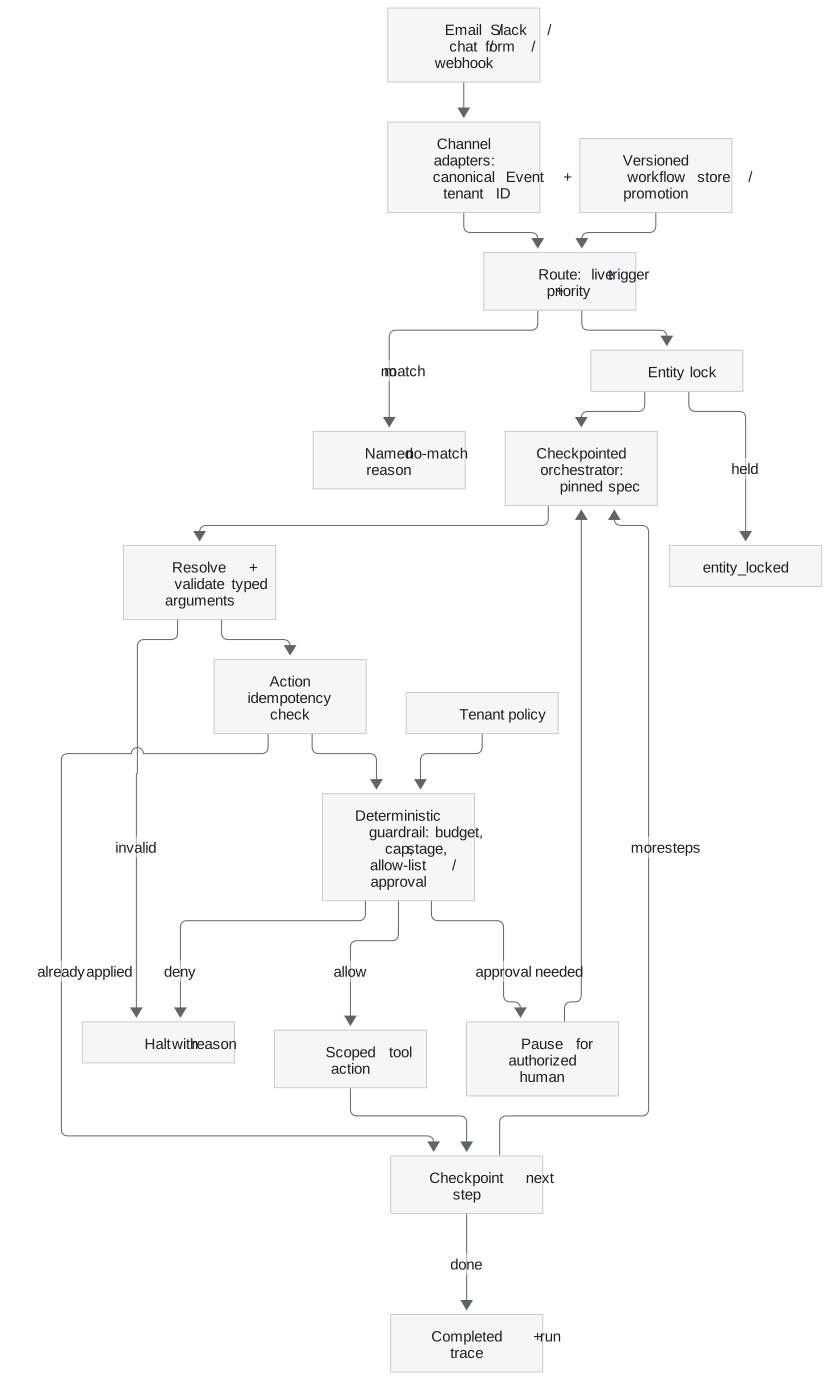
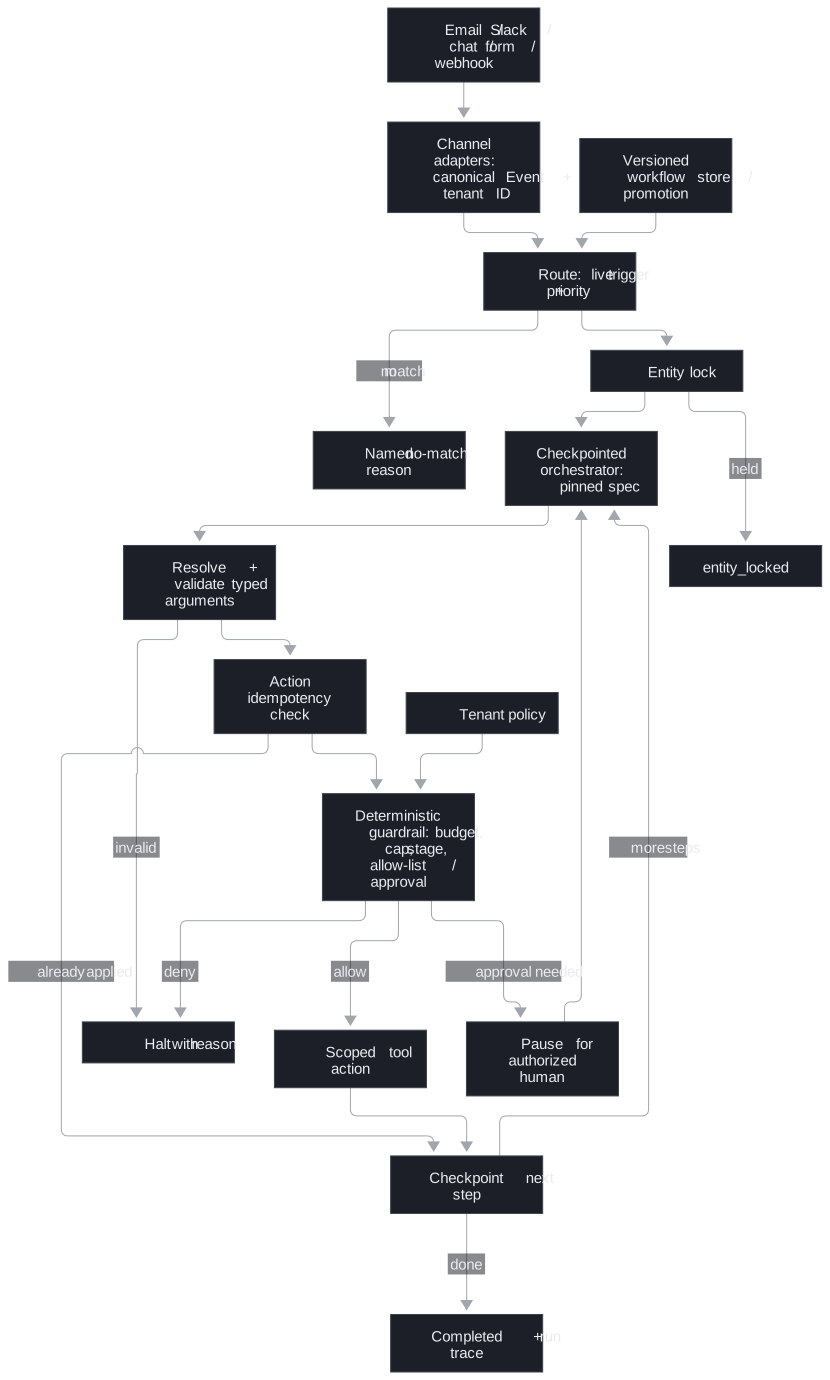
The runtime is a fixed, versioned step list in the demonstrated system. A future LLM may propose a typed value or a draft workflow spec, but code controls routing, argument schema, policy, approval, execution and resumption. An LLM is not present in the source's runnable demo.
Step-by-step architecture
- Each channel adapter translates a payload once into an event carrying channel, type, tenant, target entity, payload and raw reference.
- Routing matches only that tenant's live workflow, chooses highest priority and returns a named reason if none matches; an entity lock prevents concurrent mutations of the same ticket.
- The orchestrator pins the workflow version and resumes at
next_step_index, using the same loop for fresh and restarted runs. - Before a step runs, it resolves values and validates the tool's typed schema. A model may supply proposed values, but cannot change the spec or tool signature in the demo.
- An action-level idempotency key is checked before authorisation so a replayed side effect is a no-op and is not charged again.
- The guardrail checks the tighter workflow/tenant step and spend caps, shadow/live stage and destructive-tool allow-list or human approval. Deny wins; approval pauses safely.
- Only an allowed step calls the scoped tool. The orchestrator records the outcome, checkpoints, logs every decision and continues or finishes.
Decisions an interviewer will probe
Priority versus lock: priority chooses which workflow should run; the lock prevents two from acting at once. They solve different problems. A draft workflow never matches a live event.
Dollars versus compute cost: a refund tool must check its real amount_usd, not the tiny operational fee for calling the tool. One source bug let $500 pass a $5 cap because it checked the wrong quantity. Another bug charged the cap again on replay even though the refund was deduplicated; moving the idempotency check before authorisation fixed it.
Ordered denial: step budget → spend cap → shadow mode → not live → human approval if the destructive tool is not tenant-allow-listed. Workflow limits may tighten tenant policy but never loosen it. AUTONOMOUS raises which actions can skip approval; it never removes caps.
Promotion: DRAFT → TESTING → SHADOW → LIVE → AUTONOMOUS, one step at a time. An author cannot sign off their own workflow. Shadow mocks writes; live still needs human approval for actions that have not earned autonomous permission.
Runaway cost: measure cost per run and tenant, cap steps and model tokens, add tenant budgets and circuit breakers. Idempotency covers action effects and billing. Route deterministic events through rules and use a model only where judgement adds value.
Rollout, scale and honest gaps
Start with one channel and one non-destructive workflow, then prove negative guardrail cases and staged promotion before enabling refunds. The demo's in-process locks and idempotency dicts are not shared across workers; production needs a distributed lock (database uniqueness, or a Redis lease checked with a fencing token) and a durable shared idempotency store. The source also lacks a visual builder, natural-language-to-spec compiler, real LLM planner, automatic retry wrapper, secret vault integration, output PII (personally identifiable information) redaction and gradual version migration. A compiled natural-language spec should land in DRAFT for review, never straight in LIVE.
Two-minute interview answer
“I would separate what a non-technical user intends from what may safely execute. Each channel becomes one canonical, tenant-scoped event. Routing chooses the highest-priority live workflow, while an entity lock prevents concurrent actions. A versioned declarative spec drives one checkpointed execution loop. Arguments are typed and validated; action-level idempotency is checked before charging or authorisation; then deterministic guardrails enforce step limits, the real dollar spend cap, rollout stage and human approval or a tenant allow-list. Only an allowed tool call runs, and every decision is logged. I would prove the $500 refund is refused under a $50 cap, a replay cannot refund twice, and a crash resumes from its checkpoint. The source demo does this without an LLM; a future planner would remain inside these same boundaries.”
Technical Deep Dive · 5 min — Read after the Interview Guide. The detail behind each component, for follow-up questions.
Read with the unchanged source. The Main guide is the interview path; the Cheat Sheet is the recall card.
2. Routing and concurrency
Adapters normalise once at the edge. The router matches tenant, LIVE status and (channel,event_type) trigger; highest priority wins. It returns no_trigger_match when none qualifies. A target-entity lock then refuses a second active run with entity_locked, even if priorities are accidentally equal. Priority is a configuration choice; the lock is a safety invariant. In Cascade Robotics, ticket triage priority 10 beats a legacy tagger at priority 1 on the same webhook trigger. A production lock needs database uniqueness, or a distributed lease checked with a fencing token, rather than an in-process dict.
3. One execution loop and action-level idempotency
run_workflow() and resume() enter the same loop at next_step_index. After each completed step, the run checkpoints the next index. A crash after step 0 resumes at step 1, so step 0 is not deliberately re-run. At-least-once delivery can still replay an action around a crash, so its external side effect needs an idempotency key like {run_id}:{step_name} and a durable shared store. The same key must be passed to a provider when the provider supports it.
Check the action's applied key before authorisation. The source found that a refund replay skipped the second refund but charged the spend budget again, causing a false cap denial. Idempotency must cover all side effects, including cost accounting and audit semantics, not just the visible API call. A replay of an already-applied action is a free no-op and may advance the checkpoint.
4. Guardrail order and the $500 story
authorize_step() returns Decision(allowed, rule, reason). In order: deny if the tighter workflow/tenant step budget is exhausted; deny if the step's real cost exceeds the tighter spend cap; deny destructive writes in SHADOW; deny actions not yet LIVE; then require human approval unless the destructive tool is tenant-allow-listed for autonomy. Non-destructive work proceeds after budget checks. Deny overrides allow. The $500 Cascade refund under a $50 cap is refused rather than reduced; its autonomous status does not erase the cap or allow-list.
The first discovered bug used a nominal tool invocation fee to evaluate a $500 refund against a $5 cap, so it checked the wrong number. The fix reads amount_usd from the validated financial tool arguments. This distinguishes inference/tool operating cost from money moved on the customer's behalf. A 30-step cheap workflow trips a five-step cap; a single $500 refund trips a $50 spend cap. Neither should retry or silently clamp.
5. Promotion and negative evidence
The states are DRAFT → TESTING → SHADOW → LIVE → AUTONOMOUS; promotion moves one stage at a time, only by an approver/admin who is not the author. Testing uses historical input; shadow observes live traffic with writes mocked; live can require human approval per action; autonomous can skip approval only for tenant-allow-listed tools. The source demo has 21 deterministic tests covering wrong role, skipped stage, bad typed arguments, not-live action, cap denial, step limit, entity lock, crash resume and no duplicate effect. Those tests prove this engine's rules, not the behaviour of an unbuilt planner.
6. Product and production gaps
Templates, plain-language run history, natural-language authoring, automatic retry scheduling, real connector secrets, output PII (personally identifiable information) redaction, custom-tool sandboxing and gradual traffic split are incomplete or absent in the source. Production also needs durable run, lock and idempotency stores shared across workers, scoped connector credentials, observability and a tenant-level spending breaker. Keep the run trace understandable to the author: each allow/deny should have a rule name and plain reason. Build week one around a single safe workflow and negative guardrail proof before adding model planning or destructive actions.
Quick Review · 2 min — The whole case on one page, for recall before an interview. Assumes the guide.
Ask first
How non-technical is authoring? Which channels? Read-only or destructive actions? Blast radius? Multi-tenant from day one?
Whiteboard path
Channel adapter → canonical tenant Event → live-trigger priority → entity lock → pinned-spec orchestrator → typed args → action idempotency → guardrail / approval → scoped tool → checkpoint / trace
The demonstrated engine has no LLM (large language model). A future model proposes values or a draft spec; code and humans authorise actions.
Five rules
- Priority chooses which workflow should run; a lock stops two that can collide.
- Resume and fresh execution share one loop at
next_step_index. - Key idempotency on
{run_id}:{step_name}and check it before authorisation or billing. - Guardrail denies in order: step cap, real-dollar spend cap, shadow, not-live, missing destructive-action authority.
- Promote
DRAFT → TESTING → SHADOW → LIVE → AUTONOMOUS, one step at a time, never self-approved.
Failure story
$500 refund, $50 tenant cap: refuse, never clamp. Wrong-cost bug checked a nominal API fee; replay bug charged the cap again despite no second refund. Correct the amount and place idempotency before authorisation. The source demo has 21 deterministic tests; in-process stores still need durable shared replacements for production.
60-second close: “Non-technical intent becomes a reviewable spec. Deterministic routing, guardrails, idempotency and checkpointing decide whether a real action can run once and recover safely; the model never grants itself authority.”
Full Design 1 · 10 min — The complete, referenced write-up behind the other tabs. The sources for every tab live here.
A business user must be able to switch on an automation that moves real money, without being able to read the code that decides whether it should.
An agent platform is a safety and orchestration problem wearing an AI costume. The model can choose which value goes into an argument; everything that decides whether a destructive action runs is code. This page consolidates the group's prompts into one read for the day before. The group has one whiteboard script and one handbook module that teaches the same built project in prose.
| Case in the group | What it contributes here |
|---|---|
| #8 Agent Platform for Non-Technical Users, 60-min whiteboard script (anchor) | Sections 1 to 12 and 14: the framing, the pipeline, determinism, durability, the guardrail, the two bugs, the close |
| #64 Cascade Robotics, Module 05 running case and code project | Section 13 for what the module adds; its figures run through sections 2, 5, 6, 10 and 11 |
| Self-drill on #8, Drill Add-ons tab | Section 15 |
Sections and tables marked (own construction) were built for this page from the sources' arguments and are not in the sources verbatim.
1. Frame the Round as Trust, Not Tool Selection
Say the framing sentence in the first two minutes, because a design that starts with an LLM (large language model) choosing tools spends forty minutes on the wrong thing. The mechanics of "LLM picks a tool" have been a standard model API feature since 2023. The hard part is handing a non-programmer a button that refunds real money.
"Anyone can wire an LLM to a tool call. The hard part is letting someone who has never seen a stack trace configure that safely — which means the system has to make the dangerous decisions itself, deterministically, and never delegate them to the model's judgement in the moment."
The prompt, as quoted in a company's system-design prep guide: "Design an AI agent platform for non-technical users to configure workflow automations across multiple channels." Four phrases carry it.
| Phrase in the prompt | What it really means |
|---|---|
| "AI agent" | Something that looks at an event and takes an action — reply, refund, escalate, tag — not just answers a question |
| "platform" | Not one workflow: many tenants, each defining many workflows |
| "for non-technical users to configure" | The person building the automation is not a programmer and should never need to read a stack trace |
| "across multiple channels" | The same automation fires from email, Slack, a chat widget, a web form or a raw webhook |
Five clarifying questions actually change the design. Ask them in this order.
| Question | What it decides |
|---|---|
| How non-technical is "non-technical"? | Whether natural-language authoring is a nice-to-have or the whole product |
| Which channels, and do we own each integration? | Slack and webhook are easy; email threading and web-form dedup hide the real work |
| Read-only, or can it act? | Write actions turn this into a guardrail problem instead of a UI problem |
| What is the blast radius of a bad workflow? | A wrong Slack reply is embarrassing; a wrong refund is money. Sets how aggressive the default guardrails are |
| Multi-tenant from day one? | Whether isolation is a retrofit or load-bearing from the start |
Then scope out loud:
"I'll design for a multi-tenant platform where non-technical users configure declarative workflows — never code — that can take real, destructive actions under a guardrail service. I'm explicitly not designing the visual builder UI or a natural-language-to-spec compiler — those are their own projects — I'll name what they need to produce and move on."
2. Anchor Every Answer on One $500 Refund
One concrete tenant keeps every later claim testable. Cascade Robotics wants Tier-1 support triage across two channels: a Zendesk webhook for new tickets, and an #support-escalations Slack channel for urgent messages. A high-priority ticket gets a drafted reply. A billing complaint also gets an automatic refund up to $50; above that, a human must approve. A duplicate or retried step must never issue a second refund.
The user's request, in their own words: "If a customer messages us anywhere asking for a refund and it's under $50, just refund them. Don't bother me for small stuff." The platform must silently guarantee six things the user never has to name.
| Guarantee | Component |
|---|---|
| Email, Slack DM and widget messages become one internal shape before any decision | Channel adapters |
| Only refund messages fire the workflow, and exactly one workflow wins | Routing |
The workflow went draft → test → shadow → live and someone with authority approved it |
Staged rollout |
| "Under $50" is a spend-cap check at execution time, not a sentence in a prompt | Guardrails |
| A retried refund call refunds once | Idempotency |
| A restart mid-run resumes rather than restarting | Durable, checkpointed execution |
The demo question that drives the round: "Why didn't Cascade Robotics' $500 refund fire automatically?"
| Question | What actually happened |
|---|---|
| Wasn't the workflow autonomous? | Yes — but issue_refund was not allow-listed for autonomous use on this tenant, so it still needed a human |
| Wasn't there budget? | The tenant's spend cap is $50. A $500 refund is refused outright — spend_cap_exceeded — never silently clamped down to the cap |
| What if it retries and refunds twice? | It cannot — the idempotency key on that action exists after the first apply; a retry is a no-op |
"Notice the refund cap isn't a nice-to-have — it's the difference between 'the agent can act autonomously' and 'the agent can act autonomously up to the point where a mistake actually costs real money, and then it stops and asks.'"
3. State Requirements as Testable Constraints
A requirement that cannot fail a test is a preference. The source project proves every safety claim with a deterministic test, including the negative cases, so state requirements the same way. The functional list splits into must-haves and later work (the split is own construction; the items are the sources').
The must-haves are eight:
- Normalise every channel into one canonical event.
- Route each event to exactly one live workflow, or to none with a named reason.
- Store workflows as versioned, declarative specs.
- Validate typed tool arguments before execution.
- Checkpoint execution so a crash resumes mid-run.
- Make destructive side effects idempotent.
- Run a per-step guardrail covering budget, spend cap, rollout stage and approval.
- Promote through staged rollout under separation of duties.
The should-haves come after the safety core is trusted. They are a template library with clone(), natural-language authoring compiled to a reviewable spec, a plain-language run history, automatic retries around resume(), and gradual migration between live versions.
| Constraint | Stated so it can be tested |
|---|---|
| Safety | A destructive action never executes without an explicit human approval or an explicit per-tenant allow-list entry — even on a fully autonomous workflow |
| Money | A $500 refund against a $50 cap is refused outright, never silently clamped; the cap uses the real dollar amount |
| Idempotency | A retried or redelivered action never applies its side effect twice; external call count stays at 1 |
| Durability | A crash mid-run never re-runs a step that already completed |
| Runaway | A 30-step workflow halts at a 5-step cap instead of looping |
| Concurrency | A second run on an in-flight ticket is refused with entity_locked |
| Separation of duties | Nobody can promote their own workflow, and no stage can be skipped |
| Tenancy | Every event, workflow and policy carries tenant_id; guardrail caps are per tenant; routing matches only a tenant's own workflows |
| Auditability | Every guardrail decision, allowed or denied, is on the run's event log with a named rule and reason |
| Testability | 21 tests, deterministic, no LLM, well under a second |
Every must-have then needs an owner in the architecture (own construction).
| Requirement | Primary component |
|---|---|
| One shape for every channel | Channel adapters |
| Exactly one workflow per event | Routing: priority plus entity lock |
| Declarative, versioned workflows | Workflow store |
| Typed arguments | Tool registry with validate_args() |
| Crash-safe execution | Orchestrator checkpoint, next_step_index |
| No double side effect | Idempotency store keyed {run_id}:{step_name} |
| Budget, cap, stage, approval | Guardrail engine, authorize_step() |
| Rollout discipline | promote() with role checks |
| Replayable record | Run trace |
4. Draw the Architecture End to End
Write the nouns before the boxes, because the nouns are the contract every box shares:
Event · Channel · WorkflowSpec (versioned) · Trigger · Step · Tool · Run · Guardrail · Principal
Then narrate one event before drawing. A ticket webhook arrives, and a channel adapter normalises it into a canonical event. Routing finds the highest-priority live workflow that triggers on it and checks that no other run is already active on that ticket. The orchestrator executes the workflow's steps one at a time and checkpoints after each. A non-destructive step, such as drafting a reply, just runs. A destructive one, such as issuing a refund, goes through the guardrail first. It checks whether the workflow is live enough to act, whether this tool is allow-listed for autonomous use, whether a human is needed and whether it fits the spend cap. If it passes, it executes with an idempotency key, so a retry can never double-refund. Every decision, allowed or denied, is logged.
The anchor's board, verbatim. Label the two independent decisions in routing.
  raw payload (any channel) --> ADAPTER --> canonical Event
                                                  |
                                                  v
                                    ┌─────────────────────────┐
                                    │  ROUTING                 │
                                    │  1. priority match        │  <- design-time: which SHOULD run
                                    │  2. entity lock check      │  <- run-time: can TWO ever run
                                    └─────────────────────────┘
                                                  |
                                                  v
                              ┌───────────────────────────────────┐
                              │  ORCHESTRATOR (durable, checkpointed) │
                              │   step -> validate args -> guardrail  │
                              │   -> execute (idempotent) -> checkpoint│
                              └───────────────────────────────────┘
                                                  |
                                    COMPLETED / PAUSED_FOR_APPROVAL / HALTED
The full platform adds the authoring plane and the stores (own construction from the sources' components). The authoring plane changes what may run; the runtime plane decides whether a given step runs now.
 AUTHORING PLANE (slow, human)                     RUNTIME PLANE (every event)
 ┌──────────────────────────────┐                 ┌───────────────────────────────────────────┐
 │ builder / NL-to-spec (gap)   │                 │ email  slack  chat  web_form  webhook     │
 │        │                     │                 │   └──────┴──────┴──────┴────────┘         │
 │        v                     │                 │           CHANNEL ADAPTERS                │
 │ WorkflowSpec (DRAFT)         │                 │                  │ canonical Event        │
 │        │  promote()          │                 │                  v                        │
 │        │  approver/admin     │   all_live()    │ ROUTING: match -> priority -> entity lock │
 │        v  one stage at a time├────────────────>│                  │                        │
 │ WORKFLOW STORE (versioned)   │                 │                  v                        │
 └──────────────────────────────┘                 │ ORCHESTRATOR loop (from next_step_index)  │
                                                  │   resolve args -> validate_args()         │
 ┌──────────────────────────────┐                 │   -> idempotency check (replay = no-op)   │
 │ TENANT POLICY                │  caps,          │   -> authorize_step()  <──── policy       │
 │ spend_cap_usd, max_steps,    ├── allow-list ──>│   -> apply side effect -> CHECKPOINT      │
 │ allowed_destructive_tools    │                 │                  │                        │
 └──────────────────────────────┘                 │     tools: draft_reply  tag_ticket        │
                                                  │            issue_refund* close_ticket*    │
 ┌──────────────────────────────┐                 │            (* destructive)                │
 │ HUMAN APPROVER (role-checked)├── approval ────>│                  │                        │
 └──────────────────────────────┘                 └──────────────────┼────────────────────────┘
                                                                     v
                              STORES: lock store · idempotency store · run store + trace
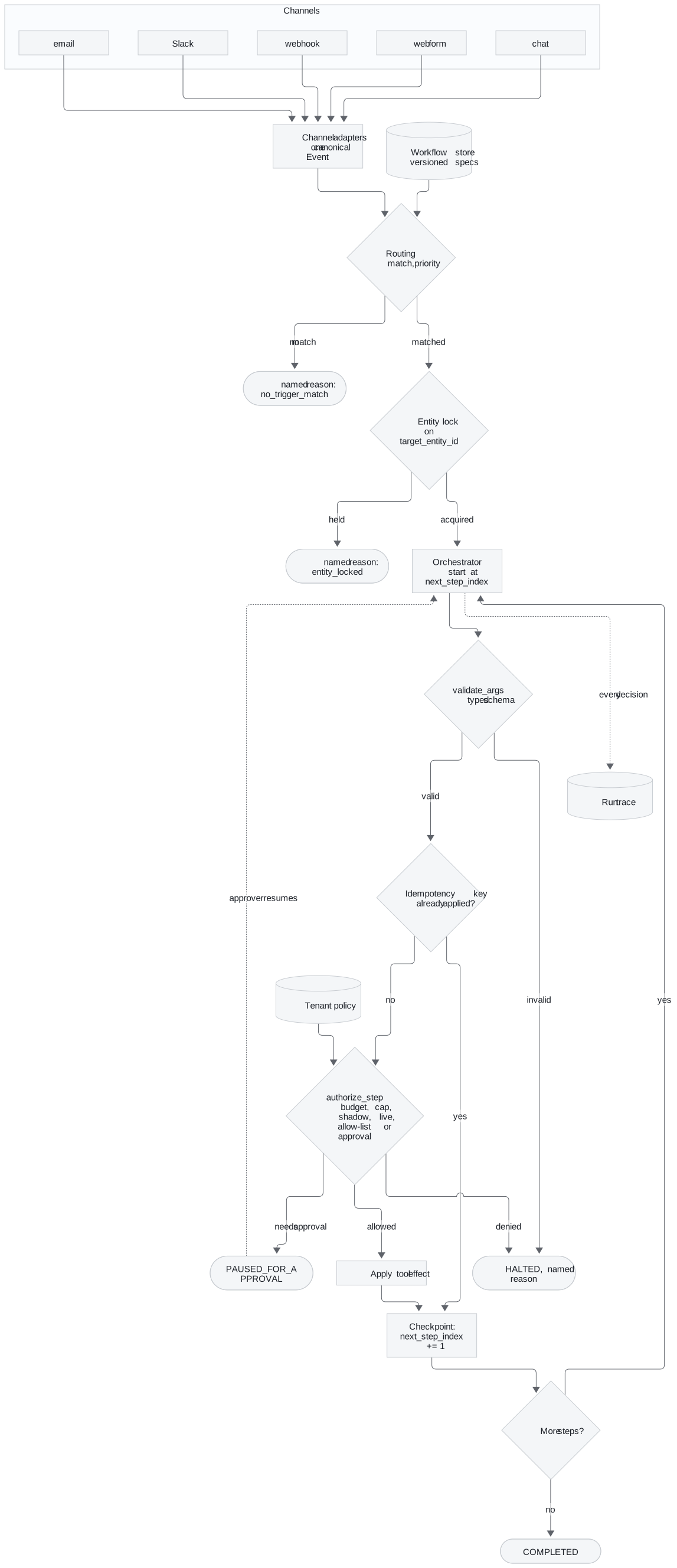
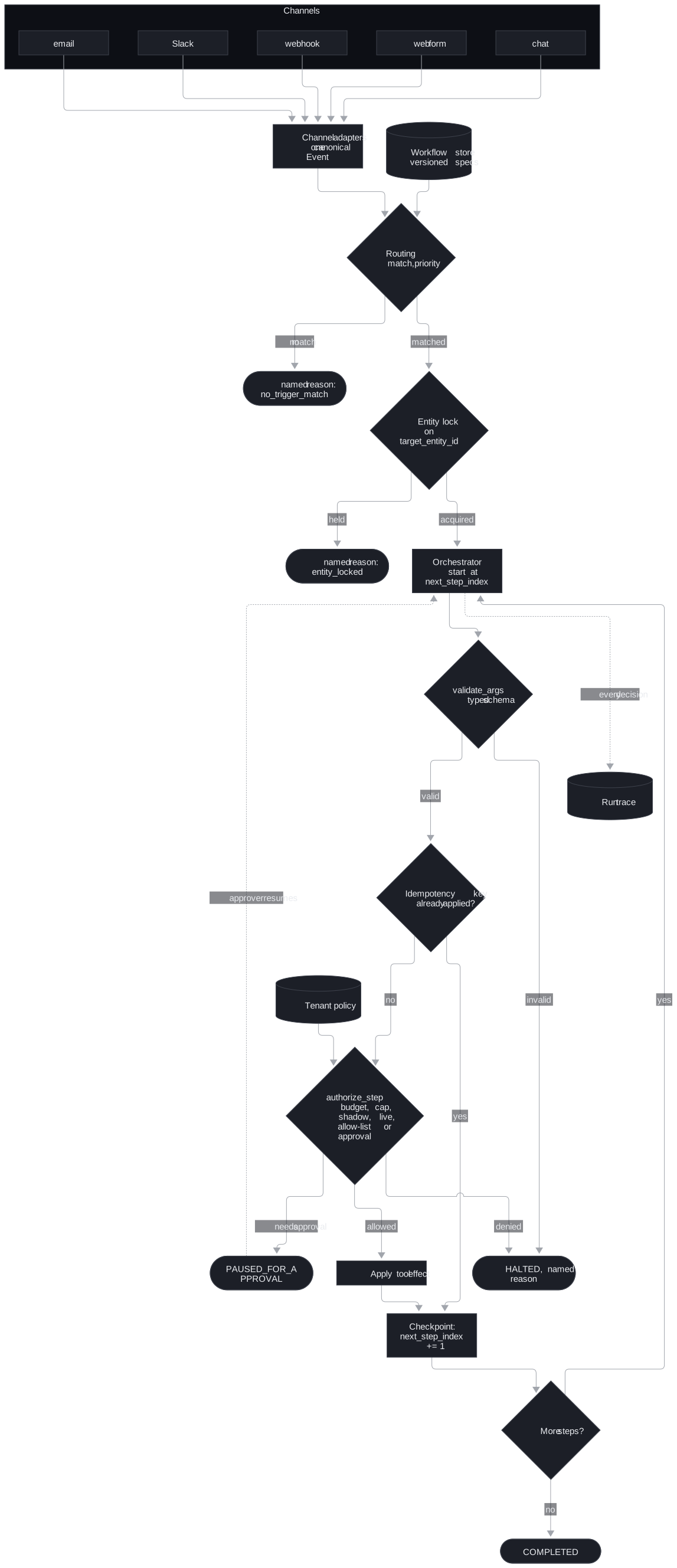
| Component | Job | What goes wrong without it (own construction) |
|---|---|---|
Channel adapters (from_webhook, from_slack, from_email) |
Translate each payload once into Event |
Every downstream component learns every channel, forever |
Canonical Event |
channel, event_type, tenant_id, target_entity_id, payload, raw_ref |
No tenant scope, no lock key, no audit pointer |
Routing (matching_workflows, route) |
Highest-priority live workflow, or a named non-selection | Two workflows both claim the event, or a silent no-op |
Entity lock (acquire_lock, release_lock) |
One active run per target entity | A priority misconfiguration becomes a concurrent-mutation bug |
Workflow store (WorkflowStore) |
Every version kept; a run pins to its version | Editing a workflow changes runs already in flight |
Tool registry (REGISTRY, validate_args) |
Typed schema, required fields, destructive flag, scopes |
A hallucinated or wrong-typed argument reaches a real system |
Orchestrator (run_workflow, resume, _continue) |
Walks the step list, checkpoints after each step | A crash re-runs completed steps |
Idempotency store (_apply_side_effect) |
First apply of a key wins; repeats are no-ops | A redelivered event refunds twice |
Guardrail engine (authorize_step) |
Five ordered deny rules, two allows | A destructive step runs without authority |
Tenant policy (GuardrailPolicy) |
Spend cap, max steps, autonomous allow-list | One tenant's risk appetite applies to another |
Promotion (promote) |
One stage at a time, approver or admin only | An author ships their own workflow straight to live |
Run trace (observability.py) |
Every decision with rule and reason | Nobody can say why a refund did or did not fire |
Full Design 2 · 8 min — The complete, referenced write-up behind the other tabs. The sources for every tab live here.
5. Translate Every Channel Once, at the Edge
Normalise at the first layer and nowhere else. If channel-specific logic leaks past the adapter, every later component must know every channel forever.
The canonical Event has six fields, and five carry the design. channel and event_type are what triggers match on. tenant_id scopes everything downstream. target_entity_id is what the entity lock keys on. raw_ref means normalisation is not destruction: the original is always recoverable for audit. Downstream of the three adapters, nothing knows which channel an event came from except by reading event.channel. Adding a sixth channel is one new adapter and zero changes anywhere else.
The Slack adapter shows why adapters are more than field mapping. It classifies urgent_message against plain message from the raw flag. That is how Cascade Robotics' wf_slack_escalation workflow triggers only on urgent messages.
6. Route Twice: Priority for Configuration, a Lock for Safety
Routing asks two independent questions, so it runs two independent checks. Priority answers a configuration question: which workflow is supposed to win. The entity lock answers a safety question: can two workflows ever mutate the same ticket at once.
Routing runs in three steps. First, match: return every workflow whose tenant, status and trigger fit, where a Trigger is (channel, event_type, priority). A DRAFT workflow never matches a real event, and that single rule is what makes authoring safe. Second, prioritise: the highest priority wins. Third, lock: acquire_lock(target_entity_id, run_id) refuses if another run is active on the same entity. route() returns the selected workflow or a named reason, no_trigger_match or entity_locked. It never returns a silent no-op.
Cascade Robotics' fixture builds the conflict on purpose. wf_ticket_triage at priority 10 and wf_legacy_ticket_tagger at priority 1 share the trigger webhook / ticket.created. The triage workflow wins.
"Priority answers which workflow SHOULD run. A lock answers whether two ever CAN run at once — two different questions, two different checks."
Build only priority, and a configuration mistake becomes a concurrent-mutation bug. Build only the lock, and there is no way to say which workflow should win. The lock holds even when two workflows are accidentally given the same priority.
7. Keep Control Flow in Data, and Let the Model Fill Only Typed Values
The signal the prompt tests is whether deterministic control flow is split from probabilistic reasoning. The model may decide that a refund is warranted. It never decides the shape of the call that moves money.
  Bad:   tool_call("issue a refund of about fifty dollars for this order")
  Good:  issue_refund(order_id: str, amount_usd: float)   <- typed, validated BEFORE execution
A WorkflowSpec is a declarative document: workflow_id, version, status, triggers, steps, max_steps, max_cost_usd. Each Step names a tool and an args_template, such as {"amount_usd": "{payload.refund_amount}"}, resolved from the event at execution. The orchestrator does not execute the spec as code; it walks it. Nobody, human or model, changes the list at runtime.
That is exactly the artefact a non-technical user can review. "Refund anyone under $50" becomes a form showing the trigger, the amount < $50 condition and the issue_refund action. The user confirms it before anything runs. The user approves a form instead of trusting a black box.
Five determinism controls are all built and tested.
| Control | What it prevents | Where |
|---|---|---|
| Constrained tool schemas over free-text arguments | A hallucinated or wrong-typed argument reaching a real system | validate_args(), before execution |
| Idempotency keys on side-effecting calls | A retried step applying its side effect twice | Orchestrator (section 9) |
| Max-step and max-cost budgets, halt and escalate | A runaway run | authorize_step(), tighter of workflow and tenant (section 10) |
| Confirmation gates on destructive actions, per tenant and tool | An irreversible action without authority | Guardrail approval plus per-tenant allow-list (section 10) |
| Deterministic control flow split from probabilistic reasoning | The model improvising what happens next | The fixed, declarative step list |
The registry holds four tools: draft_reply, issue_refund, close_ticket, tag_ticket. Two are destructive and two are not. destructive is declared once at registration, so the guardrail asks "is this one of the tagged ones?" and never "does this call look risky?" A guardrail cannot reason about risk it is not told about explicitly. scopes lists what the tool may touch, which is the start of least privilege for connector credentials.
The non-technical half of the problem has five constraints, and the sources are honest about which exist.
| Constraint | In plain language | Built? |
|---|---|---|
| Templates, not a blank canvas | Clone "Auto-refund small orders" and change the numbers | ❌ clone() over pre-built specs is the low-effort fix |
| Plain English compiles to a reviewable spec | The sentence becomes a form you confirm | 🟡 The spec is the form; the compiler is not built |
| A test mode where nothing happens | Shadow mode fakes every write | ✅ SHADOW blocks every destructive step unconditionally, even for an admin |
| Run history in human words | "Refunded 12, escalated 2, denied 1 for exceeding the cap" | ❌ The trace is structured; a sentence per step is low effort |
| Staged rollout, like a driving test with levels | One stage at a time, and the author cannot grade their own test | ✅ promote() |
Versioning follows from the same idea. WorkflowStore keeps every published version, and a Run pins to the version it started on. Editing a workflow mid-flight never changes runs already in progress.
8. Checkpoint Every Step and Run One Loop for Resume
A recovery path that is different code from the normal path gets tested only during incidents. So there is no recovery path. There is one loop that always starts wherever next_step_index says.
  Run 1: step 0 (draft) -> CHECKPOINT -> step 1 (refund, needs approval) -> PAUSED

  [process restarts / human takes an hour to approve]

  resume(): reads next_step_index=1, re-enters at step 1 - step 0 NEVER re-runs.
  Approval granted -> step 1 executes -> idempotency_key = "run_id:refund" recorded.

  If step 1 is somehow attempted again (a redelivered event, a retry):
  same idempotency_key already exists -> no-op. The refund never fires twice.
The checkpoint is not a separate mechanism; it is one integer on the Run. resume() and a fresh run_workflow() call the same _continue() loop, so the recovery path is exercised on every run. The demo proves it by actually crashing. run_workflow(..., crash_after_step=0) sets the state to CRASHED after the checkpoint is saved, and resume() continues from step 1. The external call count shows step 0 never ran again.
A run ends in exactly one of COMPLETED, PAUSED_FOR_APPROVAL or HALTED_BUDGET, plus CRASHED as a transient state that resume() clears. There is no fourth "it just stopped and nobody knows" path.
The verified happy path, from scripts/run_workflow_demo.py: run_001 on wf_ticket_triage v1. Step 0, the draft, is applied at 0.02 USD. Step 1, the refund, is denied without approval and the run pauses. An approver resumes it, the refund applies, and the run completes.
"There's no separate crash-recovery code path.
resume()and a fresh run call the exact same loop — it always starts atnext_step_index, whether that's 0 or the middle of a long-running workflow. One loop, one set of bugs to find, not two."
9. Key Idempotency on the Action, and Cover Every Side Effect
A run legitimately retries after a transient failure, so a run-level "already started" flag cannot stop one step from firing twice. The key goes on the action: idempotency_key = f"{run_id}:{step_name}". _apply_side_effect() returns True only the first time a key is seen. Reruns of the loop are fine; reruns of an already-applied side effect are not. The verified result: before retry, 1 apply; after retry, still 1 apply.
Two real bugs from building the project are the strongest material in the round. Tell them as stories.
Bug 1: the spend cap checked the wrong number. A $500 refund on a workflow with a $5 spend cap passed authorisation. The cost function charged a flat, nominal fee per tool call, which is fine for drafting a reply. The refund used the same fee, so the cap was checking against $0.00 every time. It conflated the operational cost of running a step with the dollars that step spends on the customer's behalf. The fix: a financial tool's cost is the real amount in its own arguments, args["amount_usd"].
Bug 2: idempotency covered the side effect but not its cost. After the first fix, an approved run whose refund step was retried started failing with spend_cap_exceeded. Nothing extra had happened in the real world. The idempotency guard correctly skipped the second refund, but the retry still went through authorize_step() and its cost was added to the run total again. The fix moves the idempotency check before authorisation. A replay of an applied key is a free, pre-authorised no-op that never touches the budget or the approval logic.
"Idempotency has to cover every side effect of a step, not just its most obvious one." Cost accounting is a side effect too.
The anchor links bug 1 to a false-security-alarm bug in the RAG (retrieval-augmented generation) project. Both are safety checks that look like they measure something while quietly measuring the wrong quantity. Note one detail when quoting: the story uses a $5 cap, while the Cascade Robotics tenant policy uses $50. Both figures are the sources'; they are different scenarios.
Full Design 3 · 8 min — The complete, referenced write-up behind the other tabs. The sources for every tab live here.
10. Deny in a Fixed Order, and Let Deny Override
Every step of every run goes through one decision. authorize_step() returns Decision(allowed, rule, reason), and deny overrides allow.
| # | Rule | Denies when |
|---|---|---|
| 1 | step_budget_exceeded |
The run has used its step allowance, the tighter of the workflow's max_steps and the tenant's |
| 2 | spend_cap_exceeded |
This step's real cost, the actual refund amount for a financial tool, would exceed the cap, again the tighter of workflow and tenant |
| 3 | shadow_mode |
The workflow is in SHADOW; destructive steps never execute here, regardless of role or approval |
| 4 | not_live |
The workflow has not been promoted to LIVE |
| 5 | needs_human_approval |
Destructive, not allow-listed for autonomous use on this tenant, and no approver present |
| — | autonomous_allowlisted / human_approved |
The two ways a destructive step is actually allowed to run |
Non-destructive steps pass after the two budget checks. Destructive steps must clear all five rules and then match one of the two allows. The whiteboard script draws the same logic as a seven-line ladder, with "non-destructive? just run it" as its third rung. The handbook's five-rule table is the cleaner version to draw.
The step budget and the spend cap count different things; they are not two severities of one check. The step budget counts how many steps a run has taken, so it catches a loop no matter how cheap each step is. The spend cap counts the dollars one step is about to spend, so it catches one expensive action on step one. Both halt and escalate. Neither retries, and neither clamps the amount down to fit.
"Autonomous status raises the ceiling on which actions can skip approval. It never removes the ceiling itself."
The tenant policy is GuardrailPolicy(spend_cap_usd, max_steps, allowed_destructive_tools_autonomous). A workflow can be tighter than its tenant's policy but never looser. The allow-list belongs to the tenant alone.
Build the negative control for anything claimed safe. scripts/demo_guardrail_failure.py shows seven denials. wrong_role: the author cannot promote their own workflow. cannot_skip_stage: draft cannot jump to autonomous. type_mismatch or missing arguments: rejected before execution. not_live: a draft workflow never fires a destructive step. spend_cap_exceeded: a 500 USD refund against a 50 USD cap is refused, not clamped. step_budget_exceeded: a 30-step workflow halts at the 5-step cap. entity_locked: a second run on an in-flight ticket is refused. A demo that shows things being stopped proves more than one that shows things working.
11. Make Autonomy Something a Workflow Earns Through Four Gates
A workflow moves DRAFT → TESTING → SHADOW → LIVE → AUTONOMOUS, one stage at a time. Only an approver or admin may promote it, never its author. Each stage removes exactly one kind of "we don't actually know yet".
| Stage | The one question it answers | What breaks if skipped |
|---|---|---|
DRAFT |
Is this even wired correctly? | The first idea is tested against real customer messages |
TESTING |
Does it behave correctly on realistic input, run against sample or historical data? | It is found wrong only once it is watching live traffic |
SHADOW |
Does it decide correctly on live traffic, with every write mocked? | Bad decisions surface only after a real refund |
LIVE |
Will a human still vouch for each individual action? | Straight from "looked fine in shadow" to acting alone |
AUTONOMOUS |
Has it earned the right to act without asking every time? | The destination, not a gate; the same guardrails still apply |
Fewer gates lose a distinct answer. Merge TESTING into SHADOW and cheap, repeatable replay disappears. Merge SHADOW into LIVE and debugging moves into production. More gates add stages someone must remember to promote through. The guardrail policy already scales risk within a stage.
promote(store, workflow_id, to_status, signer) denies two things. wrong_role stops an author promoting their own work; only an approver or admin can promote at all. cannot_skip_stage stops a jump from DRAFT to LIVE. The identity fixture includes u_author_wrong_hat, a negative control proving an author cannot approve their own work however the request is framed.
The same mechanism answers the two follow-ups the round always gets. How does a user try a workflow before it is live? Shadow mode. How is a bad one stopped mid-flight? The step and spend budget halts it, and the entity lock stops a second run compounding the damage.
12. Name the Gaps Before the Interviewer Does
The source project contains no LLM (large language model) at all, on purpose, so every property can be proven with fast, reproducible tests. State that plainly, and never imply the demo proves an LLM planner is safe.
| Gap | Status | What to say |
|---|---|---|
| Planner | 🟡 Fixed step list | Swapping in an LLM or rule engine that picks the next tool is a moderate change. The architecture stays: a reasoning loop with deterministic guardrails around it |
| Authoring surface | 🟡 / ❌ | The spec is what a builder would serialise to. NL-to-spec needs a real LLM call, and its output enters at DRAFT behind the same promote() gate |
| Automatic retries | ❌ | resume() is correct, but nothing calls it automatically. A retry wrapper with backoff is low effort because idempotent resumption is done |
| Connector secrets | ❌ | A Connector model referencing a vault secret is moderate work; the vault itself is infrastructure |
| PII redaction | ❌ | Low effort. The RAG project's redact_pii() is reusable on step outputs before a human sees them for approval |
| Custom tools | 🟡 | Schema validation and scoping exist. Sandboxed execution and review-before-publish reuse promote()'s role-gated pattern |
| Gradual version migration | ❌ | A traffic_split on the spec, consulted by routing |
The scale answer is one sentence of mechanism and one of storage:
"Every lock and idempotency key in this demo lives in an in-process dict - correct in shape, wrong in storage. At real volume that becomes a distributed lock (a unique-constraint row in a database, or a Redis lease checked with a fencing token) and a durable idempotency store shared across workers. The mechanism doesn't change -
acquire_lock/release_lockstay the same two functions - only where they're backed changes."
The failure table tells the interviewer what a workflow does, not what breaks.
| Fails | Behaviour |
|---|---|
| A step's arguments don't validate | Rejected before execution; run halts with a named reason |
| A destructive step needs approval that never comes | Run stays PAUSED_FOR_APPROVAL indefinitely; it does not silently expire into either action |
| A workflow runs away (misconfigured self-trigger) | Halts at the step budget |
| The process crashes mid-run | Resumes from the last checkpoint; the completed step never re-runs |
| An event is redelivered (at-least-once channel semantics) | The idempotency key makes the redelivery a no-op |
13. Walk Through the Cascade Robotics Example
Cascade Robotics is a worked, runnable build of this design. Nothing in it contradicts the answer above, and it adds four things.
First, the three-layer map that organises the whole answer:
 LAYER 3   "Is this user allowed to configure/run this, and did we ask a human when we should have?"
              -> guardrails: approvals, spend caps, staged rollout (draft/test/shadow/live)

 LAYER 2   "If this runs twice by accident (retry, crash, redelivery), does it break something?"
              -> idempotency keys, checkpointed/resumable execution

 LAYER 1   "No matter which channel this came from, does it look the same to everything downstream?"
              -> a canonical event schema + one adapter per channel
A weak answer spends its time on Layer 1 and waves at an LLM doing reasoning. A strong answer spends most of it on Layers 2 and 3, because that is where real incidents happen: double refunds, a skipped human check, a re-run completed step.
Second, the example data. The tenant is cascade_robotics, with three workflows. wf_ticket_triage runs at priority 10 on webhook / ticket.created. wf_legacy_ticket_tagger runs at priority 1 on the same trigger, to demonstrate the conflict. wf_slack_escalation runs at priority 10 on slack / urgent_message.
Third, the cross-project shape. The RAG platform, this agent platform and the delivery framework all return Decision(allowed, rule, reason) from a named policy where deny overrides. The three functions are authorize_step() here, sign_off() in the delivery framework and decide() in enterprise RAG. Access control, delivery gates and workflow guardrails are the same kind of problem wearing three different hats. That line works well as a bridge when the interviewer has seen the G01 or G12 design.
Fourth, the coverage discipline: every claim is marked built and runnable or known but not demonstrated, with an effort label to close it. The punch list, by effort:
- Low: template library with
clone(), a retry wrapper aroundresume(), PII redaction on step outputs, a plain-language run summary. - Moderate: a
Connectormodel with a vault abstraction, a real planner, sandboxed custom-tool review, canary migration between versions. - Large: a visual builder, and a real secrets manager with a distributed lock store.
The one-breath restatement is worth memorising:
"We're building the safety and orchestration layer that sits between a non-technical user's plain-English intent and a real, destructive action — so that no matter which channel the trigger came from, the action only runs when it's actually supposed to, runs exactly once, and survives crashes and retries without ever surprising anyone."
Full Design 4 · 11 min — The complete, referenced write-up behind the other tabs. The sources for every tab live here.
14. Deliver It in Sixty Minutes
Announce where the risk is, then spend the hour there. The channel adapters are comparatively boring.
"The hardest part of this system is making the dangerous decisions deterministic instead of delegated to the model. I want to spend my time on the guardrail engine and the orchestrator."
| Minutes | Phase |
|---|---|
| 0–8 | Clarify and scope: five questions, the framing sentence, Cascade Robotics (sections 1, 2) |
| 8–12 | Entities and the happy path, narrated before drawing (section 4) |
| 12–20 | The architecture, with the two routing decisions labelled (sections 4, 6) |
| 20–40 | Deep dive: determinism, the guardrail, the two bugs, durability (sections 7 to 10) |
| 40–55 | Cross-cutting and failure: tenancy, security, observability, failure table, scale (sections 11, 12) |
| 55–60 | Close: three sentences, trade-offs, week one |
The three-sentence close:
"A multi-channel platform where every dangerous decision - which workflow runs, whether a destructive step executes, whether a retry can double-apply a side effect - is deterministic and enforced in code, never delegated to the model in the moment. Workflows are declarative and versioned, promoted through a staged rollout the same way a person earns more autonomy over time. Durability and idempotency mean a crash or a redelivered event is a non-event, not an incident."
| Decision | Chose | Would revisit if |
|---|---|---|
| A fixed step-list planner over an LLM reasoning loop | Deterministic, testable, free | The task space is open-ended enough that a fixed plan cannot cover it; then a model picks the next tool inside the same guardrail |
| Priority plus entity lock over one ranking mechanism | Two independent checks | Conflicts became rare enough that the lock is not worth it — unlikely, since the lock makes a misconfigured priority merely wrong instead of dangerous |
| In-process locks and idempotency store | Simple, fast for a demo | Any real deployment on day one |
The forward-deployed close, which must not be skipped:
"If I were shipping this, week one isn't the full agent runtime. It's: one channel, one non-destructive workflow, the guardrail engine, and the staged rollout - prove that a non-technical user's workflow genuinely can't take an unapproved destructive action, before anyone argues about which LLM plans the steps."
The lines that carry the round:
- "The model decides THAT something should happen. A typed, validated function signature decides HOW - that boundary is where determinism lives."
- "Autonomous status raises the ceiling on what can skip approval. It never removes the ceiling."
- "One execution loop, not two - resume and a fresh run share the exact same code path."
- "An idempotency key is on the action, not the run - because a run can legitimately retry, but one specific side effect must never apply twice."
- "Priority answers which workflow SHOULD run. A lock answers whether two ever CAN run at once."
- "A halted run with a named reason beats a workflow that loops until someone notices."
Questions to ask them: how much of their agent configuration is already declarative versus code? Does the guardrail decision live in the platform or in each connector? What is the story for a workflow that acts across two channels in one run? How does a workflow earn autonomous status?
With a laptop, run python scripts/run_workflow_demo.py, then python scripts/demo_guardrail_failure.py, then pytest -q for 21 deterministic tests. The durability demo is the most persuasive artefact. A run crashes mid-flight and resumes, and the completed step provably never re-runs.
15. Stop Runaway Automations Before the Invoice Does
The interviewer's cost pivot is "users built automations and the bill exploded." Non-technical users will build loops. The platform bounds them, because the users cannot.
| Dominant driver | Retries and loops in user-authored automations, with no budget owner per tenant |
| Cheapest lever first | Per-automation step and token caps; per-tenant budgets with a circuit breaker; idempotency keys on every action; deterministic events instead of free-text triggers |
| Metric that proves it | Cost per automation run; steps per run; runaway kills per day; cost per tenant |
| Do not | Trust users to write bounded workflows |
| 60-second line | Non-technical users will build loops. The platform bounds them: caps per run, a budget per tenant, idempotent actions, and a breaker that trips before the invoice does. |
Most of the levers are already in the design, which is the point to make aloud (own construction). The step budget is the per-run cap, and max_steps is the tighter of workflow and tenant. The spend cap already meters real dollars before the action, not after. The idempotency key already stops a redelivered event paying twice for the same work. The per-tenant breaker and token metering are the additions. Meter model tokens per run into total_cost_usd alongside tool cost, and trip the tenant's breaker when the day's spend crosses its budget.
Bug 2 belongs in this answer too. Cost accounting is a side effect, so a replayed step must not be billed twice.
Every strong cost answer is generated by four verbs in order. Measure cost per run and per tenant first. Route deterministic events to deterministic handling, and use a model only where judgement is needed. Bound runs with step caps, spend caps and the breaker. Cache safely, never across tenants.
Level calibration
Anyone can wire a model to a tool; the level shows in how much of the dangerous decision is code, and how far its owner looks past one tenant.
| Level | Sounds like | Missing |
|---|---|---|
| Senior | Canonical events per channel, priority plus an entity lock, a versioned spec walked by one checkpointed loop, typed arguments and an idempotency key on the action. Refuses the $500 refund under a $50 cap rather than clamping it. | Who may promote a workflow, how a non-technical author reviews what will run, and what stops a tenant's runaway bill. |
| Staff | Adds separation of duties and the author's view: promotion one stage at a time by someone other than the author, shadow mode to try a workflow, plain-language run history, and per-tenant budgets with a breaker. Tells both real bugs, including idempotency that must cover cost accounting. | How the same decision shape serves other products, and what changes when a real planner or a natural-language compiler joins. |
| Principal | Names Decision(allowed, rule, reason) with deny overriding as the one policy shape across access control, delivery gates and workflow guardrails. Sequences the path: one channel and one non-destructive workflow first, any future planner or compiler landing in DRAFT behind the same promote() gate, and in-process stores moving to a distributed lock and a shared idempotency store. |
Which destructive tools each tenant will allow-list and how much autonomy it will grant, which depends on that customer's risk appetite. |
Key Takeaways
- The hard part is trust, not tool selection, and the framing sentence goes on the board in the first two minutes.
- One $500 refund against a $50 cap, on an autonomous workflow without an allow-list entry, anchors every later claim.
- Requirements are stated as testable guarantees, and each has a named owner in the architecture.
- One diagram shows adapters, two-check routing, a checkpointed orchestrator and a guardrail on every step, with three named exits.
- Every channel is translated once at the edge into a six-field canonical event.
- Priority answers which workflow should run, and the entity lock answers whether two can run at once.
- The workflow is declarative data the orchestrator walks, and the model fills only typed, validated values.
- The checkpoint is
next_step_index, and resume and a fresh run share one loop. - The idempotency key is on the action, and the replay check runs before authorisation because cost is a side effect too.
- Five ordered deny rules decide every step, and autonomy raises the ceiling without removing it.
- Four rollout gates each answer one question, and only someone other than the author may promote.
- The no-LLM choice and the in-process stores are named gaps with sized fixes, not hidden ones.
- Cascade Robotics is the anchor in prose, adding the three-layer map, the fixture and the shared decision shape.
- The hour goes to determinism, the guardrail and durability, and the close is a week-one plan.
- The cost pivot is answered with caps per run, budgets per tenant, idempotent actions and a breaker.
Check Yourself
- Why is "the hard part is trust" a stronger framing than "the hard part is tool selection"? Tool calling is a standard API feature; the tested question is how a non-programmer can trust an automation to do only what they meant under model error, retries and crashes.
- Why did Cascade Robotics' $500 refund not fire on an autonomous workflow?
issue_refundwas not on the tenant's autonomous allow-list, and $500 exceeded the $50 spend cap. It was refused, not clamped. - Why does routing need both priority and an entity lock? Priority is configuration, choosing which workflow should win. The lock is safety, stopping two runs mutating one entity, and it holds even when priority is misconfigured.
- What does the model decide, and what does it never decide? It may decide that an action is warranted and which value fills an argument. It never decides the call's shape or the control flow, which are a typed schema and a fixed step list.
- Why must
resume()andrun_workflow()share one loop? A separate recovery path is second code whose bugs surface only in incidents; one loop starting atnext_step_indexis exercised on every run. - Why is the idempotency key on the action rather than the run? A run legitimately retries; keying
{run_id}:{step_name}deduplicates the specific side effect while letting the loop rerun. - Explain bug 2 in one sentence. A replayed refund skipped the side effect but was still charged against the spend cap, so the idempotency check moved before authorisation because cost accounting is a side effect too.
- Give an example that trips the step budget but not the spend cap, and one that does the reverse. A 30-step chain of cheap steps halts at a 5-step cap; a single $500 refund trips a $50 cap on step one.
- What question does each rollout gate answer? DRAFT: wired correctly? TESTING: correct on realistic data? SHADOW: correct decisions on live traffic, writes mocked? LIVE: will a human vouch for each action? Then AUTONOMOUS.
- What is the scale gap, and why does it not change the design? Locks and idempotency keys live in in-process dicts; they move to a distributed lock and a durable shared store behind the same functions.
- How do non-technical users run up a bill, and what stops it? They build loops and retries; per-run step and token caps, per-tenant budgets with a breaker, and idempotent actions bound it.
References
Fact-check sources (checked 27 Sep 2026)
- Redis docs: Distributed locks with Redis — Redis lock patterns and their limits
- Kleppmann: How to do distributed locking — a lease lock needs a fencing token to be safe
- Slack docs: Events API — failed event deliveries are retried, so redelivery is normal
- Stripe API reference: Idempotent requests — passing an idempotency key to a provider that supports it
- OpenAI: Function calling and other API updates — function calling shipped in the API in June 2023