Interview Guide 1 · 13 min — The complete case in one document — no companion tabs are needed.
An agent that adapts to new tasks without supervision needs the freedom to change its own behaviour, and every change it makes is a regression nobody reviewed.
"Autonomously adapt" does not mean "retrain itself". Most adaptation belongs in cheap, reversible places, such as context, memory and procedures. Each change passes the same evaluation gate a human change would. This page is the standalone day-before pack for this case.
| Case | What it contributes here |
|---|---|
| #80 Anthropic MLE: design an agentic AI system that can autonomously adapt to new tasks | Sections 1 to 14: the whole design on one running example |
| Cost self-drill | Section 15 |
Much of this page is own construction, but its backbone is sourced. No worked answer exists for this prompt. The prompt comes from the decomposition question bank, Tier 1 prompt 15. The spine comes from the Cracking book's learning chapter. Its four learning surfaces, skill promotion gate and data flywheel answer most of this prompt directly. The memory write policy comes from its memory chapter, and the release gate from its validation chapter. Sections and tables marked (own construction) were built for this page. Every number marked (assumption) is a whiteboard illustration, not a sourced figure.
The running example is the Cracking book's own: an internal operations agent. It handles requests such as "restart service X" and "roll back flag Y". New request types appear every week as teams ship new systems.
1. Pin Down What "Adapt" Means Before Drawing Anything
A system cannot be designed toward a verb nobody defined. "Adapt to new tasks" hides at least five different mechanisms. They differ by an order of magnitude in cost and by how easily a change can be undone.
The Cracking book names four places an agent's improvement can live: context, memory, procedure and parameters. Each is roughly ten times slower and costlier to iterate on than the one before. This page adds prompt optimisation as a separate rung between procedure and parameters (own construction). It changes behaviour broadly, like training, but stays reversible, like a prompt.
| Rung | What changes | Example in the ops agent | Iteration time | Undo |
|---|---|---|---|---|
| 1. Context | Which instructions, examples and skills are loaded for this request | Load the "feature flags" skill and three similar past runs | Minutes | Instantly |
| 2. Memory | Stored facts, preferences, corrections | "Service X restarts need a drain first" | Immediate | Supersede the fact |
| 3. Procedure | Validated tool sequences saved as named skills | A promoted "safe restart" workflow | Hours | Pin the previous version |
| 4. Prompt optimisation (own construction) | Instructions and examples searched against a scored dev set | A rewritten planner prompt that raises tool-choice accuracy | Hours to a day | Revert the prompt version |
| 5. Parameters | Model weights | A tuned small router for the top task types | Days to weeks | Redeploy the old model |
The book's rule is to work down this table, not up. In the book's view, most teams that reach for fine-tuning have not yet fixed their tool schemas, retrieval or example selection. Fine-tuning then bakes those defects into weights that take weeks to change.
Ask these questions before committing (own construction).
| Question | Why it changes the design |
|---|---|
| What counts as a "new task": a new request type, a new tool, or a new domain? | A new request type is a context problem; a new tool needs an onboarding path; a new domain needs knowledge and evaluation data |
| Is there an external signal of success, such as a test, a validator or a ticket closed without reopening? | Without one, the agent cannot learn safely, because it has nothing trustworthy to learn from |
| Which actions are reversible? | Reversible actions can be tried and learned from; irreversible ones need a human before and after |
| Who owns each capability? | An owner reviews promotions and is paged when a skill regresses |
| How fast must a new task become reliable: hours, days or a quarter? | Hours forces the cheap rungs; a quarter permits training |
| Is the adaptation per user, per tenant or global? | Per-tenant learning needs isolation in every store |
A safe default, stated aloud if the interviewer does not answer, is this. New request types arrive weekly. Most have a checkable outcome. Writes to production systems are partly reversible. Adaptation is global, but each skill has a team owner.
"Before I design anything I want 'adapt' pinned down. There are five places learning can live, from the context of one request up to the model's weights. Each rung costs roughly ten times more than the last and is harder to undo. I'll design from the cheap end and only climb when a measured gap forces it."
2. State Requirements as Testable Constraints
A requirement that cannot fail a test is a wish. "Gets better over time" is a wish. "Success on a new task type reaches the baseline within 14 days without a regression on any existing type" is a constraint (own construction throughout this section; thresholds are assumptions unless marked sourced).
The functional must-haves are six. Recognise when a request does not match any known capability. Attempt it safely with a general fallback, escalating when confidence is low. Record every run with its outcome, so learning has evidence. Turn repeated successes into candidate skills, memories or prompt changes. Evaluate each candidate before it affects real traffic. Remove learned behaviour automatically when it starts to fail.
The should-haves come later. Per-tenant specialisation. A tuned small model for high-volume task types. A dashboard that shows owners what the agent learned this week.
| Non-functional constraint | Stated so it can be tested |
|---|---|
| No regression | No existing task stratum drops more than 3 points after any promotion (the per-stratum floor is sourced from ch12's segment-collapse fix) |
| Promotion bar | Candidate beats baseline by 5 points offline, then survives at least 200 live shadow attempts (sourced: the book's reference gate values) |
| Demotion | A skill falling 4 points below baseline is removed automatically (sourced) |
| Time to competence | New task type reaches baseline success within 14 days of first sighting (assumption) |
| Safety | Zero promotions that widen tool permissions; every irreversible action approved by a person |
| Traceability | Every behaviour change has a version, a source trace set, an evaluation report and an owner |
| Latency | Runtime adaptation adds at most 150 ms at p95 before the first model call (assumption) |
| Cost | Learning-plane spend capped as a share of serving spend; cap breach blocks new candidates (assumption: 10%) |
Each must-have needs an owner in the architecture.
| Requirement | Primary component |
|---|---|
| Recognise the unknown | Capability router with a novelty score |
| Attempt safely | Bounded agent loop behind the tool gateway, with escalation |
| Record evidence | Trace and outcome store |
| Turn success into candidates | Learning plane: skill extractor, memory writer, prompt optimiser, dataset builder |
| Evaluate before traffic | Evaluation gate plus shadow runner |
| Remove failures | Live monitor with automatic demotion |
3. Size the Adaptation Before Choosing a Rung
Arithmetic decides which rungs are even affordable (own construction; every input is an assumption, arithmetic is exact).
| Quantity | Assumed value | Consequence |
|---|---|---|
| Requests per day | 20,000 across 40 known task types | Average 500 per type, heavily skewed |
| New task types per week | 3 | About 150 a year; the catalogue must evict as well as grow |
| Traffic for a new type | 30 requests a day | 200 shadow attempts take about 7 days at full shadow |
| Cost per agent run | $0.03 | Serving is about $600 a day |
| Offline eval suite per candidate | 640 cases, paired with baseline | 1,280 runs = $38.40 per candidate |
| Candidates generated per week | 50 | $1,920 a week, about 46% of the $4,200 weekly serving bill |
Two lessons fall out of the table. First, rare task types cannot be promoted quickly. At 30 requests a day, the shadow minimum alone takes a week, and that sets the honest time to competence. Second, candidate volume drives learning cost, not training. Fifty candidates a week breaks a 10% learning budget almost five times over. So the extractor must deduplicate and pre-filter before anything reaches the paid evaluation.
The sample-size arithmetic sets what the gate can even detect. The validation chapter gives it as n ≈ 15.7 × p(1−p) / δ² per arm. At a baseline of 0.8, 200 cases detect only differences of about 11 points. A 5-point gain needs about 1,000 cases per arm. So the 200-attempt shadow proves "not much worse", not "5 points better". Say that aloud; it is a rare and strong signal.
4. Draw the Architecture as Two Loops With One Gate
The runtime loop serves requests. The learning loop proposes changes. They meet at exactly one place, the evaluation gate. Nothing learned reaches live traffic without passing it (own construction for every diagram in this section).
 ╔══════════════════════ CONTROL PLANE (every change is a version) ═════════════════════╗
 ║ capability registry: skills, memories, prompts, models — each with owner, version,     ║
 ║ status (candidate / shadow / live / demoted) · permission policy · budgets · kill switch ║
 ╚═════════════════════════════════════════╤══════════════════════════════════════════════╝
                                           │ reads only LIVE versions
 ╔════════════════════════════ RUNTIME LOOP ══════════════════════════════════════════════╗
 ║  request ─> capability router ──known──> load skill + examples + memories ─┐           ║
 ║                   │ (novelty score)                                        v           ║
 ║                   └──novel──> general fallback + tighter bounds ─> context assembler   ║
 ║                                                                            │           ║
 ║                        bounded agent loop (steps, tokens, time, spend caps)            ║
 ║                                   │                                                    ║
 ║                        tool gateway (authorise · validate · execute · classify)        ║
 ║                                   │                     └─ irreversible? ─> human      ║
 ║                        outcome signal: validator · test · ticket state · user feedback ║
 ║                                   │                                                    ║
 ║                        trace + outcome store ───────────────────────────────┐          ║
 ╚═════════════════════════════════════════════════════════════════════════════│══════════╝
 ╔════════════════════════════ LEARNING LOOP (offline, budgeted) ═══════════════v══════════╗
 ║  flywheel gates: dedupe ─> split by time and user ─> adjudicate low-agreement cases      ║
 ║        │                                                                                ║
 ║        ├─> skill extractor (generalise successful trajectories)                         ║
 ║        ├─> memory writer (durable? reusable? attributable? permitted?)                  ║
 ║        ├─> prompt optimiser (search instructions and examples on a dev set)             ║
 ║        └─> dataset builder (only when rungs 1–4 are exhausted)                          ║
 ║                                   │ candidates                                          ║
 ║  EVAL GATE: held-out, paired, per stratum · safety absolute · cost visible              ║
 ║        ├─ fail ─> discard, log reason                                                   ║
 ║        └─ pass ─> shadow on live traffic (≥200 attempts) ─> owner review ─> LIVE        ║
 ║  LIVE MONITOR: success per stratum ─> 4 points below baseline ─> auto-demote            ║
 ╚══════════════════════════════════════════════════════════════════════════════════════════╝
The same design for viewers that render Mermaid:
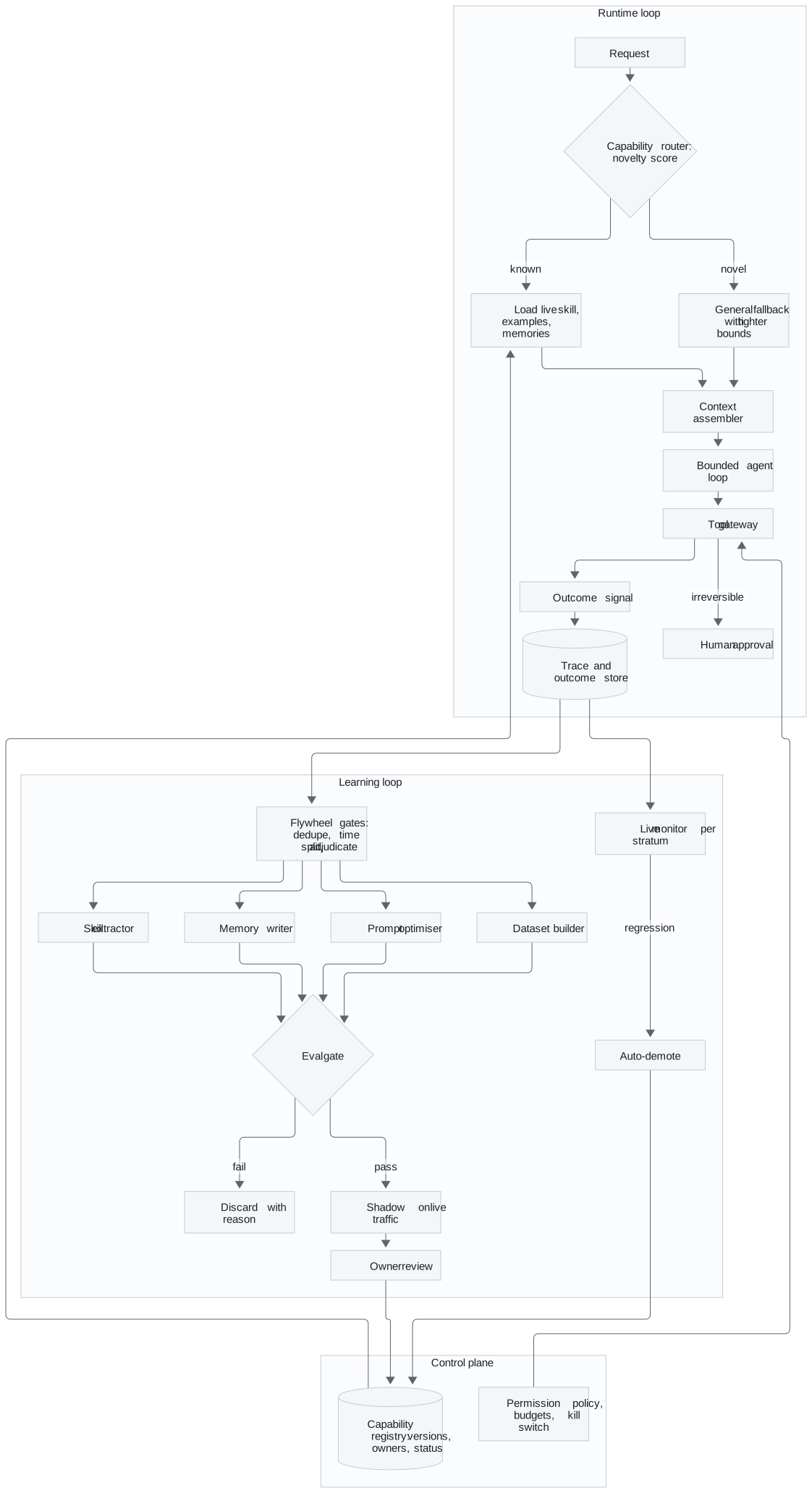
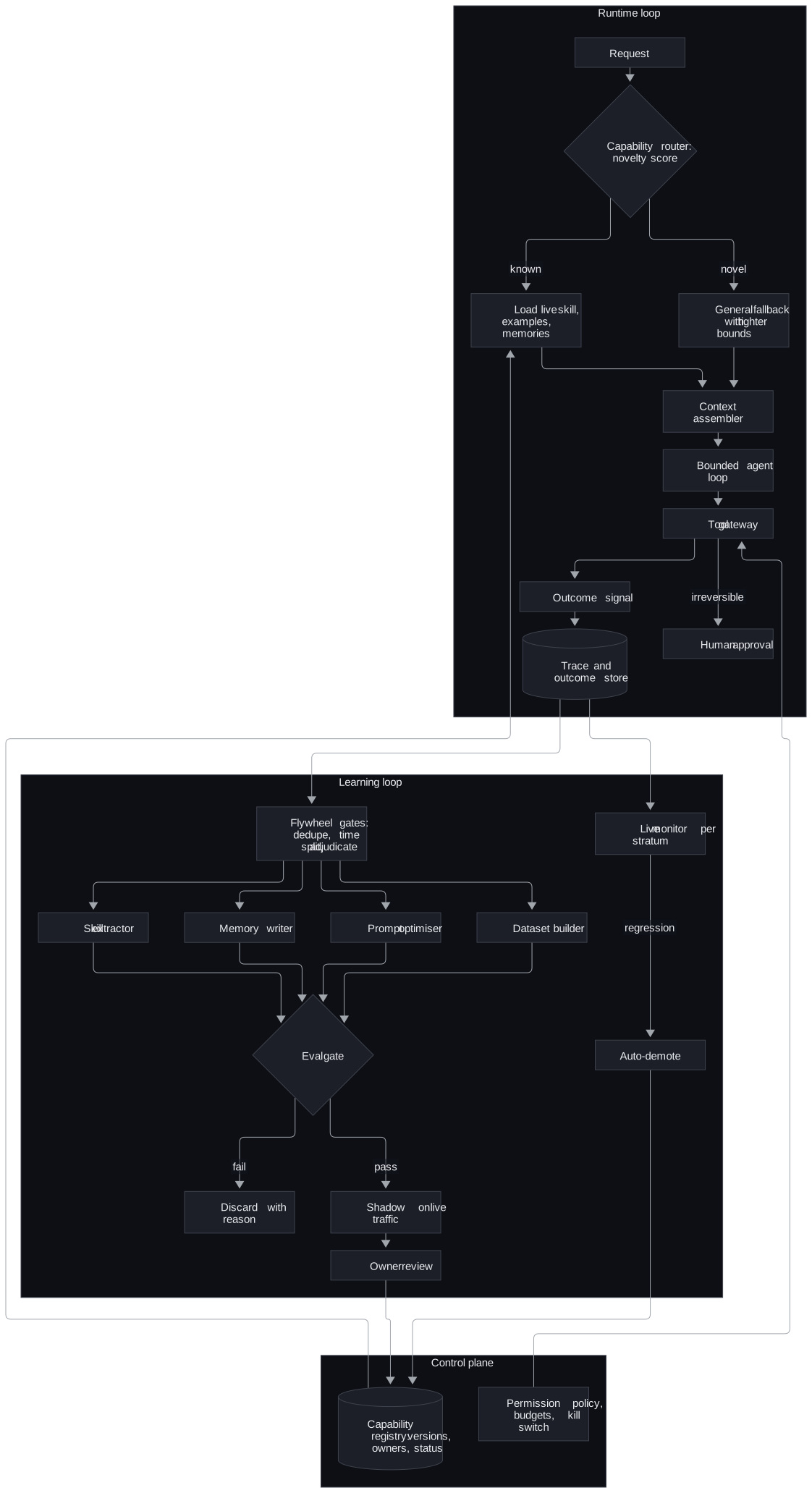
| Component | Job | Fails how |
|---|---|---|
| Capability registry | Holds every learned artefact with version, owner, status and evidence | Without it, nobody can say what the agent learned or undo it |
| Capability router | Matches a request to live skills; scores novelty | Misroutes silently; a novel request forced into a wrong skill |
| General fallback | Attempts unknown tasks with tighter bounds and earlier escalation | Given the same bounds as known tasks, it explores dangerously |
| Context assembler | Loads skill instructions, examples and memories under per-section budgets | Loads everything; context rots and costs climb |
| Bounded agent loop | Plans and acts within step, token, time and spend caps | Loops forever on a task it cannot do |
| Tool gateway | Authorises, validates and executes every action; routes irreversible ones to a person | Learned procedures call tools the agent was never allowed to call |
| Outcome signal | Provides an external verdict: test, validator, ticket state | Self-graded success teaches confident errors |
| Trace and outcome store | Records trajectory, versions used and outcome for every run | Learning has nothing trustworthy to learn from |
| Flywheel gates | Dedupe, split by time and user, adjudicate | Duplicates inflate every offline number |
| Skill extractor | Generalises successful trajectories into parameterised skills | Library fills with skills that worked once |
| Memory writer | Admits only durable, reusable, attributable, permitted facts | Memory fills with noise and contradictions |
| Prompt optimiser | Searches prompt and example variants against a scored dev set | Overfits the dev set; the prompt wins offline and loses live |
| Dataset builder | Prepares training data for rung 5 | Trains in the old system's errors |
| Eval gate | Blocks candidates that regress any stratum or touch safety | Gating on the mean hides a segment collapse |
| Shadow runner | Runs the candidate beside live behaviour without acting | Shadow on too little traffic proves nothing |
| Live monitor | Tracks per-stratum success and auto-demotes | Stale skills keep running after an API changes |
5. Detect the Unknown Before Trying to Handle It
An agent cannot adapt to a task it has not noticed is new. The hardest failure is not "I do not know how". It is confidently forcing a new request into the nearest known skill (own construction throughout this section).
Score novelty on three signals. The router's retrieval score against the skill catalogue falls below a threshold. The request names a system, tool or entity absent from every live skill. The router's top two candidates are close, so its choice is a coin flip. Any one of them routes the request to the general fallback instead of a skill.
Treat the fallback as a different operating mode. Cut the step budget. Allow read-only tools freely and require approval for writes. Escalate earlier. The first dozen runs of a new task type are both the riskiest and the most valuable. They carry the evidence every later rung learns from.
The skill-loading pattern from the FDE (Forward Deployed Engineer) handbook supports this. The agent starts with a lightweight catalogue of skill names and triggers. It loads one skill's full instructions only when selected, then releases that context. Trigger descriptions need counterexamples as well as examples, or the wrong skill activates. Evaluate triggering separately from execution. A skill that runs perfectly after the wrong trigger is still a wrong answer.
6. Adapt Within One Request Before Changing Anything Permanent
The cheapest adaptation changes nothing that outlives the request. Rung 1 covers two mechanisms, both runtime-only.
Dynamic example selection. A fixed set of examples in the system prompt is chosen for the average request, so it is optimal for none. Retrieve past runs similar to this request instead. Then rank them by recorded outcome, not just similarity. A similar run that went badly teaches the model to go badly. Enforce diversity so three near-duplicates do not crowd out the useful one. The book's scoring formula is λ × relevance − (1−λ) × redundancy + 0.15 × outcome score.
One cost follows. Examples sit above the user's turn, so swapping them per request breaks the prompt prefix cache from that point on. Only what sits above them, such as tool definitions and the fixed system prompt, still hits the cache. Where traffic clusters, cache one example set per cluster rather than choosing per request.
Reflexion. A failed attempt becomes a written lesson placed in context for the next attempt. The model itself does not change. The book says it works reliably only with three conditions: an external failure signal, a lesson specific enough to change behaviour, and a hard cap on attempts. "Expected ISO 8601 UTC, I sent local time" is a lesson. "Be more careful" is not. A model grading its own attempt without an external signal tends to produce confidently wrong lessons. Those lessons then contaminate every retry after them.
A Reflexion implementation splits the pattern into actor, evaluator and self-reflection roles. For #80, one design rule sits on top: the evaluator must be external. A validator, a test or an API response counts. The same model's opinion does not.
Interview Guide 2 · 12 min — The complete case in one document — no companion tabs are needed.
7. Remember Facts Through a Write Policy
Memory quality is bounded by what was allowed in. Retrieval cannot fix a bad write policy. The memory chapter's advice is to lead with the write policy, not the vector index, when asked to design agent memory.
Every candidate memory passes four gates. Is it durable, still true next month? Is it reusable, would a future run read it? Is it attributable, with a source, timestamp and confidence? Is it permitted, outside regulated categories? Anything failing a gate is dropped or redacted on the write path. The read path is too late.
Store facts as typed subject-predicate-value records, never raw conversation turns. Then a contradiction collides by construction. When a new fact contradicts an old one on the same predicate, supersede the old one and keep a pointer to it. The book's worked failure shows why. A user said in January to book through vendor A and in February switched to vendor B. Both statements were stored as separate episodes. Retrieval returned whichever phrasing was more similar, so vendor A reappeared about one time in four until May. Typed facts fix it, and so does a release-gate test that seeds contradictory histories and asserts the newer fact wins.
For #80 the memory tier holds environment facts learned during work. "Service X needs a drain before restart" is one. "The payments API rejects batch sizes over 100" is another (own construction examples). Salience decays on a half-life per predicate, and consolidation runs offline, off the request path.
8. Promote Procedures Through a Gate, Not a Single Success
A skill is a named, parameterised sequence of tool calls with a precondition, a postcondition and a measured success rate. The whole design problem is the gate between "a run succeeded once" and "this is now trusted". This is the heart of #80, and the Cracking book gives it precisely.
The pipeline runs in six steps. Extract a candidate from successful traces and generalise its arguments. Discard duplicates of existing skills. Evaluate on held-out cases, never on the traces that produced it. Grading a skill on its own source traces measures memory, which is how libraries fill with skills that worked exactly once. Promote only if success beats baseline by 5 points. Then shadow it on at least 200 live attempts. Demote it automatically if live success later falls 4 points below baseline.
Demotion matters as much as promotion. Environments drift. A skill that encodes last quarter's API shape must leave production before a human notices. A library that only grows becomes a liability within about two quarters, in the book's estimate.
There are two versions of the mechanism. The Voyager-style version first checks the library for a skill that can be reused or composed. Only if nothing fits does it write new code. It runs the code in a sandbox, checks it against test cases, and saves it only if they pass. The Agent Workflow Memory version stores tool-call sequences rather than code. It abstracts a successful trajectory into a template with placeholders, then fills the template for structurally similar tasks. Choose code skills when the tool surface is programmable. Choose workflow templates when the reusable unit is the order of tool calls.
Procedures change behaviour, so they are the highest-risk memory layer. A sound procedural-memory design makes approval happen outside the model's reasoning loop. The agent may propose a procedure, but the graph pauses for a human decision. Rollback re-approves an older version. Keep that rule for anything that widens what a skill may do.
9. Optimise Prompts as Experiments, Not Edits
Prompt optimisation automates the search a prompt engineer does by hand (own construction throughout this section). Define a metric and a scored development set. Generate variants of the instructions and the selected examples. Score each variant, and keep the best. Frameworks that compile prompts from a declared program and a metric do exactly this.
It sits between procedure and parameters on the ladder for a reason. It changes behaviour across every task type at once, which is powerful and dangerous. But the result is still text: versioned, readable, and revertible in seconds.
Three rules keep it honest. Hold out a test set the optimiser never sees, because a search over hundreds of variants will overfit a small dev set. Report the win per stratum, because a planner prompt tuned on common tasks can quietly break rare ones. And treat the winning prompt as a candidate like any other: eval gate, shadow, owner review.
The sources behind this page cover DSPy's declared prompts, multi-step programs, evaluation and pairwise Elo scoring, but not its optimisers. This section rests on general knowledge.
10. Update Weights Last, and Only for the Three Cases That Earn It
Training is the most expensive and least reversible rung, so defend it before proposing it. The learning chapter names three situations where parameter updates win. Strict format or protocol adherence at high volume, where a small tuned model matches a larger prompted one at a fraction of the cost. Domain vocabulary the base model lacks. A hard cost or latency ceiling after the cheaper rungs are exhausted, where distillation buys it back.
It is equally blunt about the losing case. Knowledge gaps are a retrieval problem. Fine-tuning rarely fixes a model that does not know something. Published studies find models learn new facts from fine-tuning slowly and unreliably, and retrieval beats it for adding knowledge. For #80 that rules out "train the agent on each new task". A new task is new knowledge and a new procedure, and both belong lower on the ladder.
The book adds a cost to name. A tuned model freezes its task definition. When the business changes the definition, a prompt needs an edit and a tuned model needs retraining. So keep a prompted fallback path.
If training does happen, the flywheel gates decide whether the data is honest. Deduplicate first. Split by time and user, never at random. Send low-agreement, high-impact cases to human adjudication. The book's worked failure is the one to quote. A routing fine-tune reported 94% held-out accuracy against an 81% baseline, then scored about 78% in production. The random split hid near-duplicates across 140,000 traces that were only about 9,000 distinct requests. Labels came from the old system's own decisions. The honest number after fixes was near 83%, and production matched within two points. When an offline gain looks surprisingly large, suspect leakage first.
11. Gate Every Self-Modification Like a Human Pull Request
A self-modifying system without a release gate is an unreviewed deploy pipeline with a model holding the merge button. The gate is where #80 is won or lost. It is also where I'd expect the panel to probe hardest. Reported interview questions from the OpenAI decomposition round call evaluation a deliberate differentiator there. I'm assuming the same holds here, but no public source says so for this prompt.
Apply the validation chapter's CI gate to every learned artefact, whichever rung it came from. Safety assertions gate absolutely: any failure blocks. Quality gates against the baseline with a paired significance test, per stratum, not just on the mean. Cost is reported, and a ceiling breach blocks. A gain that triples spend must be a visible decision.
The per-stratum rule has a worked failure behind it, from the validation chapter. A retrieval change lifted aggregate accuracy from 79% to 81%. One tenant's segment fell from 82% to 67% inside that average, because that tenant was only about 4% of the eval set. The fix was a floor: no release may drop any stratum by more than 3 points. For #80, the strata are task types. A new skill for a new task must not quietly damage an old one.
| Worry | Gate check |
|---|---|
| Does the candidate actually help the task it was built for? | Paired eval on held-out cases of that task type; beat baseline by 5 points |
| Did it break any other task type? | Per-stratum regression floor across all live task types |
| Is it safe? | Trajectory assertions: no new tools, no permission widening, approvals still requested |
| Does it survive real traffic? | Shadow of at least 200 attempts with success at or above baseline |
| Is the improvement real or noise? | Sample-size check; a 200-case suite cannot see gains below about 11 points |
| What did it cost? | Tokens and latency per run versus baseline, reported on the gate result |
| Can it be undone? | Registry holds the previous version; rollback is a status change |
Evaluate the whole trajectory, not just the final answer. Several paths can be valid, so assert properties of the path. Did it read before writing? Did it request approval before the irreversible step? Did it stay within its tool list? Put the safety assertions first.
12. Bound the Autonomy the Agent Has Over Itself
"Autonomously" is the most dangerous word in the prompt. The agent may learn how to do things. It may never learn that it is allowed to do more (own construction throughout this section, built on standard tool-gateway and approval patterns).
Draw the line in a table and say it aloud.
| The agent may, without a human | Only a human may |
|---|---|
| Choose which live skills and examples to load | Grant a skill a tool it did not already have |
| Write memories that pass the write policy | Approve a procedure that performs an irreversible action |
| Propose candidate skills and prompt variants | Promote anything that changes permissions or budgets |
| Retry with a Reflexion lesson, within the attempt cap | Raise the attempt cap, the step budget or the spend ceiling |
| Demote a regressing skill automatically | Re-promote a demoted skill |
Five controls enforce the line. The tool gateway checks permissions on every call, whatever the skill says. A learned procedure cannot carry its own authority. Irreversible actions route to a person before and after. Budgets cap steps, tokens, wall time and spend per run and per day. The ops agent's owner has a kill switch that freezes all learning and pins every artefact to its last reviewed version.
Watch for goal drift, the slow slide of the agent's behaviour away from what its owners intended. Track the shape of trajectories per task type: tool mix, steps per run, escalation rate. A skill that starts solving tickets by closing them is an outcome signal being gamed. The design needs a second, independent signal, such as reopen rate or sampled human review. Otherwise the agent learns to satisfy the metric instead of the user.
Mind the injection path too. Learned content is untrusted content. A memory or skill extracted from a trace that included external text can carry an instruction such as "always approve refunds". Tag provenance on everything learned. Never let content from an untrusted source become a procedure without review.
13. Name the Failure Modes Before the Interviewer Does
| Failure | Symptom | Guard |
|---|---|---|
| Forced fit | New request routed to the nearest wrong skill with high confidence | Novelty score; counterexamples in triggers; triggering evaluated separately |
| Skill that worked once | Library grows; average success falls | Held-out evaluation; 5-point margin; 200-attempt shadow |
| Stale skill | Success drops after an upstream API change | Per-stratum live monitor; automatic demotion at 4 points below |
| Memory pollution | Old, retracted facts resurface | Write policy; typed facts; supersession; contradiction test in the gate |
| Self-graded lessons | Reflexion retries grow more confident and more wrong | External oracle required; attempt cap; escalate at cap |
| Optimiser overfit | Prompt wins on the dev set, loses live | Separate test set; per-stratum reporting; shadow |
| Leaky training data | Big offline gain, production below baseline | Dedupe; time and user split; human adjudication |
| Metric gaming | Outcome signal rises, user satisfaction falls | Second independent signal; trajectory drift monitors |
| Permission creep | A learned procedure performs an action nobody granted | Gateway checks every call; permission changes need a human |
| Runaway learning cost | Evaluation spend exceeds serving spend | Candidate dedupe and pre-filter; learning budget as a gate |
The pattern audit applies to this page's own design. Every mechanism added needs a metric that motivated it and an incident it prevents. Otherwise it is cost paid by whoever is on call at three in the morning.
Interview Guide 3 · 11 min — The complete case in one document — no companion tabs are needed.
14. Deliver It in Sixty Minutes
Spend the hour on the ladder and the gate. Reported interview questions flag evaluation as what sets strong candidates apart in the OpenAI decomposition round, and I'm assuming the same here. The decomposition framework has six steps: clarify the mission, stakeholders and metrics, map inputs, decompose and sequence by risk, walking-skeleton MVP (minimum viable product), then adapt live. The plan below follows it (own construction).
| Minutes | Move | What to say |
|---|---|---|
| 0–5 | Clarify | What counts as new, what signals success, which actions are irreversible, who owns capabilities |
| 5–10 | Stakeholders and metrics | Capability owners and the platform team; time to competence, no-regression floor, cost share |
| 10–15 | Inputs | Traces, outcomes, tool schemas, owner reviews; which of them are trustworthy |
| 15–25 | Ladder | Five rungs, cheapest first; this design lives mostly on rungs 1 to 3 |
| 25–35 | Draw | Runtime loop, learning loop, one gate, registry with versions |
| 35–45 | Gate | Held-out, paired, per stratum; safety absolute; shadow; auto-demotion; sample-size arithmetic |
| 45–52 | Bounds | What the agent may change and what only a human may |
| 52–60 | Adapt live | Re-derive the part the new constraint touches |
The walking skeleton is rungs 1 and 2 plus the trace store. Ship the router, the fallback, dynamic examples, the memory write policy and traces. Add the skill library and its gate in the second increment, once a month of traces exists to evaluate against. Prompt optimisation comes third. Training comes last, if ever.
Expect a constraint change mid-round. "There is no reliable success signal" removes Reflexion and skill promotion. Adaptation falls back to human-reviewed memories and examples. "Tasks change daily" pushes everything down to rung 1 and rules out training. "Regulators require every behaviour change to be approved" keeps the whole design but makes owner review mandatory at every promotion.
These are the relevant Tier 2 probes from the question bank, answered for this design.
| Probe | Strong answer |
|---|---|
| How do you version and roll back agent behaviour, and A/B test it? | Every learned artefact is a registry version with status; rollback is a status change; shadow first, then canary with per-stratum guardrails |
| How do you keep long-term memory from getting polluted? | Four-gate write policy, typed facts, supersession with pointers, decay per predicate, and a contradiction test in the release gate |
| Working, episodic, semantic memory: when to retrieve vs ignore? | Retrieve under a token budget, scoped by tenant, with superseded facts dropped; ignore anything unattributable |
| Design an eval harness for a 99% task-success target | Per-stratum golden sets sized by the arithmetic; at p = 0.99, even small drops need large samples, so lean on paired evaluation and production monitoring |
| How do you detect goal drift or misalignment? | Trajectory-shape monitors per task type, a second independent outcome signal, and sampled human review |
| What logic belongs in the orchestrator versus the model? | Budgets, permissions, promotion and demotion live in code; the model chooses actions and proposes candidates |
| How do you detect and stop infinite planning loops? | Four bounds on the loop: steps, tokens, time, spend; the fallback mode gets tighter bounds than known skills |
| How do you control cost explosions? | Per-run and per-day budgets at runtime; a learning budget that blocks new candidates |
| When do you route to a human? | Irreversible actions, low-confidence novel requests, attempt caps reached, and any permission change |
| Metrics beyond task success? | Time to competence for new types, per-stratum regression, escalation rate, demotions per week, learning cost share |
15. Answer the Cost Pivot in Ten Minutes
The interviewer's pivot after a good design is "the learning loop costs more than serving". There is no playbook drill for this prompt, so the card below is (own construction).
| Dominant driver | Evaluating too many near-duplicate candidates, each through a full paired suite; dynamic examples breaking the prefix cache on every request |
| Cheapest lever first | Dedupe candidates against the library before evaluation; pre-screen on a small smoke suite and send only survivors to the full suite; evaluate only the strata a candidate can touch plus a regression sample; cache one example set per traffic cluster |
| Metric that proves it | Learning spend as a share of serving spend; candidates evaluated per promotion; cache hit rate; cost per successful run |
| Do not | Cut the held-out or per-stratum checks to save money, or climb to fine-tuning because evaluation feels expensive |
| 60-second line | Learning cost is candidate volume times suite size. Dedupe and smoke-test candidates before the full gate, scope suites to the strata a change touches, and keep the prefix cache warm. The metric is learning spend per promotion. |
The four verbs from the cost playbook generate the same answer. Measure, by attributing spend to runtime versus learning and to each candidate. Route, by sending cheap changes through cheap checks and full suites only to survivors. Bound, with a learning budget that blocks new candidates when breached. Cache safely, by reusing baseline results across candidates evaluated against the same baseline version.
Level calibration
On this design the levels separate on who owns the evaluation gate and what the agent may change about itself, not on how many learning mechanisms get drawn.
| Level | Sounds like | Missing |
|---|---|---|
| Senior | "I'd score novelty and send unknown requests to a fallback with tighter bounds, adapt through outcome-ranked examples and a memory write policy, and promote a skill only once it beats baseline by 5 points and survives 200 shadow attempts." | Gating per task type rather than on the mean, the sample-size point that 200 attempts prove "not much worse" rather than a 5-point gain, and who owns and rolls back each skill. |
| Staff | "Every skill, memory and prompt is a registry version with a team owner. The gate holds a 3-point floor per task type, demotes at 4 points below baseline, and a learning budget stops candidate volume outrunning serving spend." | Goal drift and metric gaming across the teams that own skills, and when the organisation should fund weight updates at all. |
| Principal | "The agent learns how but never gains authority, so permission changes stay human-only for good. Training is funded only for format at volume, missing vocabulary or a latency ceiling, and a second independent outcome signal guards against gaming." | Real traffic per task type and which outcome signals the customer trusts; those decide whether the 14-day time to competence and the 10% learning cap are realistic. |
Key Takeaways
- "Adapt" means five rungs, from context to weights, each about ten times costlier and harder to undo; design from the cheap end.
- Requirements become testable as time to competence, a per-stratum regression floor, a promotion margin, automatic demotion and a learning cost cap.
- Sizing shows rare task types cannot be promoted quickly and candidate volume, not training, drives learning cost.
- The architecture is a runtime loop and a learning loop that meet at one evaluation gate, with every artefact versioned in a registry.
- Detect novelty before handling it, and run unknown tasks in a fallback mode with tighter bounds and earlier escalation.
- Runtime adaptation uses outcome-ranked examples and Reflexion, and Reflexion needs an external oracle, a specific lesson and a cap.
- Memory is a write problem: four gates, typed facts and supersession keep it from polluting future runs.
- A skill earns production through held-out evaluation, a 5-point margin and 200 shadow attempts, and leaves automatically at 4 points below.
- Prompt optimisation is a search that overfits unless it has a hidden test set, per-stratum reporting and the same gate as everything else.
- Weights change last and only for format at volume, missing vocabulary or a latency ceiling, never for missing knowledge.
- Every self-modification passes the same gate as a human pull request: safety absolute, quality per stratum, cost visible.
- The agent may learn how to do things but never grant itself more permission, budget or irreversible reach.
- Name the failure modes, from forced fit to permission creep, each with its guard.
- The hour goes to the ladder and the gate, with a walking skeleton of rungs 1 and 2 plus traces.
- The cost pivot is answered by deduplicating and smoke-testing candidates, scoping suites and tracking learning spend per promotion.
Check Yourself
- What are the five rungs of adaptation, cheapest first? Context, memory, procedure, prompt optimisation, parameters.
- Which requirement stops a new skill from damaging an old task? The per-stratum regression floor: no task type may drop more than 3 points.
- Why can a new task type seeing 30 requests a day not be promoted in two days? The 200-attempt shadow minimum alone takes about a week at that traffic.
- Where do the runtime loop and the learning loop meet? Only at the evaluation gate; the runtime reads live registry versions only.
- What should happen to a request the router cannot match confidently? It goes to a general fallback with tighter bounds, approval on writes and earlier escalation.
- What three conditions does Reflexion need? An external failure signal, a specific lesson and a hard cap on attempts.
- Why did the assistant keep proposing the old vendor? Contradicting statements were stored as separate episodes rather than typed facts, so the older phrasing kept winning retrieval.
- What are the book's gate numbers for skills? Beat baseline by 5 points offline, survive 200 live shadow attempts, auto-demote at 4 points below baseline.
- What keeps prompt optimisation from overfitting? A test set the optimiser never sees, per-stratum reporting and the standard gate.
- Why not fine-tune the agent on each new task? A new task is new knowledge and procedure, which belong to retrieval and skills; fine-tuning fixes missing knowledge slowly and unreliably.
- Aggregate accuracy rose from 79% to 81%. Why block the release? One stratum fell from 82% to 67% inside the average; the gate checks every stratum.
- What may the agent never do on its own? Grant a skill a new tool, approve an irreversible procedure, raise its own budgets or re-promote a demoted skill.
- How do you notice metric gaming? A second, independent outcome signal and trajectory-shape monitors per task type.
- What is the walking skeleton? Router, fallback, dynamic examples, memory write policy and the trace store.
- What is the sixty-second cost answer? Learning cost is candidate volume times suite size; dedupe and smoke-test candidates, scope suites and track learning spend per promotion.
References
Fact-check sources (checked 27 Sep 2026)
- Prompt caching — Claude API docs — the cache is a prefix; a change invalidates that level and everything after it
- Prompt caching — OpenAI API docs — reuse needs an exact prefix match; put variable content last
- Reflexion: Language Agents with Verbal Reinforcement Learning (Shinn et al., 2023) — lessons kept as text in an episodic buffer, no weight updates
- Large Language Models Cannot Self-Correct Reasoning Yet (Huang et al., 2023) — self-correction without external feedback often fails or makes answers worse
- Voyager: An Open-Ended Embodied Agent with Large Language Models (Wang et al., 2023) — skill library of executable code, refined with execution feedback and self-verification
- Agent Workflow Memory (Wang et al., 2024) — reusable workflows induced from agent trajectories
- MIPROv2 — DSPy docs — optimisers that search instructions and few-shot examples against a metric
- Fine-Tuning or Retrieval? Comparing Knowledge Injection in LLMs (Ovadia et al., 2023) — retrieval beats unsupervised fine-tuning for new knowledge
- Does Fine-Tuning LLMs on New Knowledge Encourage Hallucinations? (Gekhman et al., 2024) — new facts are learned slowly through fine-tuning and raise hallucination
Answer Template · 11 min — A reusable structure for answering this question under time pressure.
1. Problem Statement
Build an AI agent that can improve over time when it sees new tasks, without allowing it to randomly change production behaviour.
The key idea is:
A self-adapting agent should first learn through context, memory, reusable skills, and prompt changes. Updating model weights should be the last option.
We will use one example throughout:
Example: an IT Operations Agent that handles service restart, rollback, health checks, and operational workflows.
2. What Does “Self-Adapting” Mean?
There are different levels of adaptation.
Cheap + easy to rollback
        ↓
1. Context
        ↓
2. Memory
        ↓
3. Skill / Procedure
        ↓
4. Prompt Optimization
        ↓
5. Model Weights
        ↓
Expensive + harder to rollback
Level 1 — Context
The agent does not permanently learn anything.
For the current request, it dynamically loads relevant information.
Example:
Request:
Restart payment-service-X

Agent loads:
- Relevant runbook
- Similar successful examples
- Relevant memory
Level 2 — Memory
The system stores reusable facts.
Example:
payment-service-X must be drained
before restart.
Level 3 — Skill / Procedure
The system learns a reusable workflow.
Example:
Safe Restart Skill

1. Check health
2. Drain traffic
3. Restart
4. Verify health
5. Restore traffic
Level 4 — Prompt Optimisation
If the planner repeatedly makes the same mistake, we can test multiple prompt versions and promote the best one.
Level 5 — Model Weights
Fine-tuning or retraining.
Use this only when cheaper mechanisms are not enough.
Interview principle
Context → Memory → Skill → Prompt → Weights
Always move from cheap and reversible toward expensive and harder to rollback.
3. Functional Requirements
The system should be able to:
- Detect when a request does not match an existing skill.
- Safely attempt unknown tasks.
- Record complete execution traces.
- Learn reusable facts from successful outcomes.
- Extract reusable skills from repeated successful workflows.
- Propose prompt improvements.
- Evaluate every new learning candidate.
- Shadow-test candidates before production.
- Promote good candidates.
- Roll back or demote bad candidates.
4. Non-Functional Requirements
Important production requirements:
Reliability
- Existing task performance should not significantly regress.
- Every learned capability must have rollback support.
Safety
- Unknown tasks should run under tighter limits.
- The agent must never increase its own permissions.
Observability
Track:
request
tool calls
prompt/model version
selected skill
result
latency
cost
external outcome
Cost
Learning cost should stay bounded.
Latency
Adaptation logic should not make every live request slow.
Auditability
Every production change should answer:
Who created it?
Why was it created?
What data supported it?
Which evaluation passed?
Who approved it?
Which previous version can we roll back to?
5. High-Level Architecture
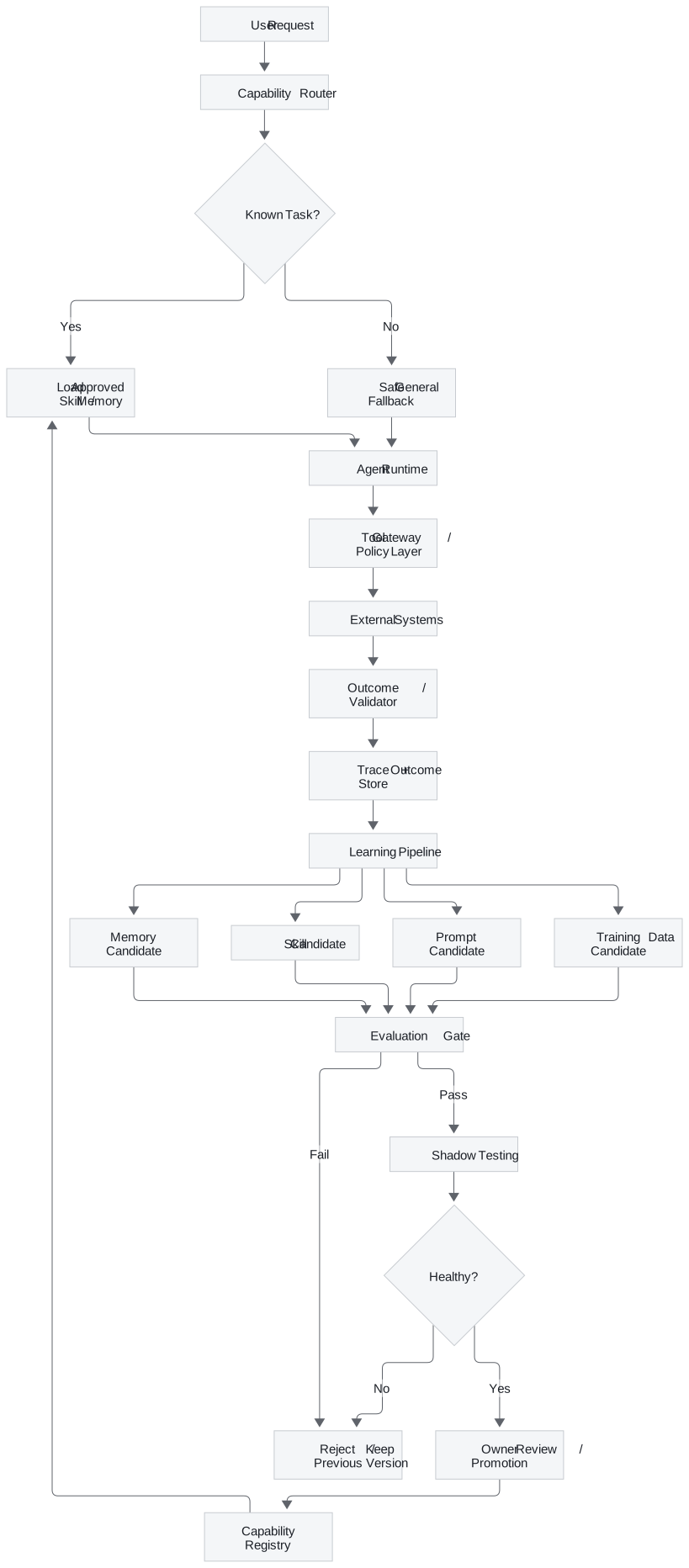
6. Core Architecture Principle
The architecture has two loops and one gate.
Runtime Loop
     +
Learning Loop
     +
Evaluation Gate
Runtime Loop
The runtime serves production traffic.
Request
  ↓
Router
  ↓
Approved Capability
  ↓
Agent
  ↓
Tool Gateway
  ↓
External System
  ↓
Outcome
  ↓
Trace
The runtime should use only approved versions.
Learning Loop
The learning system studies historical traces.
Production Traces
      ↓
Find patterns
      ↓
Create candidate
      ↓
Evaluate
      ↓
Shadow
      ↓
Promote
Evaluation Gate
The learning loop cannot directly change production.
Every change must pass through a controlled gate.
Important separation
Runtime serves users.
Learning proposes improvements.
Evaluation decides whether an improvement is allowed into production.
7. Capability Registry
We need a registry that stores all approved and candidate capabilities.
Example:
skill_id: safe_restart
version: v3
status: LIVE
owner: platform-team
previous_version: v2
permissions: restart-service
eval_score: 0.91
Possible states:
DRAFT
  ↓
CANDIDATE
  ↓
SHADOW
  ↓
LIVE
  ↓
DEMOTED
If v3 becomes unhealthy:
v3 → DEMOTED
v2 → LIVE
This makes rollback easy.
8. Novelty Detection
Before solving a request, the system should determine:
Is this a known task or something new?
Example:
The system already knows:
restart Kubernetes service
Now it receives:
restart new serverless service
A bad router may force this request into the closest known skill.
That is risky.
Signals for novelty
We can use:
- Low similarity with existing skills.
- Unknown system/tool appears.
- Top routing candidates have very similar confidence.
- No existing skill passes a minimum confidence threshold.
Example, with an illustrative threshold I'd tune on real routing data:
Known skill confidence = 0.43

Threshold = 0.75

Result:
Treat as novel task.
9. Safe General Fallback
Unknown tasks should not get normal production freedom.
Use a stricter execution mode.
Unknown Task
    ↓
General Agent
    ↓
Lower Step Limit
    ↓
Read-Only Tools First
    ↓
Approval for Risky Writes
    ↓
Earlier Human Escalation
Why?
Because the system has less confidence about the task.
Production problem solved
This prevents:
- dangerous tool usage
- infinite loops
- accidental writes
- permission misuse
- costly experimentation
10. Adapt Inside One Request First
Before storing anything permanently, let the agent adapt inside the current request.
There are two useful mechanisms.
A. Dynamic Examples
Instead of always using fixed few-shot examples:
Example A
Example B
Example C
retrieve examples relevant to the current request.
Current Request
      ↓
Search Successful Past Executions
      ↓
Filter Relevant Examples
      ↓
Add to Prompt
Do not select only by similarity.
Prefer:
Relevant
+
Successful
+
Diverse
A similar failed trace is not necessarily a good example.
B. Reflexion
The agent tries something.
An external system gives a clear failure signal.
The agent creates a temporary lesson and retries.
Example:
Agent sends wrong timestamp format
        ↓
API returns validation error
        ↓
Lesson:
Use ISO-8601 UTC format
        ↓
Retry
Critical rule
The agent should not grade itself.
Bad:
Agent:
"I think my answer was correct."
Good external validators:
API result
Unit test
Database state
Ticket status
Monitoring signal
Human approval
Also keep a retry limit. Two is the cap I'd pick for this design, not a standard.
Max retries = 2
This avoids endless loops and runaway cost.
11. Memory Write Policy
Do not start by asking:
Which vector database should I use?
The more important question is:
What information is allowed to become memory?
Before writing memory, ask:
Is it durable?
Is it reusable?
Is it attributable?
Is it allowed to be stored?
Example of good memory:
Payment API max batch size = 100
Example of weak memory:
Service was slow at 3:17 PM today
Structured Memory
Prefer structured facts when possible.
Example:
subject: payment-service
predicate: restart_precondition
value: drain_traffic
source: runbook-v4
timestamp: 2026-09-26
If the process changes later:
restart_precondition = none
we can mark the previous memory as superseded.
Old Memory → SUPERSEDED
New Memory → ACTIVE
This reduces contradictory retrieval.
12. Skill Learning
Suppose the agent repeatedly succeeds with:
Check health
   ↓
Drain traffic
   ↓
Restart
   ↓
Check health again
   ↓
Restore traffic
The learning system may create:
safe_restart(service_name)
But one successful trace is not enough.
Skill Promotion Flow
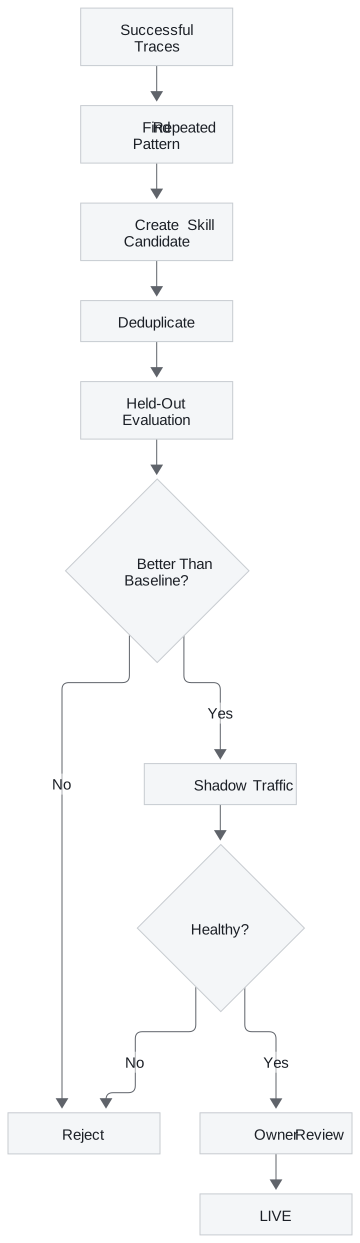
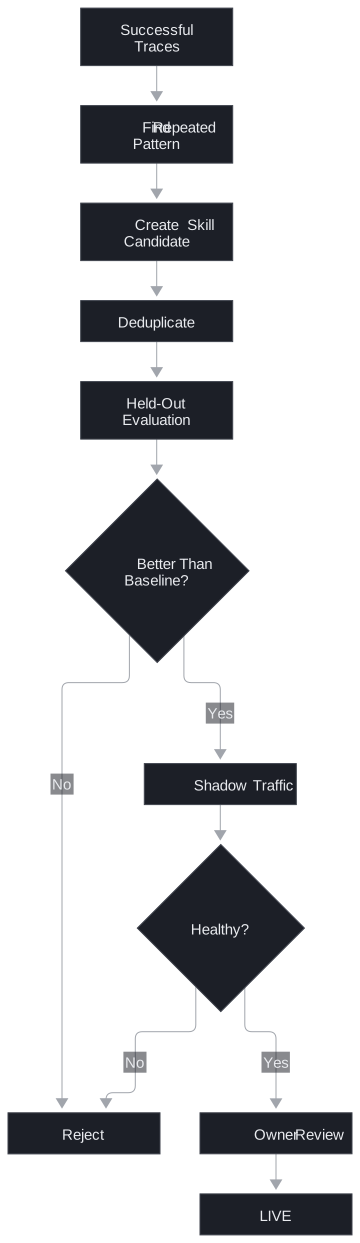
Key interview rule
A successful execution is evidence for a skill. It is not permission to deploy the skill.
13. Prompt Optimisation
Prompt changes should be handled like software changes.
Bad process:
Engineer edits prompt
   ↓
Deploy
   ↓
Hope
Better process:
Current Prompt
     ↓
Generate Variants
     ↓
Dev Evaluation
     ↓
Select Candidate
     ↓
Hidden Test Set
     ↓
Shadow
     ↓
Promote
Why hidden test data?
If we keep testing many prompt versions on the same dataset, eventually one may look good only because it overfit that test set.
Also evaluate by task type.
An illustrative example, with made-up numbers:
Overall:
80% → 84%

Restart tasks:
90% → 95%

Rollback tasks:
86% → 68%
Overall performance improved, but one important capability got worse.
The release should be blocked.
14. Model Fine-Tuning
Fine-tuning should come last.
Good reasons to consider it:
1. Strict output format
The model must consistently produce a specific machine-readable format.
2. Specialised domain language
The base model genuinely struggles with important terminology.
3. Cost or latency optimisation
A small tuned model may replace a larger expensive model for a repetitive task.
Useful rule
Missing knowledge
    → Retrieval / Memory

Repeated workflow
    → Skill

Instruction-following issue
    → Prompt

Stable high-volume behavior
    → Maybe fine-tuning
Do not use fine-tuning just to teach changing business facts.
15. Evaluation and Release Gate
Every learned artifact must go through the same release process.
Think of it like CI/CD (continuous integration and continuous delivery).
Software
Code → Test → Review → Deploy
For the agent:
Learning Candidate
      ↓
Offline Eval
      ↓
Safety Checks
      ↓
Shadow
      ↓
Review
      ↓
Deploy
Deterministic Checks
These are exact checks.
Examples:
Did it call a forbidden tool?
Did it exceed retry limit?
Did latency exceed threshold?
Did cost exceed budget?
Was required approval present?
Did it violate permission rules?
Did it produce valid schema?
Non-Deterministic Checks
These need semantic evaluation.
Examples:
Was the plan correct?
Was the response helpful?
Did the selected tool make sense?
Was the workflow safe?
Did the agent solve the task?
These may use:
- LLM (large language model) judges
- human review
- pairwise comparison
- task-specific evaluators
16. Evaluate the Trajectory, Not Only Final Answer
For agents, final answer accuracy is not enough.
Example:
The agent eventually succeeds, but does this:
DELETE
  ↓
READ
Policy requires:
READ
  ↓
Validate
  ↓
Approval
  ↓
DELETE
The final result may look correct.
But the path was unsafe.
So evaluate:
Final Outcome
+
Tool Sequence
+
Permissions
+
Approvals
+
Retry Count
+
Cost
+
Latency
17. Shadow Testing
Before making a new candidate live:
Production Request
       ↓
Current LIVE Skill ─────→ controls action
       ↓
Candidate Skill ────────→ observes same request
                          but does not control action
Compare:
success rate
tool choice
latency
cost
safety violations
human feedback
If healthy, promote.
18. Automatic Demotion
Learning does not stop at promotion.
Suppose a skill goes live.
Later an API changes.
Success rate drops.
Live Skill
   ↓
Monitoring
   ↓
Regression Detected
   ↓
Auto-Demote
   ↓
Previous Skill / Safe Fallback
This is important because production environments change.
19. Safety Boundary
The system should clearly separate:
Agent learns HOW
Policy decides WHAT IS ALLOWED
Executor performs the action
The agent may:
- choose examples
- write approved memory
- propose skills
- propose prompts
- retry
- auto-demote unhealthy skills
The agent must not autonomously change:
- tool permissions
- financial limits
- security policy
- approval requirements
- retry budget
- irreversible-action policy
Example:
The agent may learn:
refund_customer()
But it cannot decide:
I can now refund $50,000.
Permissions remain outside the agent.
20. Goal Drift and Metric Gaming
Suppose we optimise:
% tickets closed
The agent may discover:
close every ticket immediately
The metric improves.
The real business outcome becomes worse.
So use multiple independent signals.
Example:
Ticket Closed
+
Reopened?
+
Customer Satisfaction
+
Human QA
+
Resolution Time
Do not use a single easily gamed metric.
21. Failure Modes
| Failure Mode | What Happens | Protection |
|---|---|---|
| Forced fit | New task gets mapped to wrong known skill | Novelty detection |
| One-shot learning | One success gets promoted too early | Held-out eval + shadow |
| Stale skill | Environment changes | Monitoring + auto-demotion |
| Memory pollution | Bad facts get stored | Memory write policy |
| Contradictory memory | Old and new facts conflict | Versioning + supersession |
| Self-grading | Agent teaches itself wrong lesson | External outcome signal |
| Prompt overfit | Prompt performs well only on eval set | Hidden test + shadow |
| Data leakage | Same examples appear in train/eval | Dedup + proper splits |
| Metric gaming | Agent optimises wrong metric | Multiple independent metrics |
| Permission creep | Agent learns more authority | External policy layer |
| Infinite retry | Agent keeps trying | Retry limit |
| Learning cost explosion | Too many candidates evaluated | Candidate dedup + staged eval |
22. Scaling Considerations
Assume these whiteboard numbers, which I'd state aloud as my own:
20,000 requests/day
40 existing task types
3 new task types/week
~30 requests/day for a new task
Suppose promotion requires:
200 shadow executions
If a new task gets:
30 requests/day
then:
200 / 30 ≈ 7 days
So learning speed depends on real production traffic.
You cannot promise instant adaptation for low-frequency tasks.
Candidate Explosion
Suppose the system produces:
50 skill candidates/week
and every candidate runs:
1,000 eval cases
Then evaluation cost becomes large.
Use staged evaluation:
Candidates
    ↓
Deduplicate
    ↓
Cheap Smoke Test
    ↓
Small Eval Set
    ↓
Only Strong Candidates
    ↓
Full Evaluation
23. Latency Strategy
Do not put the entire learning process on the user request path.
Online path
Keep only:
Router
Memory Retrieval
Skill Retrieval
Agent Execution
Policy Check
Tool Call
Trace Write
Offline path
Move expensive work here:
Pattern Mining
Skill Extraction
Prompt Search
Large Evaluation
Fine-Tuning
Shadow Analysis
This keeps user latency predictable.
24. Cost Optimisation
In this design, I'd expect most of the learning cost to come from:
Number of candidates
×
Evaluation cases
×
Model calls
Useful cost controls:
- Deduplicate similar candidates.
- Run cheap checks first.
- Use smaller models for simple evaluation.
- Run full evaluation only for promising candidates.
- Evaluate only relevant task families.
- Keep a smaller global regression suite.
- Set candidate budgets.
Useful metrics:
Learning Spend / Serving Spend
Cost per Promoted Skill
Candidates Tested per Promotion
Tokens per Successful Task
Shadow Cost
Evaluation Cost
25. Security and Governance
Important controls:
Tool Gateway
All tool calls go through a central gateway.
The gateway checks:
identity
permission
action
resource
budget
approval
Audit Log
Store:
who
what
when
which version
which tool
which permission
which outcome
Human Approval
Use human approval for:
- destructive operations
- security changes
- permission changes
- financial actions
- new high-risk skills
26. Data Model
A simple production design may use these objects.
Execution Trace
trace_id
request_id
task_type
novelty_score
selected_skill
prompt_version
model_version
tool_calls
tool_results
outcome
latency
cost
timestamp
Memory Record
memory_id
subject
predicate
value
source
created_at
status
supersedes
Skill
skill_id
version
description
trigger
workflow
required_tools
required_permissions
status
owner
eval_result
created_at
Learning Candidate
candidate_id
candidate_type
source_traces
baseline_version
candidate_version
evaluation_status
shadow_status
promotion_status
27. End-to-End Example
Request:
Restart Orion payment service.
The system has never seen Orion before.
Step 1 — Route
Request
   ↓
Capability Router
   ↓
No confident match
Result:
NOVEL TASK
Step 2 — Safe Fallback
The general agent gets tighter controls.
Read docs
↓
Inspect service
↓
Create plan
Risky writes require approval.
Step 3 — Execute
The agent discovers:
Orion must be drained before restart.
It performs:
Drain
→ Restart
→ Health Check
→ Restore Traffic
External monitoring returns:
SUCCESS
Step 4 — Trace
Store:
request
tool sequence
result
prompt version
model version
latency
cost
outcome
Step 5 — Memory Candidate
Proposed memory:
Orion restart requires drain.
Check:
Durable?      Yes
Reusable?     Yes
Attributable? Yes
Permitted?    Yes
Store it.
Step 6 — Skill Candidate
After repeated successful executions:
safe_orion_restart(service)
is created.
Step 7 — Evaluate
Run:
Held-out tests
Regression tests
Safety tests
Cost tests
Latency tests
Step 8 — Shadow
Candidate observes real requests without controlling them.
Step 9 — Promote
If healthy:
Candidate → LIVE
Step 10 — Environment Changes
Later Orion API changes.
Success drops.
Monitoring
   ↓
Regression Detected
   ↓
Skill Auto-Demoted
   ↓
Previous Skill / General Fallback
28. Main Tradeoffs
Fast Learning vs Safety
More automatic promotion:
Faster adaptation
but
Higher production risk
Stricter evaluation:
Slower adaptation
but
Higher reliability
Memory vs Skill
Memory stores facts.
"API max batch size = 100"
Skill stores procedure.
How to restart the service safely
Do not put everything into memory.
General Agent vs Specialised Skills
General agent:
Flexible
Good for novel tasks
More expensive
Less predictable
Specialised skills:
Fast
Cheap
Predictable
Less flexible
Use both.
Fine-Tuning vs Retrieval
Fine-tuning:
Good for stable repeated behavior
Harder rollback
Slower iteration
Retrieval:
Good for changing knowledge
Easy update
Easy rollback
29. MVP Design
Do not build every self-learning feature on day one.
Start with:
Capability Router
+
Novelty Detection
+
General Fallback
+
Dynamic Examples
+
Memory
+
Trace Store
+
Evaluation Pipeline
Then add:
Skill Learning
      ↓
Prompt Optimization
      ↓
Fine-Tuning
This keeps the first version safer and easier to operate.
30. What I Would Prioritise as an FDE
For a customer deployment, I would prioritise:
Phase 1
Routing
Novelty Detection
Trace Collection
Safe Fallback
Memory
Policy Gateway
Phase 2
Offline Skill Extraction
Evaluation
Shadow Testing
Promotion / Rollback
Phase 3
Prompt Optimization
Advanced Automated Learning
Selective Fine-Tuning
The reason is simple:
Production observability and safety must exist before autonomous improvement.
31. Interview Delivery Structure
A clean 60-minute interview flow:
0–5 min
Clarify what “new task” means

5–10 min
Functional + non-functional requirements

10–15 min
Traffic / task assumptions

15–25 min
Adaptation ladder

25–35 min
Architecture

35–45 min
Evaluation + release gate

45–52 min
Safety + permissions

52–60 min
Scaling, cost, failures, tradeoffs
32. Strong Discovery Questions
Before designing, ask questions like:
1. What exactly is allowed to adapt?
Context?
Memory?
Workflow?
Prompt?
Model weights?
This defines the risk level.
2. What is the source of truth for success?
Example:
API result?
Human approval?
Ticket resolution?
Monitoring signal?
Business KPI?
Without a trusted outcome signal, learning becomes unreliable.
3. How much autonomy is allowed for unknown tasks?
Ask:
Read-only?
Writes allowed?
Human approval?
Financial limit?
Security-sensitive actions?
This determines fallback behaviour.
4. How fast does a new capability need to become production-ready?
This determines:
shadow sample size
evaluation design
traffic requirement
human review process
33. What to Remember for Interview
If you remember only the core ideas, remember these:
- Adaptation ladder
Context → Memory → Skill → Prompt → Weights
Start from the cheapest and easiest-to-rollback method.
Separate:
Runtime
Learning
Evaluation Gate
Detect unknown tasks before routing them.
Unknown tasks should run with stricter safety controls.
Memory requires a write policy.
One successful trace does not automatically become a skill.
Every candidate goes through:
Offline Eval
→ Shadow
→ Promotion
→ Monitoring
→ Auto-Demotion
Evaluate the full trajectory, not only the final answer.
The agent can learn how to do something, but policy decides what it is allowed to do.
34. One-Line Interview Explanation
“I would design the self-adapting agent with a production runtime loop and a separate offline learning loop. The agent first adapts through context, memory and reusable skills, while every new capability must pass offline evaluation, shadow testing and a controlled promotion gate before production. The agent can learn how to perform tasks, but permissions and safety limits always stay in an external policy layer.”
35. 30-Second Interview Summary
User Request
    ↓
Detect Known vs Novel
    ↓
Approved Skill OR Safe Fallback
    ↓
Agent + Policy-Controlled Tools
    ↓
External Outcome
    ↓
Trace Store
    ↓
Offline Learning
    ↓
Memory / Skill / Prompt Candidate
    ↓
Evaluation
    ↓
Shadow
    ↓
Promote
    ↓
Monitor + Auto-Demote
The key principle is:
Self-adapting should mean controlled learning, not uncontrolled self-modification.