Practice Worksheet · 3 min — Attempt the case yourself first. Read-only here — use the interactive version to save answers.
1. Interview prompt
You are the FDE (Forward Deployed Engineer) asked to bring GenAI capability into an Air-Gapped Environment, a network with no route to the internet. Treat that boundary as the heart of the design, not as an obstacle to work around.
2. Clarify the customer problem
- Which classification level covers the data, and which handling rules come with it?
- Is the local hardware fixed, and what exactly sits in the pool?
- What is the path for bringing artifacts in, from scanning and approval to signing and roll-in?
- Which identity, storage and directory services already run inside the boundary?
- What limits apply to logging, retention and recovery?
3. Users and workflows
| User | Workflow | Current pain | AI assist opportunity | Human approval needed? |
|---|---|---|---|---|
| Analyst (end user) | ||||
| Operations / IT admin | ||||
| Security / compliance officer | ||||
| Programme sponsor |
4. Requirements
Functional
Non-functional
- Latency target:
- Availability target:
- Cost budget:
- Security/privacy constraints:
- Audit/compliance requirement:
5. Data and integration map
| Data source | Format | Owner | Freshness | Permission model | Risk |
|---|---|---|---|---|---|
6. Proposed architecture
Fill in each part of your architecture for this case:
- Build and signing:
- Transfer inspection:
- Offline registry:
- Orchestration:
- Document pipeline:
- Local telemetry:
7. Evaluation plan
| Metric | Good threshold | Bad threshold | Test dataset | Owner |
|---|---|---|---|---|
| Signature check results | No failed artifact admitted | One failed artifact admitted | Logs from each transfer hop | Security |
| Offline install success | Clean on every staging run | Install needs outside access | Installs on matched staging nodes | Platform engineering |
| GPU and queue saturation | Stays under admission limit | Held above the limit | Local GPU and queue metrics | Operations |
| Time per analyst case | Lower than baseline | No change or slower | Case timings taken inside | Sponsor |
8. Failure modes
- Install halts on a missing transitive dependency
- A bundle arrives damaged after a transfer hop
- The model does not fit in local GPU memory
- An internal certificate reaches its expiry date
- A new release cannot read the existing index
- A library tries to send telemetry out
9. Rollout plan
- Build a staging copy that matches production.
- Run the full transfer and import drill.
- Write the handoff down so anyone can repeat it.
- Put one canary node on live traffic.
- Build the rollback bundle and test it.
- Add nodes only while every gate passes.
10. Weak vs strong answer
Weak: "Put the model on a local server and lock down the firewall."
Strong: "The release path into the enclave is the most trusted part of the system. Every dependency is pinned and attested, and signatures are checked against trust roots held offline. Telemetry never leaves. An incomplete bundle is refused, and rollback is a bundle we have already tested."
11. Candidate scorecard
| Area | 1 | 3 | 5 | Score |
|---|---|---|---|---|
| Problem framing | Treats the gap as a firewall rule | Sees offline deployment | Designs around the boundary | |
| Architecture | A single container | Adds registry and mirror | Separate build and offline sides, canary node | |
| Evaluation | "Runs without internet" | Checks installs | Signature checks, saturation, analyst time | |
| Production thinking | Installs, then walks away | Adds some monitoring | Refuses bad bundles, rollback already tested | |
| Communication | Talks about the vendor | Mostly clear | Opens with the failure and the gate |
Model Answer · 12 min — Compare after attempting the worksheet: the ground a strong answer covers.
Try the worksheet before you read this key. It shows what a strong GenAI FDE (Forward Deployed Engineer) candidate asks, designs, measures, secures and explains on the way from a demo to a production system.
Strong discovery questions
- How is the data classified? Which rules say whether we may store text, keep prompts or cache outputs?
- Which GPUs and servers sit inside the network? That hardware decides between a bigger model, a smaller one or a workflow that leans on retrieval.
- Is this an assist tool, a batch job for analysts or a near-interactive copilot? Each one sets a different quality bar and latency target.
- What is the path for bringing an artifact in: import, approval, scanning, signing, rollout? Its speed sets how quickly we can patch a vulnerability.
- Which local identity system can we plug into? Which directory or storage services are already there for us?
- Inside the network, what limits apply to logging, retention, backups and disaster recovery?
- What result can the customer measure on their own side, without taking a vendor's figure on trust?
- When the build team has gone home and it is 2 a.m., who runs this? What do they need to fix without help?
Strong functional requirements
- Core workflow: inside the enclave, an analyst uploads a document and gets back a classification, an extraction or a redaction. Nothing at runtime touches the internet.
- Ship the model and the service as one offline bundle. The whole runtime installs from it and never calls out.
- Give every artifact a version and a signature. Any model, container or dependency can then be traced back to an approved release.
- Host a registry and a dependency mirror locally. Installs and redeploys stay inside the enclave.
- Hook into the local identity provider. Access then follows the accounts and groups the customer has already approved.
- Make updates and rollbacks a formal, audited ceremony. Anyone can review a promotion, and anyone with authority can reverse it.
Strong non-functional requirements
- Latency: set one budget that spans upload, preprocessing, retrieval, inference, validation and rendering. When inference eats most of it, cut the model size or the context.
- Availability: you cannot scale out on demand, or only a little, so get capacity right before launch. Plan for the 20 QPS (queries per second) peak in this case, not for the average.
- Security: pin every dependency and attest it. Check signatures against trust roots held offline. Keep privileged administration apart from everyday user work.
- Compliance: keep an append-only audit log that records the actor, the action, the artifact hash and the time. Retain it for as long as local policy demands.
- Reliability: if a bundle is incomplete or damaged, refuse it and leave the current release in service. No improvising.
- Cost:
Replicas = ⌈(QPS × Tokens_request) / (TokensPerSecond_replica × UtilizationTarget)⌉. If the result is bigger than the fixed pool, reshape the workload instead of asking for more hardware.
Architecture explanation
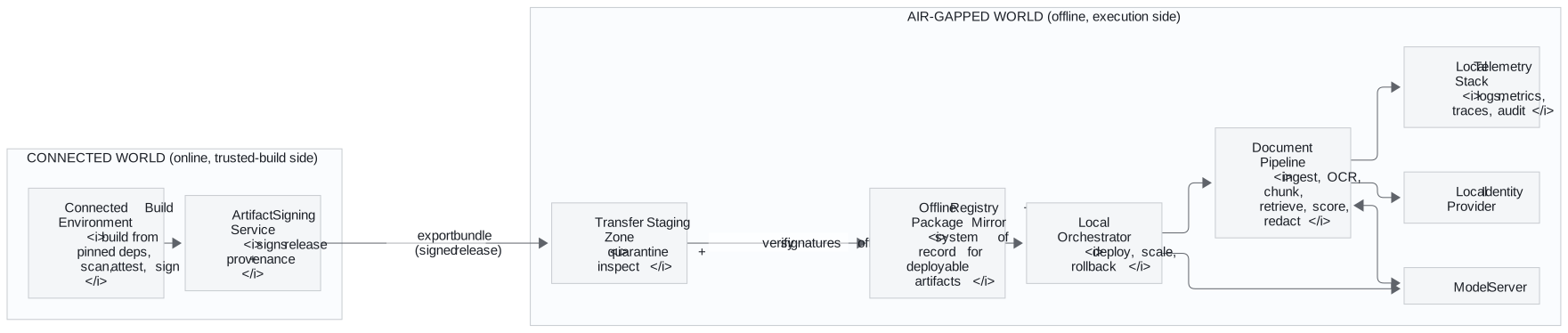
- Picture two worlds with a single controlled path between them. The trust boundary separates the connected build side from everything else.
- On the connected side, the build environment packs source code, pinned dependencies and model artifacts into a bundle anyone can rebuild, then exports it.
- A signing service attaches signatures and verifiable attestations to anything that will cross the boundary.
- The bundle then waits in a transfer staging zone. It sits in quarantine while we confirm its integrity, its chain of custody and its conformance to policy. Only then may it enter.
- Once inside, signatures are checked against the offline trust roots. Approved content goes into a local registry and package mirror, which become the offline source of truth.
- A local orchestrator runs the services and applies deployment policy. It also handles canary rollout, sending only a small share of traffic to a new release.
- The model server and the document pipeline carry the actual work: ingesting documents, OCR (optical character recognition) and parsing, splitting into chunks, retrieving, scoring, redacting and building the result.
- A local identity provider and a local telemetry stack round out the enclave. No data leaves, and no cache is ever trusted over the registry.
Data model / integration assumptions
- ReleaseManifest(version, artifact_hashes, signatures, dependencies); ModelDeployment(model_id, version, hardware, status); OfflineAuditEvent(actor, action, artifact_hash, time).
- Each team owns a clear slice. Signed release material belongs to the build team until handoff. The offline runtime then owns deployment state, and security owns the audit trail.
- We keep deployment history long enough to answer one question: which release was live when this document was analysed?
- Nobody edits an OfflineAuditEvent after it is written. Without a vendor console, that log is the only way to rebuild what happened in an incident.
- Promotions carry a revision token and use optimistic concurrency. Two operators therefore cannot promote clashing releases at the same moment.
Red-team risks
- a transitive package left out of the bundle, a damaged artifact after transfer, telemetry that secretly calls home, a local certificate past its expiry, an index that no longer matches the model
- A transitive dependency is missing, and someone is tempted to fetch it from outside. The system should refuse instead and block the promotion.
- An artifact gets damaged on the way between hops. Check hashes and signatures after each move, not just where the bundle was built.
- A library expects to send telemetry out. Crash reports or cloud diagnostics look like monitoring but break the boundary without anyone noticing.
- Privileged administration gets handled as routine work. Rotating keys, changing trust roots, rebuilding indexes and promoting a rollback each need an approval that lands in the audit log.
- A stopgap meant to be temporary quietly becomes permanent. The security officer fears this above all, and an accreditation review will spot it.
Rollout plan
- Week 0-1: agree the scope and write down the non-goals: no live internet calls, no fetching dependencies on the fly, no agents that update themselves, no cloud observability.
- Week 1-2: build a staging environment identical to production: same GPU profile, node class, OS image, trust roots and storage layout.
- Week 2-3: practise the full transfer and import drill. Verify signatures offline and install without any outside access.
- Week 3-4: write the handoff down so anyone can repeat it and audit it. "Someone will carry it over by hand" does not count as a process.
- Week 5: put a canary on one node with real traffic. It must stay within the agreed health thresholds for a set observation window.
- Week 6-8: build the rollback bundle as a proper artifact and test it. It holds the last known-good release, its signatures, an operator checklist and the escalation path.
- After pilot: add nodes only while install success, signature checks and capacity saturation stay healthy. Keep watching how old the live release is.
Evaluation plan
These are thresholds I'd pick for this case. They are not industry standards, so be ready to defend them rather than recite them.
| Metric | What it proves | Strong threshold | Dataset / method |
|---|---|---|---|
| Offline install success rate | Bundles install cleanly without any outside access | Clean every time on representative staging | Repeated installs on nodes that match production |
| Signature verification failures | Nothing unverified got into the enclave | None admitted; each failure goes to quarantine | Verification logs from every transfer hop |
| Model throughput and latency | The fixed GPU pool really does serve the workflow | Inside the interactive or batch SLO | Peak load test at 20 QPS |
| Capacity saturation | There is still headroom for a big document or a burst | Under the admission threshold | Telemetry from GPUs and queues |
| Release age and MTTR | Patching and repair still work inside the enclave | Meets the agreed windows for patching and recovery | Release ledger plus incident records |
| Analyst time saved per case | The workflow got better in ways the customer can check | A local, measurable drop against the baseline | Case turnaround measured on site |
Weak answer
My plan: run the model at the customer's own site, fenced off by a firewall, and process documents there. This is weak because it sees the air gap as a network setting, when it is the constraint that shapes everything. It never explains how artifacts get in legally, how dependencies are attested or how an update is rolled back.
Average answer
I would containerise the model and the service, sign the image, move it across the boundary and run it with local identity and a package mirror. Logs would stay on-premises. That is an improvement, but gaps remain. It never says what fails closed, how a bad release gets reverted while approvals are slow, or how capacity fits a fixed GPU pool.
Strong answer
For me the boundary is the system design. One sentence anchors it: deliver AI capability that runs and can be maintained locally, without breaking the network, artifact, identity or audit boundaries. That turns the offline release pipeline into a high-trust control plane. I'd pin and attest every dependency, check signatures against offline trust roots, keep telemetry local first, and split privileged administration from normal use. The worst failure is a bundle that is incomplete or corrupted. So the system fails closed, keeps the evidence and leaves the current release untouched. I'd size honestly for the fixed GPU pool and reshape the workload, rather than request hardware that will never arrive. My first gate: a bundle that cannot prove offline that it is intact, complete and compatible stays out.
Interviewer scorecard
| Area | 1 - Weak | 3 - Average | 5 - Strong |
|---|---|---|---|
| Problem framing | Sees the air gap as just a firewall rule | Mentions offline deployment and local identity | Makes the boundary the design and states an outcome the customer can check locally |
| Requirements | "Host it on-premises" | Covers offline packaging and signing | Gives a must-have list and explicit exclusions, and keeps constraints apart from preferences |
| Architecture | A single container on one server | Registry, orchestrator and model server | All nine components in dependency order, split across build and offline sides, with trust boundaries marked |
| Data/integration | Refers to versions | Names the manifest and the deployment record | ReleaseManifest, ModelDeployment, an append-only audit log, clear ownership, optimistic concurrency |
| Evaluation | "It runs offline" | Checks install and latency | Tracks signature failures, install success, release age, saturation and analyst time saved |
| Safety/security | "It's air-gapped, so it's safe" | Adds signing and local logs | Pinned, attested dependencies, no assumed egress, and privileged admin handled as a high-risk interface |
| Rollout | Install it and walk away | Staging first, then deploy | Staging that matches production, a rehearsed transfer drill, a one-node canary and a tested rollback bundle |
| Communication | Talks from the vendor's side | Clear but generic | Opens with the failure, names the fail-closed rule and ends on the admission gate |
Final 2-minute spoken answer
I'd begin somewhere other than the model. In an air-gapped site, the boundary is not an extra limit bolted onto a normal AI system. It is the system design, so I argue every decision against it, never around it. I'd restate the goal as AI capability that runs and stays maintainable locally, without breaking the network, artifact, identity or audit boundaries. Every later choice gets tested against that line. The architecture is two worlds with one controlled path between them. On the connected side, a build environment collects model artifacts and pinned dependencies. Anything due to cross gets attested by a signing service. The bundle then sits in a transfer staging zone, quarantined and inspected. Inside the enclave, we check signatures against offline trust roots. Approved content goes into a local registry and package mirror, which is the source of truth. An orchestrator deploys a canary and the acceptance tests run. Only after that do we promote or roll back. Identity and telemetry stay inside, and nothing calls home. My named drill is a transitive package that is missing from the bundle. The system fails closed and blocks promotion. The current release keeps running, and the bundle goes to quarantine instead of anyone reaching outside to patch it. On capacity I'd be straight with them. A fixed GPU pool means the sizing formula soon gives an awkward replica count. The right move is to question the request profile and shift work out of the live path, not to request hardware that can never get in. My first production gate: a bundle proves offline that it is intact, complete and compatible, or it stays out.
Tutorial 1 · 12 min — The full lesson: how to reason through this case from first question to rollout.
Table of Contents
- 1. The Customer Problem and Discovery
- 2. Clarifying Questions, Requirements, and Constraints
- Six Architecture-Changing Questions
- From Discovery to Requirements
- Constraints vs. Preferences
- A Compact Interview Question Tree
- MVP Prioritisation: Must, Should, Could
- What the MVP Will Not Support
- Requirement-to-Component Traceability
- The One Assumption to Protect First
- Why This Is a Strong FDE Signal
- 3. Scale Estimates, SLOs, and Capacity
- 4. Architecture and End-to-End Flow
- Two Worlds Separated by a Controlled Update Path
- Nine Components in Dependency Order
- Top-Down Architecture Diagram
- System of Record vs. Cache vs. Queue
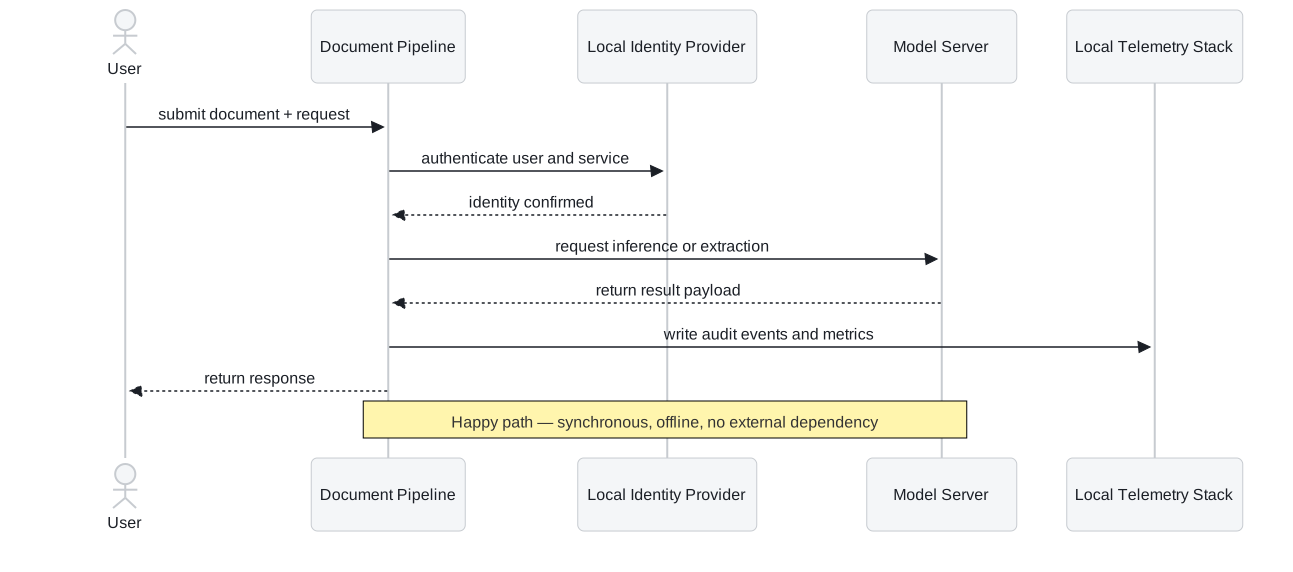
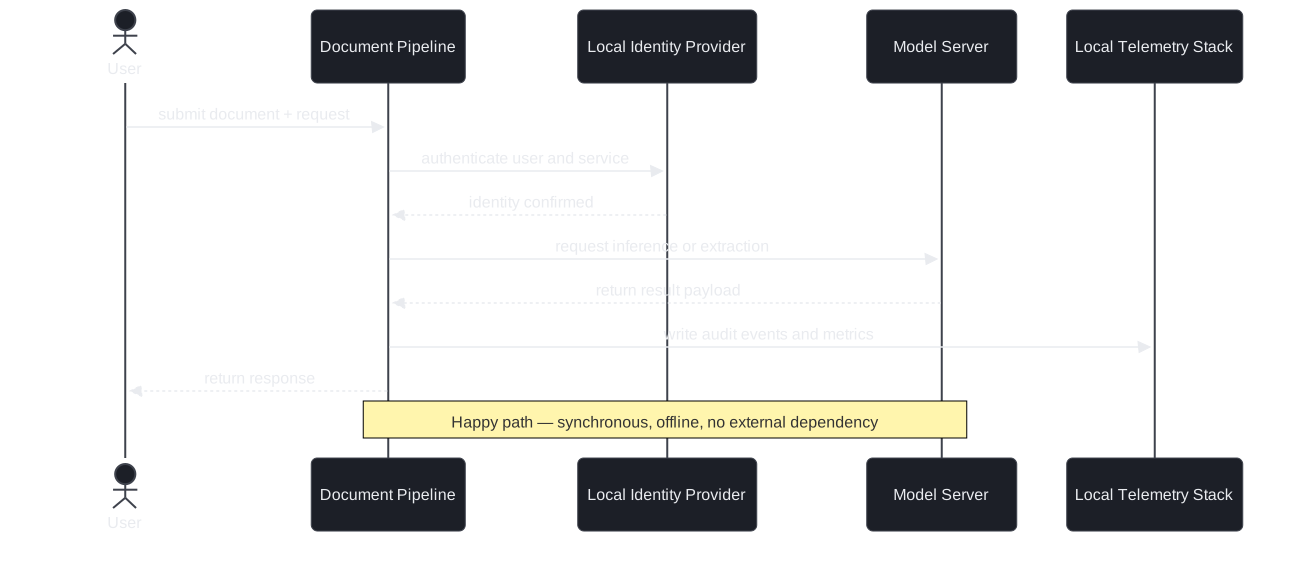
- End-to-End Happy Path
- Sequence Diagram of the Happy Path
- Dependency-Failure Drill: Fail Closed
- Backpressure and Flow Control
- Component Responsibility Table
- MVP vs. Later Evolution
- Control Plane vs. Data Plane
- 5. Data Model, APIs, and Working Code
- 6. Security, Reliability, and Failure Handling
- Lead With the Failure, Not the Model
- Threat-Model the Offline Control Plane
- Failure Policy: Fail Open, Fail Closed, Degrade, Queue
- Five-Condition Decision Table
- Blast Radius
- Critical Incident Drill: Missing Transitive Package
- Other Failure Paths
- Code: Proving One Security Invariant
- Evidence, Runbooks, and Operational Readiness
- Why This Matters for the Job
- 7. Delivery Plan, Observability, and Business Impact
- 8. Interview Walkthrough, Trade-Offs, and Practice
- Minute Zero: Open With the Customer Outcome
- A 50-Minute Pacing Plan
- Trade-Off: Model Size vs. Hardware Fit
- Trade-Off: Containers vs. Virtual Appliances
- Trade-Off: Update Frequency vs. Accreditation Cost
- Trade-Off: Central Cluster vs. Workstation Deployment
- Four Hard Follow-Up Questions
- Common Weak Answers and Repairs
- Self-Scoring Rubric
- The Final 90-Second Summary
- Practice Assignments
- Coverage Notes
1. The Customer Problem and Discovery
The Core Tension and Outcome Statement
- The enclave has no route to the outside world, yet the customer wants AI inside it, kept running by their own people. Every design choice must hold up against that fact, not work around it.
- State the outcome in one line and hold the rest of the design to it: maintainable AI that runs locally and never crosses the enclave's network, artifact, identity or audit boundaries.
- Test each later architecture choice against this line.
- Key takeaway: do not treat the boundary as a restriction bolted onto an ordinary AI system. The boundary is the design.
- Requirements, architecture, data model, security and delivery all start from it.
🎯 Interview Pointer: Learn the outcome line word for word: "maintainable AI that runs locally and never crosses the enclave's network, artifact, identity or audit boundaries". End each later 90-second summary with it. Interviewers notice when every section points back to one goal.
Stakeholder Map
- Each stakeholder wants one thing and dreads another, and they pull in different directions. Fill in both columns before you draw a box.
| Stakeholder | What they want | What worries them |
|---|---|---|
| Security/compliance officer | Proof that the boundary holds and that every update can be audited | A stopgap that quietly becomes permanent |
| Operations/IT admin | A system the local team can support without calling the vendor | An outage at 2 a.m. that no one on-site can fix |
| End users (analysts) | Quick, correct answers about their own documents | A tool that is slower than doing the work by hand, or harder to trust |
| Program sponsor | Measurable value, delivered when promised | Accreditation review stalling the program |
| External vendor/build team | A clear, clean handoff | Taking the blame for problems that appear once releases cross the boundary |
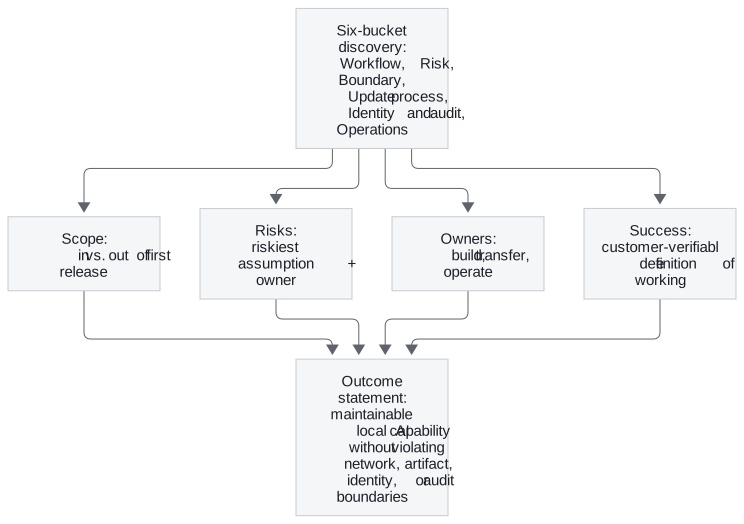
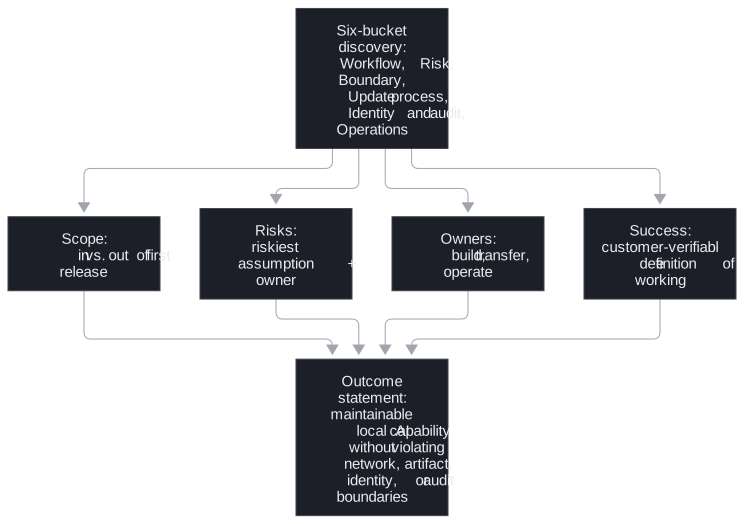
Six-Bucket Discovery Framework
- Sort your discovery questions into six buckets instead of firing them off at random:
- Workflow: the real job the user needs done.
- Risk: the cost of an answer that is wrong, slow or compromised.
- Boundary: precisely what sits inside the enclave and what stays outside.
- Update process: the lawful, safe route by which new capability gets in.
- Identity and audit: who may act, and how you prove it afterwards.
- Operations: who keeps the system up from one day to the next.
Scope, Risks, Owners, Success
- Discovery should end with clear answers to four questions:
- Scope: Which capabilities ship in the first release, and which are deliberately left out?
- Risks: Which assumption is most dangerous, and who is responsible for reducing it?
- Owners: Which team answers for each part: build, transfer and operate?
- Success: How will the customer check, on their own terms, that the system works?
Choosing a Business-Outcome Metric
- Pick a business metric the customer can check from inside the enclave, without opening the boundary.
- Analyst turnaround time per case works: the customer sees it locally. A vendor-reported figure is weaker, because believing it means trusting an outside system.
2. Clarifying Questions, Requirements, and Constraints
Six Architecture-Changing Questions
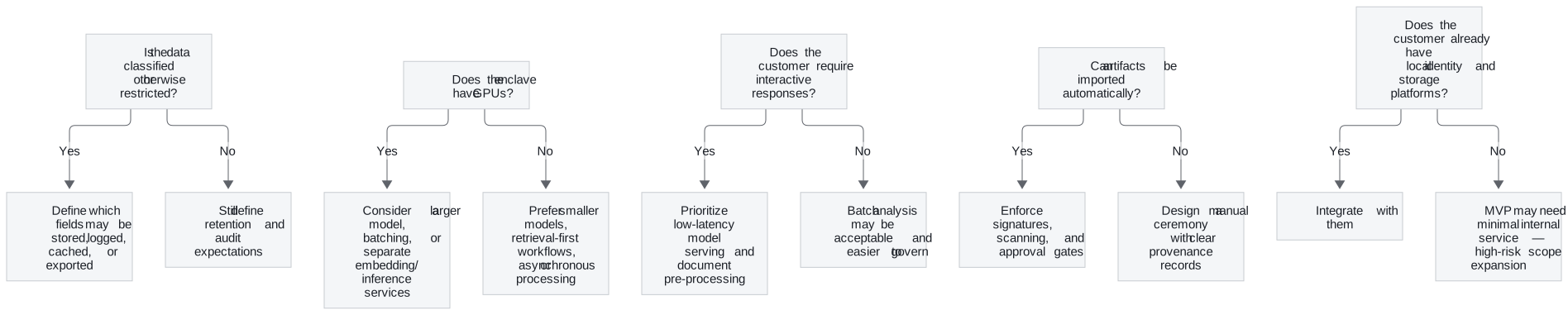
- In this scenario, six questions shape the architecture more than all the rest:
- How is the data classified, and which handling rules follow from that?
- What compute hardware sits inside the enclave?
- How good must answers be, and how long can a person wait for one?
- What path does a software artifact follow to be imported, approved, scanned, signed and rolled in?
- Which identity system runs locally, and which storage and directory services can the application depend on?
- Inside the network, what limits apply to logging, retention, backup and disaster recovery?
- What each answer changes:
- Handling rules decide whether you may store document text, keep prompts, cache intermediate results, or write audit records that hold sensitive content.
- The hardware picks one of three shapes: a single smaller model, a bigger model with batching, or a workflow that leans on retrieval and pairs it with a light model.
- Quality and latency targets set the product's role: a tool that assists a person, a batch analyst, or a copilot that feels close to interactive.
- The import process sets how fast the customer can patch a vulnerability or refresh the model.
- Identity and storage decide whether you can plug into local SSO (single sign-on), file shares, object storage or authorisation backed by a directory.
- Logging and recovery limits settle two things. Can you see failures without exposing classified data? Can the organisation ride out a lost node or a lost site and still stay within policy?
From Discovery to Requirements
- Once about half the questions have answers, stop chasing a complete picture. State your assumptions and turn them into requirements, kept in three lists: functional, nonfunctional and constraints.
- Functional requirements (what the system has to do):
- Package the model and services for offline use, so the whole runtime deploys with no internet connection.
- Sign and version every artifact, so each model, container and dependency traces back to an approved release.
- Run a local registry and a dependency mirror, so installs and redeploys never reach beyond the enclave.
- Integrate with local identity, so access follows the customer's approved accounts and groups.
- Provide observability, backups and restore procedures that work offline, so operations need no outside telemetry.
- Run an update and rollback ceremony that leaves an audit trail, so each promotion to production can be reviewed and undone.
- Nonfunctional requirements (how well it has to behave):
- Nothing depends on the internet at runtime.
- Installs from approved artifacts are reproducible.
- Every code file, model file and packaged dependency has provenance you can check.
- The system stays supportable when patches and model refreshes arrive only rarely.
Constraints vs. Preferences
- A constraint is a wall the design must stay inside, not a nice extra. Examples: all compute stays on-premises, logs are kept only locally, and updates arrive only through a manual approval path.
- A preference is softer, such as favouring one storage engine over another.
- Keep the two apart in your answer. Otherwise the team may optimise for convenience and break a boundary by accident.
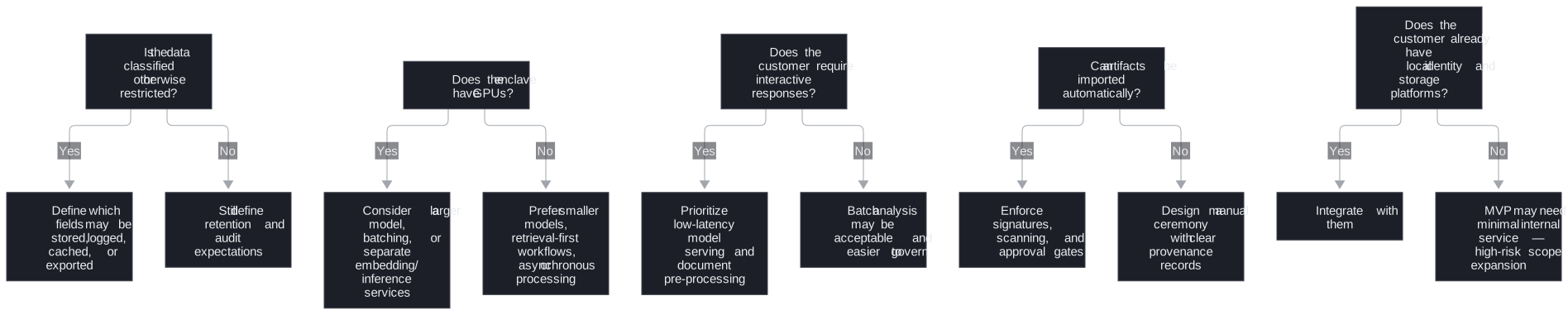
A Compact Interview Question Tree
- A small decision tree shows how you reason when facts are missing. It settles the hardest unknowns first, which tells the interviewer you are protecting delivery, not just gathering facts.
MVP Prioritisation: Must, Should, Could
- The MVP (minimum viable product) must have:
- Offline packaging for the model and services.
- Signed, versioned artifacts.
- A local registry and dependency mirror.
- Integration with local identity.
- Offline observability and backups.
- An update and rollback ceremony that can be audited.
- The list is short on purpose. It is the least the system needs to be operationally credible on a controlled network.
- Could-haves include richer analytics dashboards, a choice of models, automatic canary releases and replication across sites. In an air-gapped setting they pull attention from the core problem.
What the MVP Will Not Support
- Calls to a live model on the internet.
- Unmanaged package installs, or fetching dependencies on the fly.
- Agents that update themselves and skip the approved import process.
- Any promise of unlimited model size or of running arbitrary plugins.
- Any assumption that logs can go to a cloud observability stack.
- Backup as a vague promise. Every backup runs through a storage and restore path the customer has already approved.
- Naming these exclusions guards against scope creep and makes you look more trustworthy.
Requirement-to-Component Traceability
- Map every requirement to a component. A requirement with nothing behind it is a wish, not part of a system.
| Requirement | Component or mechanism |
|---|---|
| Offline model and service packaging | A build pipeline that emits one deployable bundle holding the model, the service and the runtime assets |
| Signed versioned artifacts | Signing step, artifact registry, release manifest and a record of each promotion |
| Local registry and dependency mirror | A container registry on-premises, plus package mirrors for each language's dependencies |
| Local identity integration | A bridge to the directory or SSO, with role mapping and authorisation checks |
| Offline observability and backups | Logs and a metrics store kept locally, backup jobs, and checks that restores work |
| Auditable update and rollback ceremony | A workflow for approving changes, a ledger of releases and a rollback runbook |
| No runtime internet dependency | Network policy that denies egress, plus an allowlist of dependencies |
| Reproducible installs | Every version pinned, every manifest locked, and build inputs that never vary |
| Verifiable supply chain | Provenance records, signatures, scan results and evidence of approval |
| Supportable under long update intervals | Cautious dependency choices, compatibility checks and written restore paths |
The One Assumption to Protect First
- If you can defend only one assumption, defend the network boundary. The system has to work completely with no internet access at runtime.
- It shapes packaging, dependency management, model deployment, observability and rollback.
- If the customer relaxes it later, the design gets simpler. If you assume the reverse and are wrong, the whole architecture falls apart.
🎯 Interview Pointer: If the interviewer says "assume whatever you need", pin down the no-internet-at-runtime assumption first. I would expect an interviewer to check that one before any other.
Why This Is a Strong FDE Signal
- The panel wants to see three habits at once. You care about the customer, you judge well as an engineer, and you deliver. Here that means finding the constraints that matter, prioritising while facts are missing, and keeping the solution shippable.
- You also guard the riskiest constraint rather than tuning the design to the easiest feature.
- What to say in the interview: ask the six questions: data handling rules, compute, latency and quality, artifact approval, local identity and storage, and logging and recovery limits. Turn the answers into the six must-haves listed above. Name the four nonfunctional requirements out loud. Finish with what the MVP leaves out.
Tutorial 2 · 9 min — The full lesson: how to reason through this case from first question to rollout.
3. Scale Estimates, SLOs, and Capacity
Anchor the Load Envelope to Customer Reality
- Candidates often slip on the first pass. They picture an on-prem service that analyses documents, guess at a few dozen active users, and settle on one model replica behind a queue. That holds up on an average day. Then the customer names a deadline, their busiest day or a date by which the backlog must be gone, and the plan falls over.
- An enclave gives you little or no room to scale out later. Get the capacity plan right before anything ships.
- Start from how the customer really works. The case fixes four facts: 1,000 users, 20 QPS (queries per second) at peak, a corpus of 50 million pages, and a GPU pool that cannot grow.
- Those figures pick the architecture for you. The options are batch processing, online interactive extraction, or a split where indexing runs asynchronously under a smaller interactive layer.
- They also decide what failure looks like: a "slow response", or a "missed mission deadline".
- Keep four figures apart, since each answers its own question:
- Average load → describes ordinary daily behaviour.
- Peak load → guards you when bursts pile up in the queue.
- Growth → tells you whether the design lasts through a year of adoption.
- Headroom → stops you running on the brink of collapse when a large document lands.
Storage Sketch
- Model weights and runtime packages, kept as one primary release and two versions you can roll back to.
- Vector or search indexes covering 50 million pages, with room for metadata and sharding overhead.
- Logs, audit trails and operational metrics, held for as long as the customer's local policy requires.
- Short-lived staging space for signed updates, validation artifacts and the packages behind a canary rollout.
- Real sizes hinge on the model you pick, how you chunk, the embedding dimension, the retention policy and compression. Skip false precision, but show that storage is never "just the model".
- Keep those rollback copies. Inside an enclave, reverting can be slow, or the approval process can hold it up, so a bad release may stay live for a long time.
Memory and Throughput per Replica
- Work out two figures for each replica: the memory it needs and the work it can serve.
- Memory has to fit model weights, the KV (key–value) cache (or an equivalent state), framework overhead and batch buffers.
- Throughput normally means tokens per second for one replica, given the model, quantisation and batch size you settled on.
- Quote GPU count with no throughput and you miss the bottleneck. Quote memory with no throughput and you miss the placement constraint.
- A memory estimate at interview scale (my own illustrative figures; none come from real hardware):
- Weights after quantisation: 12 GB.
- Runtime and framework overhead in the serving stack: 2 GB.
- KV cache plus transient activations at the target context length: 6 GB.
- Batch buffers, with slack for fragmentation: 2 GB.
- Sum: about 22 GB of GPU memory for each replica.
- A 24 GB card leaves too thin a margin for a noisy batch or a context longer than planned. You would probably step up to a 32 GB GPU, or else pick a smaller model, cap context harder, or quantise further.
- Treat the estimate as a way to decide, not an exact promise. Its job is to show whether today's class of hardware can carry the workload at all.
The Replica Sizing Formula
- One equation drives the sizing:
$$ Replicas = \left\lceil \frac{QPS \times Tokens_{request}}{TokensPerSecond_{replica} \times UtilizationTarget} \right\rceil $$
- Terms: QPS is how fast requests arrive. Tokens_request is the mean token work in one request. TokensPerSecond_replica is what a single replica can sustain. UtilizationTarget is the share of peak capacity you will spend before latency gets too bad.
- The top of the fraction turns request rate into token demand. The bottom turns one replica into the capacity it can really offer once headroom is set aside.
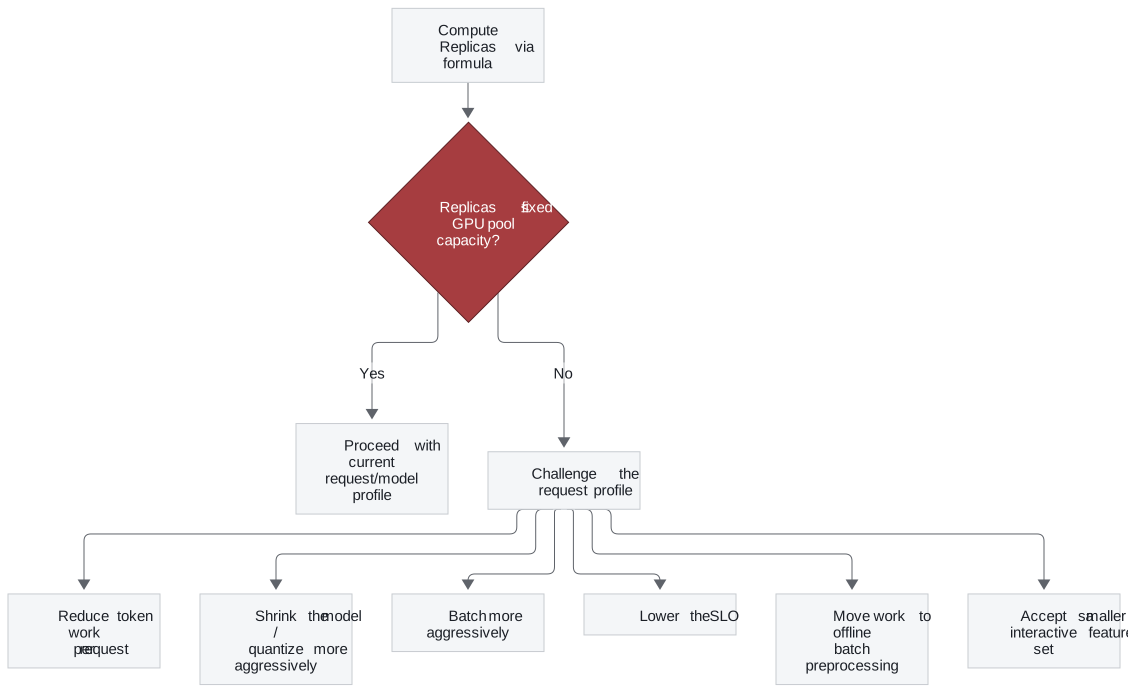
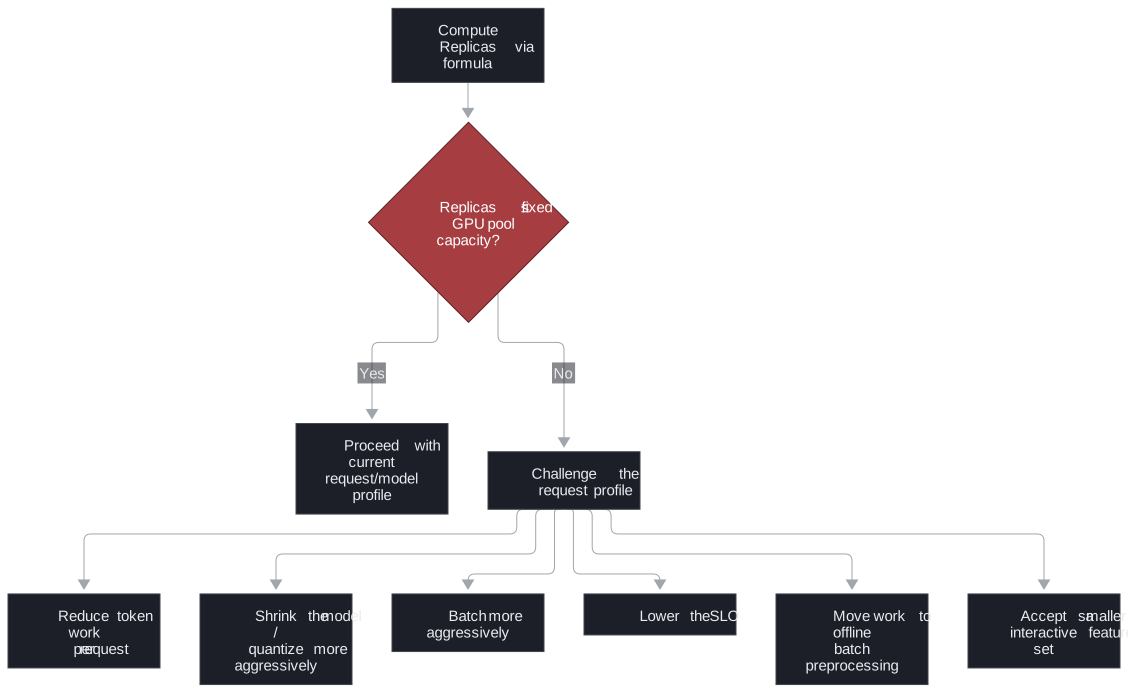
- Suppose the answer is larger than the fixed GPU pool. Hoping harder is not a plan. Cut the token work in each request, use a smaller model, batch harder, relax the SLO (service level objective), shift work into offline preprocessing, or agree to a smaller interactive feature set.
Worked Example: 1,000 Users, 20 QPS
- The case supplies 1,000 users who drive a peak of 20 QPS in a surge window. Everything else is my assumption. A typical request costs 2,000 tokens of model work, covering retrieval augmentation and the generated output. At our chosen batch shape, a replica holds 120 tokens/sec. I'd aim for 70% utilisation:
$$ Replicas = \left\lceil \frac{20 \times 2000}{120 \times 0.70} \right\rceil = \left\lceil \frac{40000}{84} \right\rceil = 477 $$
- The result is meant to feel wrong. It says the assumptions are likely wrong for a government deployment behind an air gap, where the GPU pool is fixed.
- Do not defend 477. Question the request profile:
- Not all of the 20 QPS may be LLM (large language model) inference. Much of it could be retrieval or metadata lookups.
- Chunking, caching or form-based extraction might shrink the average model work behind each request.
- The customer's workflow could really be batch-first. Then a queue with a nightly SLA (service level agreement) is the better fit.
- This is why you estimate at all: the arithmetic forces the design towards something real.
🎯 Interview Pointer: Interviewers often choose numbers that give a ridiculous replica count on purpose. They want to see whether you cling to the result or question the assumed request mix. State the formula, reach the awkward number, then move to how the workload shape could change. Do not ask for more hardware.
Sensitivity Analysis: Baseline vs. 10x Growth
- Strong answers give ranges instead of fake exactness. A sensitivity view beats one heroic number because it shows which design lever matters most.
| Scenario | QPS | Avg tokens/request | Effective token demand | Replica implication | Design pressure |
|---|---|---|---|---|---|
| Baseline illustrative case | 20 | 2,000 | 40,000 tokens/sec of demand, counted before headroom | The toy formula gives 477 replicas, a sign that this request mix cannot fit the fixed GPU pool | Steers you to batch or offline processing, less work in each request, or a far smaller model fraction |
| 10x growth case | 200 | 2,000 | 400,000 tokens/sec of demand, counted before headroom | About 4,760 replicas on the same toy assumptions | Shows the same architecture would break badly; you would need to partition the workload, precompute, or serve it another way |
- Direction matters more than the exact figures. In an enclave, ten times the load is not fixed by buying more of the same. The fixed GPU pool, the storage and the operational process cannot stretch on demand.
What Changes First at 10x Growth
- More users? Identity, audit and queueing feel the strain before raw inference does.
- More pages? The index grows, and its rebuild time or storage bandwidth may become the limit.
- Longer documents? The bottleneck moves to token count and context length.
- Stricter SLOs? You need more headroom, and the fixed GPU pool runs short.
- State uncertainty plainly: "These numbers are illustrative. I'd build the first deployment around the 20 QPS peak, plus a growth factor and some rollback margin. If the real request mix leans towards batch, the interactive pool gets smaller. If the average request is longer, we either add replicas or narrow what each request may ask for."
- I expect per-request token demand to steer component choice and partitioning more than anything else:
- Light requests → one general-purpose inference tier with retrieval may do the job.
- Heavy requests → the design tends to split three ways: cheap preprocessing up front, a retrieval/rules layer in the middle, and a small set of expensive inference workers.
- Inside an enclave, each added replica eats scarce offline capacity. Each added dependency makes updates and audits heavier.
SLIs Tied to the Workflow
- Pick SLIs (service level indicators) whose movement a customer would notice:
- Availability: share of working hours in which the system takes jobs and hands back results.
- Latency: how soon a submitted document yields its first useful result; separately, how long a whole batch takes.
- Freshness: time from the arrival of approved content until it can be searched or used by the model.
- Quality: accuracy of extraction, relevance of retrieval, or the rate at which analysts accept output.
- Security: whether the network, identity, signing and audit boundaries hold.
- Cost: GPU hours, storage footprint, support load and what a rollback costs.
- Fit objectives to the workflow. If analysts review results interactively, the interactive latency budget is the SLO that matters most. If ingestion runs nightly, freshness and completion time outrank latency per request.
- A latency budget breaks the end-to-end target into parts you can control: upload, preprocessing, retrieval, inference, validation and rendering the response.
- When inference eats most of that budget, you likely need a smaller model, a shorter context or retrieval done ahead of time.
- What to say in the interview: work out size from the peak request rate, the average token work and the throughput of the fixed GPU pool. Turn that into a replica count, a storage footprint and headroom. Keep average load apart from peak load. Build SLOs around the customer's workflow. Use sensitivity ranges to find the assumption that moves the design most. Reshape the workload before you ask for unlimited hardware.
Tutorial 3 · 10 min — The full lesson: how to reason through this case from first question to rollout.
4. Architecture and End-to-End Flow
Two Worlds Separated by a Controlled Update Path
- The clearest way to defend this design is to walk one request through it twice. On the first pass everything works. On the second, something critical has gone missing.
- Picture the scenario. Inside the restricted or classified network, a user submits a packet of documents. They want it classified, want fields pulled out of it, or want it redacted. The answer has to be useful and auditable, and producing it must not rely on the internet at all.
- One hidden constraint shapes everything else. Software, models and metadata reach the offline side through a single controlled update path and no other way. So we deliberately split the design into two worlds: an online side where things get built, and an offline side where they run.
Nine Components in Dependency Order
- Present the components in the order they depend on one another, not the order they would sit on a slide:
- Connected build environment — gathers source code, pinned dependencies and model artifacts ahead of export.
- Artifact signing service — signs whatever bundle crosses the boundary and issues attestations that anyone can check.
- Transfer staging zone — holds each bundle in quarantine for inspection until the offline side admits it.
- Offline registry and package mirror — the one trusted local store for every approved model package, container image and library.
- Local orchestrator — runs canary rollouts, applies deployment policy and decides where services run.
- Model server — hosts the local model, or the inference runtime, that the document pipeline calls.
- Document pipeline — takes documents in, runs OCR/parsing, chunks them, retrieves context, scores, redacts and builds the final result.
- Local identity provider — confirms who each user and service is, without leaving the boundary.
- Local telemetry stack — collects audit events, logs, metrics and traces, and exports none of it.
- The main trust boundary separates the build environment, the only connected part, from everything else.
- Boundaries inside the enclave count too: orchestrator versus workloads, identity versus services, document pipeline versus telemetry store. Cutting the network link does not make untrusted code vanish. It moves the threat model away from internet exposure and towards admission control, least privilege and a strong audit trail.
Top-Down Architecture Diagram
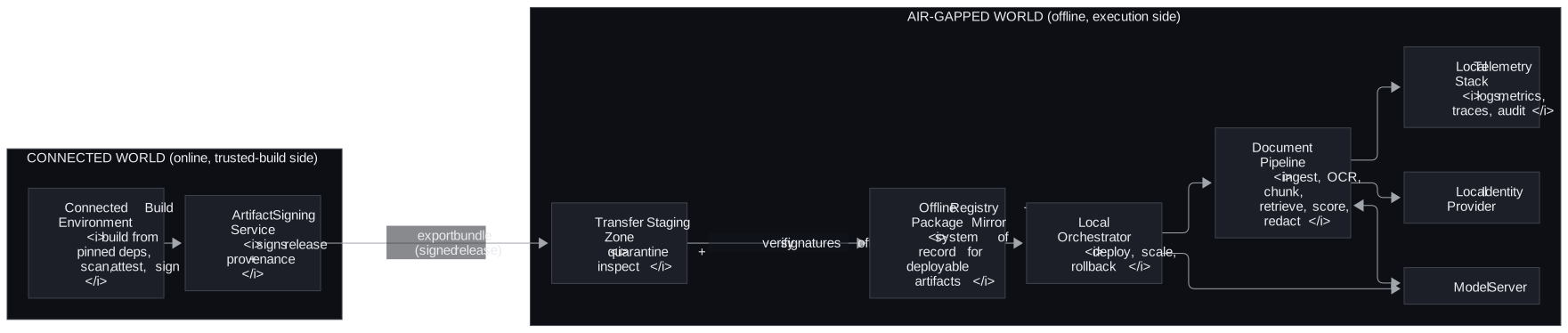
- Each box earns its place by meeting a requirement. None is there just to fill out the picture:
- Connected build environment → inputs that can be rebuilt identically.
- Signing service → evidence of exactly what crossed the boundary.
- Transfer zone → unvetted material never lands straight on the offline side.
- Registry and mirror → deployments stay deterministic.
- Orchestrator → keeps the runtime under management.
- Model server and document pipeline → do the actual work.
- Identity and telemetry stacks → every access is authenticated and every operation can be audited.
System of Record vs. Cache vs. Queue
- Getting this distinction right is what sets a strong answer apart from an architecture that merely looks good:
- System of record: approved packages and images live in the offline registry. User and service identities live in the identity provider. The audit log records each deployment and its time.
- Cache: model weights kept locally in memory, retrieval indexes or frequently used document fragments, and any response cache that saves repeating costly computation.
- Queue: jobs that ingest documents, tasks that scan, attest and export, and background jobs for enrichment or post-processing.
- External dependency: end-user traffic has none. The single thing from "outside" is the controlled build pipeline that produces the offline bundle.
- A frequent error is to let a cache act as if it were the source of truth. Air gaps make this worse. Nothing online refreshes it, so stale entries can linger unnoticed for a long while.
- When the registry marks an image as approved, the runtime must not quietly fall back to an older copy it has cached.
- A service credential revoked in the identity provider must be revoked everywhere, consistently, by the local control plane.
🎯 Interview Pointer: Interviewers love to probe the split between system of record, cache and queue. For every component you draw, be ready to say which bucket it belongs to and what breaks once its data goes stale.
End-to-End Happy Path
- Tell the happy path as a sequence of explicit state changes:
- Build from pinned dependencies. On the connected side, pin code, system packages and model package versions to known revisions.
- Scan, attest, sign, and export bundle. The bundle is checked for policy violations, given a provenance attestation, signed, then packaged ready for export.
- Inspect in the transfer zone. Before anything moves inward, the zone confirms integrity, policy conformance and chain-of-custody.
- Verify signatures offline. This proves that an authorised signer produced the bundle and that nothing altered it on the way.
- Import to local registry. The offline runtime can then pull approved model files, images and libraries from the local mirror.
- Deploy canary. The orchestrator runs a small share of model-serving and document-pipeline capacity against harmless test data.
- Run acceptance tests. They check authentication, ingestion of documents, latency, the quality of outputs, logging, and whether rollback is ready.
- Promote or rollback. A passing canary gets more traffic. A failing one is reverted, and its bundle goes into quarantine for review.
- Building, scanning, attesting, exporting and inspecting are all admin work, and they run asynchronously. In the live system, deployment, request handling and the inference users see are all synchronous.
- State it plainly to the interviewer. Document requests need a synchronous answer from the offline runtime. Updates and the supply chain run in the background, so a user never waits on them.
Sequence Diagram of the Happy Path
Dependency-Failure Drill: Fail Closed
- The fail-closed drill you must be able to run: one transitive package is absent.


- When the package mirror lacks a dependency, the offline system must fail closed. It must never improvise by reaching across the boundary for the missing piece.
- The rule: any unresolved dependency blocks promotion. The bundle stays quarantined in staging or the mirror until someone repairs the dependency and it is approved again.
Backpressure and Flow Control
- Without backpressure, a burst of document uploads can melt an offline service. With it, the service stays stable.
- At ingestion: cap the number of concurrent uploads, check file size and type as early as possible, and queue oversized jobs rather than letting them grab parser resources straight away.
- At the pipeline: shard each document's work on a fixed key: case ID, tenant or document ID. Related state then lands in one place and retries behave deterministically.
- At the model server: limit concurrency, put a ceiling on batch size, and reject or defer work once GPU/CPU saturation passes a safe threshold.
- At the orchestrator: use rollout limits so the canary sees only a small share of traffic until acceptance tests pass.
- The choice of partitioning key matters. It keeps related work local and stops state from one document corrupting another. With document ID as the key, a retry or a partial failure is much simpler to reason through than when requests land on random workers. That matters most when a document's context, its redaction choices and its audit trail must agree.
Component Responsibility Table
| Component | Primary responsibility | State ownership | Notes |
|---|---|---|---|
| Connected build environment | Pin, package and compile artifacts ready for offline use | Source tree and build metadata | Sits outside the runtime trust boundary |
| Artifact signing service | Attest and sign artifacts | Signing keys and provenance records | Keep tight control over who can use the keys |
| Transfer staging zone | Examine each bundle before it is admitted | Quarantine manifests | Never serves runtime traffic |
| Offline registry / package mirror | Hand out approved packages and images | Catalogue of approved artifacts | The authoritative record of what may be deployed |
| Local orchestrator | Deploy services, scale them and roll them back | Desired state and rollout state | Applies policy on site |
| Model server | Run inference | Model runtime state, cached weights | Keep its API small and stable |
| Document pipeline | Ingest, analyse and redact documents, then assemble outputs | Document processing state | Usually the main request path |
| Local identity provider | Confirm who users and services are | Identities, groups, tokens | The authoritative record for access |
| Local telemetry stack | Store audit events, logs, metrics and traces | Observability data | Retain for as long as policy requires |
MVP vs. Later Evolution
- Keep the MVP (minimum viable product) small and opinionated. It needs one each of offline registry, orchestrator, identity provider, telemetry stack, model server and document pipeline, plus a clear canary process.
- Signing, verification and the transfer zone are not optional extras. They ship in the first release, because without them offline updates cannot be defended.
- What comes later: smarter scheduling, routing across several models, better retrieval, reindexing in the background and richer policy engines. These are follow-on features, not prerequisites.
- The signal for the interviewer: first make the offline path dependable and auditable. Only then tune throughput and make life easier for operators.
- Failure overlay to describe out loud: a bundle arrives, but the offline mirror lacks one transitive package. Promotion stalls in the orchestrator, which leaves the canary isolated. The telemetry stack logs the failed rollout. The registry holds the bundle in quarantine. An operator repairs the package on the connected build side and retries.
Control Plane vs. Data Plane
- A diagram only helps if you can talk through how data, identity, state and failure move across it.
- Control plane: signing, verification, deployment, identity and policy.
- Data plane: inference and live document requests.
- Be clear about which workflows are synchronous and which are asynchronous, and about which system owns every durable state transition.
- Why it matters in the job market: this split lets you explain one architecture to customer stakeholders and engineering stakeholders alike.
- What the customer hears: "The system stays inside our boundary, and we can still take controlled updates."
- What engineering hears: "State has a known home, failures have a known edge, and promotion holds no surprises."
- 90-second interview summary: "I'd keep the connected build side apart from the offline runtime, with signing and staging as the only bridge. Inside the enclave sit a local registry, an orchestrator, a model server, a document pipeline, an identity provider and a telemetry stack. Requests are synchronous. Updates are asynchronous and tightly controlled. Deployable artifacts have one system of record: the offline registry. Local telemetry and the identity provider hold the audit trail. My biggest trade-off is security versus how hard updates become. The first production gate is simple: no bundle enters the enclave until it has proved, offline, that it is intact, complete and compatible. After that, a canary proves signature provenance, complete dependencies, working authentication and a rollback path before wider promotion."
Tutorial 4 · 8 min — The full lesson: how to reason through this case from first question to rollout.
5. Data Model, APIs, and Working Code
Three Governable Records
ReleaseManifest(version, artifact_hashes, signatures, dependencies)— the promise a bundle makes, and so the contract you deploy against.- Primary key:
version. Operators need one stable name they can cite, rebuild against and promote. - Lifecycle: written in the connected build environment, then signed, carried into the offline side, validated and staged. Finally it is promoted or turned away.
- Retention: keep the manifest, its signature material and enough dependency detail to show later why the release passed or failed. Audit needs and local policy set the period; no universal standard applies.
- Primary key:
ModelDeployment(model_id, version, hardware, status)— the runtime truth about which model is live, and where.- Preferred primary key:
deployment_id. When one model family can sit in several release states across different targets, add a unique constraint over(model_id, version, hardware). - Without a dedicated deployment identifier, the composite
(model_id, version, hardware)is the natural key. Pick one on purpose. - Lifecycle states:
staged,validated,active,draining,retired. - Retention: hold enough history to answer "Which model served this document when we analysed it?"
- Preferred primary key:
OfflineAuditEvent(actor, action, artifact_hash, time)— which actor took which action, on which artifact, at what moment.- Primary key: usually an event ID. The
(actor, action, artifact_hash, time)tuple serves as the business key. - Lifecycle: append-only. Nobody rewrites an audit row once it exists.
- Retention: follow the customer's audit policy. Purge too eagerly and trust goes; hoard too much and you may break local retention rules.
- Primary key: usually an event ID. The
- Ownership boundaries: the build team holds signed release material up to the handoff into offline validation. The offline runtime holds deployment state. Security/operations holds the audit trail. This split stops a government network from turning into one huge mutable blob.
API Contracts
POST /v1/documents/analyze— the data-plane call that users hit.- Request: an authenticated document payload, plus optional metadata such as an idempotency key or an analysis profile.
- Response: a typed analysis result with a pointer to the model version and a request identifier.
- Authentication stays inside the boundary, through an offline identity provider or a token minted on the network itself. "Just use OAuth" is not an answer.
- Idempotency: if one idempotency key arrives twice with an identical body, the caller gets the same result, or a stable "already processed" reply.
- Errors separate bad input, unauthorised access, no free model capacity and a policy rejection.
GET /v1/models/status— the read path for operators.- It reports each model's deployment state, the live version and whether each hardware target is ready.
- Repeated calls change nothing, so they are harmless. Callers still authenticate, because status data can reveal operational details.
- Its errors tell apart "unknown model", "not deployed" and "temporarily unavailable".
POST /v1/admin/releases/validate— the gate in the control plane.- It takes a pointer to a bundle or the uploaded bundle itself. It checks the manifest signature, compares artifact hashes and confirms every declared dependency is on hand. It returns a structured pass/fail result or a validation report.
- It is idempotent per release identifier. Two runs on one bundle yield a single logical validation record, unless the content changed in between.
POST /v1/admin/releases/{id}/promote— moves a release from validated to active.- Three guards protect it: authorisation, policy checks and optimistic concurrency.
- It refuses when the release cannot be promoted from its current state, when the target deployment moved since the client last read it, or when the live release is not the one the client expected.
- Request and response shapes carry versions, so a later change to the manifest or to validation output cannot break older tooling overnight.
- Versioning does not stop at public APIs. The bundle format, the manifest schema and the audit event schema need it too. When nobody can update the offline environment at will, each breaking change must be planned as a migration, never treated as a light refactor.
Release Verification: The Highest-Risk Code Path
- No component carries more risk than release verification. If the system cannot check a bundle offline, the rest is theatre. Hence the first production gate: no bundle enters the enclave until it has proved, offline, that it is intact, complete and compatible.
from __future__ import annotations

import hashlib
import hmac
import json
from dataclasses import dataclass
from typing import Any, Mapping


class IntegrityError(Exception):
    pass


class ManifestError(Exception):
    pass


class SignatureError(Exception):
    pass


class ValidationError(Exception):
    pass


@dataclass(frozen=True)
class VerifiedManifest:
    version: str
    artifacts: tuple[dict[str, str], ...]
    dependencies: tuple[str, ...]


def canonical_json(obj: Any) -> bytes:
    return json.dumps(obj, sort_keys=True, separators=(",", ":")).encode("utf-8")


def sha256_hex(data: bytes) -> str:
    return hashlib.sha256(data).hexdigest()


def verify_signature(trusted_public_key: bytes, payload: bytes, signature: bytes) -> None:
    # Interview sketch: replace with a real signature primitive such as Ed25519 verification.
    expected = hmac.new(trusted_public_key, payload, hashlib.sha256).digest()
    if not hmac.compare_digest(expected, signature):
        raise SignatureError("manifest signature verification failed")


def _require_str(mapping: Mapping[str, Any], key: str) -> str:
    value = mapping.get(key)
    if not isinstance(value, str) or not value.strip():
        raise ManifestError(f"missing or invalid string field: {key}")
    return value


def _require_list(mapping: Mapping[str, Any], key: str) -> list[Any]:
    value = mapping.get(key)
    if not isinstance(value, list):
        raise ManifestError(f"missing or invalid list field: {key}")
    return value


def verify_bundle(bundle, trusted_public_key: bytes) -> VerifiedManifest:
    manifest_raw = bundle.read_bytes("manifest.json")
    signature = bundle.read_bytes("manifest.sig")

    try:
        manifest = json.loads(manifest_raw)
    except json.JSONDecodeError as exc:
        raise ManifestError("manifest.json is not valid JSON") from exc

    if not isinstance(manifest, dict):
        raise ManifestError("manifest root must be an object")

    version = _require_str(manifest, "version")
    artifacts = _require_list(manifest, "artifacts")
    dependencies = _require_list(manifest, "dependencies")

    verify_signature(trusted_public_key, canonical_json(manifest), signature)

    normalized_artifacts: list[dict[str, str]] = []
    for idx, item in enumerate(artifacts):
        if not isinstance(item, dict):
            raise ManifestError(f"artifacts[{idx}] must be an object")
        path = _require_str(item, "path")
        expected_hash = _require_str(item, "sha256")
        if len(expected_hash) != 64 or any(c not in "0123456789abcdef" for c in expected_hash.lower()):
            raise ManifestError(f"artifacts[{idx}].sha256 is not a valid hex digest")
        actual_hash = sha256_hex(bundle.read_bytes(path))
        if not hmac.compare_digest(actual_hash, expected_hash):
            raise IntegrityError(path)
        normalized_artifacts.append({"path": path, "sha256": expected_hash})

    normalized_deps: list[str] = []
    for idx, dep in enumerate(dependencies):
        if not isinstance(dep, str) or not dep.strip():
            raise ManifestError(f"dependencies[{idx}] must be a non-empty string")
        normalized_deps.append(dep)

    return VerifiedManifest(
        version=version,
        artifacts=tuple(normalized_artifacts),
        dependencies=tuple(normalized_deps),
    )
- Walk through it piece by piece:
canonical_jsonturns the manifest into deterministic bytes before the signature check, so one logical manifest always hashes the same way.sha256_hexproduces a stable digest to compare artifacts against.verify_signatureis labelled a sketch on purpose. Production code needs a genuine asymmetric primitive where this HMAC (hash-based message authentication code) stand-in sits.- Three exception classes tell the caller what broke: the signature, the shape of the manifest or the integrity of the content. Each calls for a different operator response.
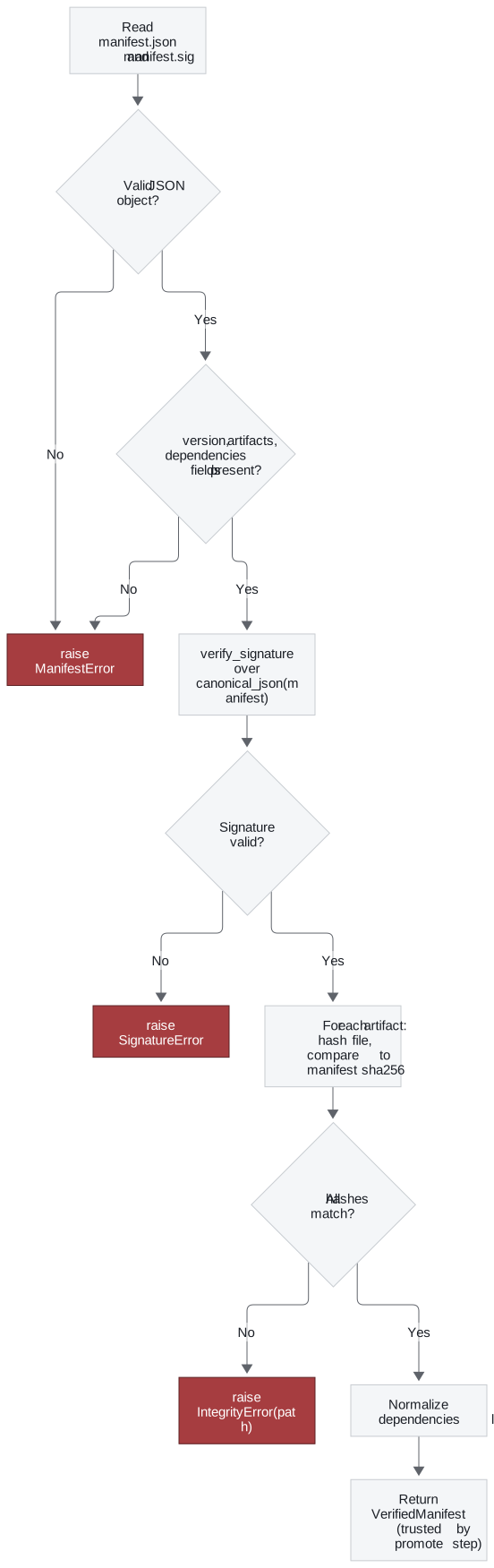
VerifiedManifestis frozen, so nothing can quietly alter a successful validation result afterwards._require_str/_require_listcheck types at the boundary. Malformed input fails early, before any state moves.verify_bundlereads the manifest and signature, parses the JSON defensively and checks the required fields. It verifies the signature over the canonical form, then compares each artifact hash withhmac.compare_digestto avoid timing leaks. It returns a normalised, typed result that a later promote step can rely on.
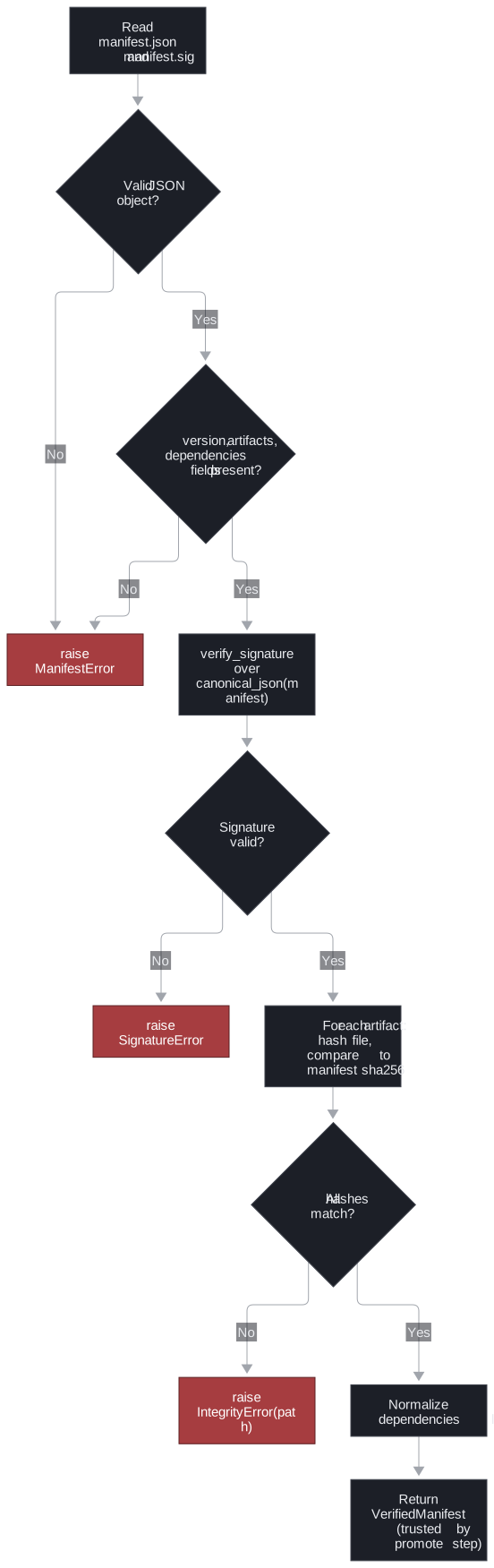
Verify-Bundle Flow
What the Snippet Omits on Purpose
- The sketch leaves out concurrency, retries and observability. They belong to the production layer around the core path.
- Concurrency: promotion should rely on optimistic concurrency in the control plane. Each release object holds a version/revision token that the promote call sends back. If another operator has already moved the deployment state on, the server refuses the write. Two people cannot then push incompatible releases live at once.
- Retries: retry safe reads and validation calls automatically, and nothing else by default. Retry a promotion only when it was built to be idempotent and a write token guards it. Document analysis requests should take an idempotency key, so a client retry creates neither duplicate work nor duplicate audit rows.
- Observability: surround the path with logs, counters and structured audit events. Each validation pass should record who validated which bundle, which hash it checked and, on failure, the reason. An air gap has no external vendor console, so these records are the only practical way to rebuild an incident.
Failure Behaviour to State Explicitly
- Duplicate requests reveal whether a design truly handles idempotency. Say an operator submits one validated bundle twice because the first response timed out. With a matching idempotency key and bundle hash, the second call returns the same validation outcome and does not move state forward again.
- If a promote request is resent after a transient fault inside the boundary, the server either returns the state already reached or rejects the repeat with a clear, stable error: this version is not waiting for promotion any more.
- The key drill is a missing transitive package. When a manifest names a dependency the offline artifact store lacks, validation must fail before installation, not at runtime. That is why
dependenciessits in the manifest rather than in someone's head.
Contract and Failure-Injection Tests
- Full coverage is not the goal. The tests only need to show the candidate knows how the deployment gate acts on a pass and on a failure.
class BundleStub:
    def __init__(self, files):
        self.files = files

    def read_bytes(self, path):
        return self.files[path]


def test_verify_bundle_accepts_known_good_bundle():
    manifest = {
        "version": "2024.10.1",
        "artifacts": [{"path": "model.bin", "sha256": ""}],
        "dependencies": ["tokenizer.json"],
    }
    files = {
        "model.bin": b"weights-bytes",
        "tokenizer.json": b"vocab-bytes",
    }
    manifest["artifacts"][0]["sha256"] = sha256_hex(files["model.bin"])
    manifest_bytes = canonical_json(manifest)
    key = b"trusted-key"
    sig = hmac.new(key, manifest_bytes, hashlib.sha256).digest()
    bundle = BundleStub({
        "manifest.json": manifest_bytes,
        "manifest.sig": sig,
        **files,
    })

    verified = verify_bundle(bundle, key)

    assert verified.version == "2024.10.1"
    assert verified.artifacts[0]["path"] == "model.bin"
    assert verified.dependencies == ("tokenizer.json",)


def test_verify_bundle_rejects_corrupted_artifact_hash():
    manifest = {
        "version": "2024.10.1",
        "artifacts": [{"path": "model.bin", "sha256": "0" * 64}],
        "dependencies": ["tokenizer.json"],
    }
    manifest_bytes = canonical_json(manifest)
    key = b"trusted-key"
    sig = hmac.new(key, manifest_bytes, hashlib.sha256).digest()
    bundle = BundleStub({
        "manifest.json": manifest_bytes,
        "manifest.sig": sig,
        "model.bin": b"tampered-weights",
        "tokenizer.json": b"vocab-bytes",
    })

    try:
        verify_bundle(bundle, key)
        raise AssertionError("expected IntegrityError")
    except IntegrityError as exc:
        assert str(exc) == "model.bin"
- Test 1 (contract test): with a valid manifest, a valid signature and matching artifact hashes, the verifier returns a normalised
VerifiedManifestholding the expected version and dependency list. - Test 2 (failure-injection test): it fakes corruption with a wrong hash and altered artifact bytes, then checks that
IntegrityErrornames the exact path that failed. - A real repository would add a third test that damages
manifest.sigand expectsSignatureError, since a bad signature and a bad artifact need different operational responses. For a whiteboard sketch, one contract test and one failure-injection test are enough.
Why This Is a Strong FDE Answer
- An FDE (Forward Deployed Engineer) does more than draw the architecture. The job is to turn it into production-grade detail a customer can trust.
- The lesson: an answer earns credibility once its state changes, API contracts and failure-safe code are spelled out.
- 90-second implementation summary: I'd ship each release as a signed manifest that lists every artifact hash and declares every dependency. Deployment state lives apart from audit state. Versioned endpoints cover analysis, status, validation and promotion. Every write path is idempotent and uses optimistic concurrency. Release verification is the riskiest part, so I'd build and test it first: typed checks on the manifest, a signature check, a hash check per artifact, and clearly structured failure modes. The result is maintainable AI that runs locally and never crosses the enclave's network, artifact, identity or audit boundaries.
Tutorial 5 · 9 min — The full lesson: how to reason through this case from first question to rollout.
6. Security, Reliability, and Failure Handling
Lead With the Failure, Not the Model
- Open the way a security and operations reviewer would: with the incident that hurts most. The update package lands, yet one transitive package never made it into the offline mirror.
- "Just retry" is the wrong reflex. With no network, a retry cannot conjure an artifact nobody copied in.
- A good answer does something else. It halts the promotion, keeps the manifest and the evidence intact, and shrinks the damage to the smallest slice of the system it can.
Threat-Model the Offline Control Plane
- Inference is only one thing you defend. The local AI capability depends on a chain of signing keys, model artifacts, index files, package repositories, privileged admin actions and update workflows. Any link can be attacked.
- Control 1 — pin and attest every dependency. Nothing crosses into the air-gapped network without it. The release manifest lists each exact version and hash. The installer checks signatures against offline trust roots. Anything outside the known-good set is turned away at deployment.
- Control 2 — avoid telemetry egress assumptions. In a connected product, teams switch on cloud diagnostics, remote metrics and crash reporting without a second thought. Inside the enclave that habit is wrong. Each observability path has to be local-first and approved on purpose. Metrics flow to an internal collector. Support bundles leave only through a controlled operator workflow. A library that silently calls home is a leak, not monitoring.
- Control 3 — treat privileged administration as a high-risk interface. Admin commands live apart from the everyday user flow. Demand local role-based approval for them. Key rotation, index rebuilds, trust-root updates and rollback promotion should each run as a deliberate, explicit operation that leaves an audit record.
🎯 Interview Pointer: Telemetry egress is where candidates slip. Interviewers wait to hear "we'll send logs to our SaaS dashboard", said out of habit. Say plainly that every observability path stays local-first and approved.
Failure Policy: Fail Open, Fail Closed, Degrade, Queue
- A strong FDE (Forward Deployed Engineer) answer sorts each failure into a bucket: fail open, fail closed, degrade, queue, or hand to a human. For example:
- Authentication and signature checks fail closed.
- When the downstream classifier is down, document ingestion can queue, but only inside a bounded local buffer.
- Search on a stale index can degrade, as long as users see a freshness warning.
- If memory runs short, model serving can drop to a smaller approved model, provided that fallback was verified in advance.
- Promoting a bundle or updating a trust root needs a human to approve it.
- This split is what separates a system that is simply down from one that is dangerous.
Five-Condition Decision Table
| Condition | Policy | User-visible behaviour | Recovery path |
|---|---|---|---|
| Missing transitive package | Fail closed | Promotion is blocked; the current release keeps running | Put the mirrored artifact back, then repeat verification |
| Artifact corrupted during transfer | Fail closed | Bundle is refused before installation | Copy it again from the release origin; check hash and signature |
| Model exceeds GPU memory | Degrade or queue | A smaller approved model answers, or the request waits for capacity | Rework routing, or retrain the packaging policy |
| Local certificate expires | Admin actions fail closed; read-only flows degrade where policy permits | Admin operations stop; some reads may carry on | Rotate the cert from the offline trust anchor |
| Update breaks stored-index compatibility | Queue or rollback | Promotion pauses; the old index stays live | Rebuild the index offline, or roll back model and index together |
Blast Radius
- Spell out the blast radius per workflow, per tenant, per dependency and per region (enclave/site).
- On an air-gapped government network, a "region" is often a physical enclave or site, not a cloud geography.
- Where tenants or workspaces can be isolated, one bad index rebuild must not knock out document search across the whole enclave.
- A rollout of a model that fails must leave the audit service valid.
- If policy lets reads continue, a certificate fault in the admin plane must not stop read-only document lookup.
- Give every dependency a containment boundary of its own.
Critical Incident Drill: Missing Transitive Package
- This drill is mandatory because it tests whether a candidate grasps what offline really means. The bundle carries a valid signature, yet operations finds that the installer cannot pull one transitive dependency from the local mirror.
- The tempting mistake is to let the install go ahead "just this once". That is exactly what not to do.
- Containment (immediate):
- Halt the promotion before it writes any partial state.
- Capture the failing dependency graph, plus its exact bundle hash and manifest version.
- Save signer metadata, logs and the artifact itself as evidence.
- Check that the release now in service has not been touched.
- Let the operator know this is not a runtime defect: the mirrored set is incomplete.
- Recovery: use the source of truth to rebuild the offline mirror, prove the dependency closure is whole, and verify hashes and signatures again.
- Prevention: run a dependency-closure preflight before the bundle ever reaches the enclave. A release process that cannot prove completeness must never hand the bundle to the installer.


Other Failure Paths
- Artifact corruption during transfer: check cryptographic hashes and signatures at every hop, not only where the bundle was built. A bundle that verifies at its origin but fails at the enclave boundary is hostile or damaged until shown otherwise. Set the bad artifact aside for investigation; do not overwrite it.
- Model exceeds GPU memory: this is a capacity and packaging problem, and it should never surprise you at runtime. Send the request to a smaller approved model, hold it until a compatible worker frees up, or reject it with a clear operational error. Never let the node crash in the hope that the scheduler sorts it out. Where you can, spot memory pressure before admission. Keep an explicit compatibility map that ties model size, quantisation format and hardware profile together.
- Local certificate expiring: at first this is about availability and administration. It turns into a security problem the moment the system skips checks just to stay up. Issue a short-lived operational certificate, watch its expiry, renew it locally from an offline trust anchor, and keep an escalation path for overdue rotation. Privileged actions should halt, while read-only workflows may keep going in degraded form if policy says so.
- Update breaks stored-index compatibility: give the index format a version that moves with the model and the reader code. The three ship as one unit. They ship only when the new reader can read the old index, or can rebuild it deterministically. If the new release cannot read the current index, pause promotion and let the old path keep serving. A human should step in if nobody is sure what the compatibility matrix says, or if rebuilding would take longer than the recovery objective allows.
Code: Proving One Security Invariant
- Interview code should prove a security invariant rather than walk a toy happy path. The invariant here: a tampered bundle is refused before it is deployed.
from __future__ import annotations

from dataclasses import dataclass
from pathlib import Path
import hashlib
import hmac
import json
import tempfile
from typing import Mapping


class IntegrityError(RuntimeError):
    pass


@dataclass(frozen=True)
class TrustedKey:
    name: str
    secret_key: bytes


@dataclass(frozen=True)
class Bundle:
    root: Path

    def replace(self, relative_path: str, content: bytes) -> None:
        target = self.root / relative_path
        if not target.is_file():
            raise FileNotFoundError(relative_path)
        target.write_bytes(content)


@dataclass(frozen=True)
class AuditEvent:
    action: str
    detail: str


def _sha256_file(path: Path) -> str:
    digest = hashlib.sha256()
    with path.open("rb") as f:
        for chunk in iter(lambda: f.read(1024 * 1024), b""):
            digest.update(chunk)
    return digest.hexdigest()


def _load_manifest(bundle: Bundle) -> Mapping[str, object]:
    manifest_path = bundle.root / "manifest.json"
    if not manifest_path.is_file():
        raise IntegrityError("missing manifest")
    try:
        manifest = json.loads(manifest_path.read_text(encoding="utf-8"))
    except json.JSONDecodeError as exc:
        raise IntegrityError("invalid manifest") from exc
    if not isinstance(manifest, dict):
        raise IntegrityError("invalid manifest")
    return manifest


def _audit(log: list[AuditEvent], action: str, detail: str) -> None:
    log.append(AuditEvent(action=action, detail=detail))


def verify_bundle(bundle: Bundle, trusted_key: TrustedKey, audit_log: list[AuditEvent] | None = None) -> None:
    audit_log = audit_log if audit_log is not None else []
    manifest = _load_manifest(bundle)

    if manifest.get("signer") != trusted_key.name:
        _audit(audit_log, "verify_bundle", "untrusted signer")
        raise IntegrityError("untrusted signer")

    signature = manifest.get("signature")
    if not isinstance(signature, str) or not signature:
        _audit(audit_log, "verify_bundle", "missing signature")
        raise IntegrityError("missing signature")

    expected = manifest.get("artifacts")
    if not isinstance(expected, dict):
        _audit(audit_log, "verify_bundle", "invalid artifact list")
        raise IntegrityError("invalid artifact list")

    # Validate the closure of the bundle before any promotion occurs.
    for relative_path, expected_hash in expected.items():
        if not isinstance(relative_path, str) or not isinstance(expected_hash, str):
            _audit(audit_log, "verify_bundle", "invalid artifact entry")
            raise IntegrityError("invalid artifact entry")
        artifact_path = bundle.root / relative_path
        if not artifact_path.is_file():
            _audit(audit_log, "verify_bundle", f"missing artifact: {relative_path}")
            raise IntegrityError(f"missing artifact: {relative_path}")
        actual_hash = _sha256_file(artifact_path)
        if not hmac.compare_digest(actual_hash, expected_hash):
            _audit(audit_log, "verify_bundle", f"hash mismatch: {relative_path}")
            raise IntegrityError(f"hash mismatch: {relative_path}")

    # Offline trust-root check: the manifest is authenticated with a pinned local key.
    material = json.dumps(
        {"signer": manifest["signer"], "artifacts": manifest["artifacts"]},
        sort_keys=True,
        separators=(",", ":"),
    ).encode("utf-8")
    expected_sig = hmac.new(trusted_key.secret_key, material, hashlib.sha256).hexdigest()
    if not hmac.compare_digest(signature, expected_sig):
        _audit(audit_log, "verify_bundle", "signature verification failed")
        raise IntegrityError("signature verification failed")

    _audit(audit_log, "verify_bundle", "bundle accepted")


def _write_bundle(root: Path, signer: str, secret_key: bytes, model_bytes: bytes) -> Bundle:
    root.mkdir(parents=True, exist_ok=True)
    (root / "model.bin").write_bytes(model_bytes)
    artifact_hash = hashlib.sha256(model_bytes).hexdigest()
    manifest_body = {"signer": signer, "artifacts": {"model.bin": artifact_hash}}
    material = json.dumps(manifest_body, sort_keys=True, separators=(",", ":")).encode("utf-8")
    signature = hmac.new(secret_key, material, hashlib.sha256).hexdigest()
    manifest = {**manifest_body, "signature": signature}
    (root / "manifest.json").write_text(json.dumps(manifest), encoding="utf-8")
    return Bundle(root=root)


def test_tampered_model_is_rejected():
    with tempfile.TemporaryDirectory() as tmpdir:
        bundle_root = Path(tmpdir) / "bundle"
        trusted_key = TrustedKey(name="offline-root-1", secret_key=b"local-trust-root-secret")
        bundle = _write_bundle(
            bundle_root,
            signer=trusted_key.name,
            secret_key=trusted_key.secret_key,
            model_bytes=b"approved-model-bytes",
        )

        bundle.replace("model.bin", b"tampered")
        audit_log: list[AuditEvent] = []

        try:
            verify_bundle(bundle, trusted_key, audit_log=audit_log)
        except IntegrityError:
            assert any(event.action == "verify_bundle" for event in audit_log)
            assert (bundle_root / "model.bin").read_bytes() == b"tampered"
            return
        raise AssertionError("tampered bundle should be rejected")
- The sketch is sized for an interview on purpose. For production, keep this control flow but swap the teaching scaffold for a hardened release verifier. Check the manifest schema explicitly, write structured audit events to local storage, and add tests for the negative cases: signer mismatch, a malformed manifest, a missing file and a broken dependency closure.
- Running cleanly is not what the test is for. It shows that the system will not install a bundle whose integrity it cannot establish.
Evidence, Runbooks, and Operational Readiness
- Runbooks must exist before go-live for node replacement, index rebuild, rollback, certificate renewal, trust-root rotation and verification failure.
- Every runbook names who may run it, which evidence it keeps, which systems it pauses and how success is judged.
- The audit trail captures the operator's identity and approval record, the signed manifest with its hash list, the trust-root fingerprint, installation logs and any rollback decision.
- Later, a customer may ask why a release was blocked. The evidence by itself should be enough to rebuild the answer.
- Skip this discipline and each incident turns into forensic guesswork. Keep it, and operations can show that a release was rejected for a real integrity reason rather than a flaky installer.
Why This Matters for the Job
- A strong FDE goes past the happy-path diagram. They show the design survives stale state, partial failure, dependency outages, hostile input, retries that change nothing, and political pressure to "just make it work."
- They know which failures should queue, which should degrade, which must fail closed and which need a person. They can explain the blast radius, hold on to evidence and back a safety invariant with a test.
- 90-second interview summary: "The offline release pipeline is a high-trust control plane, and I guard it that way. Every dependency is pinned and attested. Signatures are checked against offline trust roots. Telemetry never assumes it can leave the network. Privileged admin is kept apart from normal use. The riskiest failure is a bundle that is incomplete or corrupted. So the system fails closed, keeps the evidence and leaves the running release alone. Runtime problems each get a clear policy: some queue, some degrade to an approved fallback, some need a human. My first production gate: no bundle enters the enclave until it has proved, offline, that it is intact, complete and compatible."
🎯 Interview Pointer: When someone asks for your first production gate, give the same sentence every time, in every section, and learn it by heart: no bundle enters the enclave until it has proved, offline, that it is intact, complete and compatible.
Tutorial 6 · 11 min — The full lesson: how to reason through this case from first question to rollout.
7. Delivery Plan, Observability, and Business Impact
From Prototype to Trusted Production
- A working demo is only the start. The milestone is the customer seriously asking when they can rely on it in production.
- Once that question lands, the interview moves past architecture into delivery. You now need a phased rollout, gates you can measure, named owners and a support model that holds up when the first incident hits.
- Inside an air gap, delivery belongs to the design itself. If the team must improvise to move, verify, install, watch or roll back the software, what they have is an encouraging demo, not something they can deploy.
- The FDE's job is to turn the prototype into an operating path: safe enough for the enclave, dull enough for operators, valuable enough for users.
Four Phases That Move Risk Out of the Dark


- Stand up a staging environment on identical hardware.
- Owner: infrastructure or platform engineering, with a security review by the enclave team.
- Exit criteria: trust roots, OS image, GPU/CPU profile, storage layout and node class all match production, so install and runtime results are representative.
- Why it matters: a staging setup built for convenience masks the problems that bite later, such as package incompatibility, driver mismatch, disk layout surprises and painful upgrades.
- Rehearse the signed transfer.
- Owner: release engineering runs it; security and operations watch the drill together.
- Exit criteria: the team carries a release bundle along the controlled transfer path, checks its signatures offline and installs it with no call beyond the boundary.
- Why it matters: real systems often fail at the transfer step. A plan of "someone will hand-carry it" falls short unless the handoff is written down, repeatable and auditable.
- Run a canary on a single node.
- Owner: operations runs it, while the product owner and an incident responder stay on call.
- Exit criteria: a single production node takes the new release, handles real traffic and stays within the agreed health thresholds for a set observation window.
- Why it matters: the canary contains the risk. No cloud-scale rollback shortcut exists on a closed network. So the first live node must show that configuration, dependencies, model and bundle behave well together.
- Keep a tested rollback bundle and its runbooks.
- Owner: operations carries out a rollback, release engineering keeps the artifacts, and the technical lead approves.
- Exit criteria: the last known-good bundle sits stored, tested and ready for immediate use, along with its escalation path, operator checklist, rollback steps and signatures.
- Why it matters: treat rollback as a prepared artifact rather than an idea. When a release goes wrong, the team needs a trusted route back, not a scramble to rebuild confidence under pressure.
- Each phase gets an owner, a gate and a stopping point before damage spreads. That separates a staged rollout from deployment by hope.
Technical Health Metrics
- Offline install success rate
- Calculation: offline installs that succeed divided by offline installs attempted, both counted over the same release window.
- Data from: installer logs, release logs and node boot records.
- Owner: release engineering.
- Alert threshold: a rate under baseline, or failures on more than one staging or production node in one release cycle, halts expansion. Check bundle integrity, dependency drift and environment mismatch.
- Signature verification failures
- Calculation: how many signature checks on bundles, artifacts or manifests fail in transfer or at install.
- Data from: transfer logs, plus the verification logs written at install time.
- Owner: security engineering or release engineering, whichever the local operating model assigns.
- Alert threshold: treat any unexpected failure as a go/no-go blocker until the root cause is clear.
- Model throughput and latency
- Calculation: documents or pages handled per unit of time, together with request latency at the chosen percentile on user-facing paths.
- Data from: local performance counters and service telemetry.
- Owner: platform or ML (machine learning) operations.
- Alert threshold: when latency leaves the band users accept, or throughput drops under the demand forecast, look at queue limits, hardware saturation, model quantisation or batching changes.
- Capacity saturation
- Calculation: how much of the safe operating headroom is in use, across token budget, queue depth, disk I/O, memory, GPU or CPU.
- Data from: service queues and host metrics.
- Owner: infrastructure or SRE (site reliability engineering).
- Alert threshold: if the system runs close to its ceiling for a sustained period, scale up, shed load or throttle workflows before it turns unstable.
- Mean time to repair
- Calculation: the average time between declaring an incident and restoring service.
- Data from: incident timelines.
- Owner: incident management together with the primary on-call team.
- Alert threshold: if repair times climb from one release to the next, the team probably lacks documentation, automation or spare capacity.
- Release age
- Calculation: time elapsed since the approved bundle now running was signed off and deployed.
- Data from: deployment records and the release registry.
- Owner: release manager.
- Alert threshold: a release that is too old has drifted away from the latest security fixes and operational lessons. Releases that change too fast get too little soak time.
User and Business Metrics
- These are distinct from technical health. A perfectly healthy system can still go unused.
- Adoption metrics: repeat use, active users, documents submitted, and the share of workflows done with no manual workaround.
- Business outcome metrics: time saved on each case, a lighter manual review load, more analyst throughput, and fewer missed deadlines or rework cycles.
- Outcome owner: normally the business sponsor or the operations manager, backed by product and the FDE.
- Tie the layers together. Faster throughput means little if analysts distrust the output. And if users adopt it but still correct results by hand, the workflow gain is smaller than the demo implied.
A Dashboard That Tells One Story
- Avoid a wall of green lights. The dashboard should trace how value for users depends on each layer of the stack.
- Top row: user outcome.
- Documents handled in each shift.
- Mean turnaround time per case.
- Proportion of cases finished without any manual fallback.
- Middle row: service behaviour.
- Offline install success rate for each release.
- Signature verification failures for each transfer event.
- Model latency and throughput per node.
- Indicators of queue depth and saturation.
- Bottom row: operational control.
- Age of the release now running.
- Whether a rollback bundle is available.
- Mean time to repair, alongside open incidents.
- The most recent successful signed transfer.
- Laid out this way, the dashboard settles the question that counts most in a closed network. Is the user's problem getting better because the system is healthy? Or is the system just staying alive while the workflow stays painful?
🎯 Interview Pointer: "How would you dashboard this?" comes up often. Answer with three rows (user outcome, service behaviour, operational control) rather than a flat list of metrics. It shows you reason in causal layers instead of collecting green lights.
Ownership, Gates, and Rollback Triggers
- Product or business owner: sets the case-review workflow and decides what success means.
- Release engineering: packages the artifacts, signs the bundles and keeps the release records.
- Security: signs off on trust-root handling, audit evidence and the transfer process.
- Operations or SRE: monitors health metrics, runs the canary and carries out rollback.
- ML or platform engineering: answers for model performance, runtime efficiency and compatibility.
- Help desk or support lead: sorts user problems, training gaps and documentation defects.
- Go/no-go gates: the first two apply the rule that no bundle enters the enclave until it has proved, offline, that it is intact, complete and compatible.
- Offline verification of the bundle passes.
- The bundle is complete and fits the target node class.
- On hardware close enough to production, the staging run shows the expected behaviour.
- Latency, throughput and saturation on the canary node stay within thresholds.
- Someone has actually tested the rollback bundle; archiving it is not enough.
- Rollback triggers: signature failures that repeat, an install failure nobody can explain, a latency regression on the canary, a climbing error rate, or any sign that the release puts enclave integrity at risk. In an air-gapped setting, "we'll debug it live" is no plan. Saying it means the team never had a working way back.
Standardisation Strategy
- This sorts what should be the same for every customer from what should stay local:
- Configuration: approval thresholds, retention rules, document types, queue limits, which approved offline model to use, and the rules that route workflows.
- Adapter: importers that read the customer's document sources, connectors that export to case systems, and translation layers that map local formats into the analysis pipeline.
- Shared service: the release registry, audit logging, bundle validation, signature verification and model serving primitives. These are strong candidates to reuse across enclaves.
- Core product: the document analysis engine, the health-check framework, the offline package manager and the discipline of rollback. Improve these and every deployment benefits.
- This split shows product thinking, not only implementation. The FDE should not hand-build one-off integrations forever. The goal is to turn repeated local pain into reusable product capability while respecting every customer boundary.
Risk Register
- Risk: the offline bundle lacks a transitive package.
- Owner: release engineering.
- Mitigation: dependency lockfiles, a preflight check that validates the bundle, and an install rehearsed in staging.
- Trigger: an install fails, or an import cannot be resolved at boot.
- Risk: signatures do not match during transfer.
- Owner: security engineering.
- Mitigation: validating the trust root offline, checking signed manifests, and transfer steps that need dual control.
- Trigger: any verification failure nobody expected.
- Risk: on one node, model latency goes beyond what users will tolerate.
- Owner: platform or ML operations.
- Mitigation: a smaller variant of the model, adjusted batching, or moving the work to other hardware.
- Trigger: the canary shows a latency regression or queues keep growing.
- Risk: operators need tribal knowledge to support the workflow.
- Owner: support lead and technical lead.
- Mitigation: incident drills, runbooks, training, and explanations attached to alerts.
- Trigger: the same questions keep coming, escalations stall, or people handle cases inconsistently.
The Delivery Story the Interviewer Wants to Hear
- The prototype runs, and the customer wants to know when it will be production-ready. "After we tune the model some more" is the wrong reply.
- The right reply takes four steps from prototype to staged rollout. Build staging on hardware identical to production, rehearse the signed transfer, run a canary on one node, and keep a tested rollback bundle with runbooks.
- Track release age, mean time to repair, saturation, latency, throughput, signature verification failures and offline install success rate.
- Track business outcome, adoption, model quality and technical health as separate layers. Only then can you tell whether the product really makes the workflow better.
- Name owners and set gates, so a bad release halts before it turns into an incident.
- Measurable customer impact statement: the system counts as a success only when analysts use it, documents are handled faster and more consistently, and the operating team keeps it running as maintainable AI that runs locally and never crosses the enclave's network, artifact, identity or audit boundaries.
Tutorial 7 · 13 min — The full lesson: how to reason through this case from first question to rollout.
8. Interview Walkthrough, Trade-Offs, and Practice
Minute Zero: Open With the Customer Outcome
- Lead with what the customer gains, phrased the way they would say it: "We want local AI we can maintain inside an air-gapped government network. Updates have to be controlled, nothing can lean on the internet, and we need an audit trail that stands up to scrutiny."
- It shows you heard the operating constraint, and it keeps you out of a stock chatbot design.
- Before you draw anything, get the interviewer to confirm which boundary carries the most risk:
- What does the air gap actually protect?
- Is the isolation total, or do governed transfer points exist for media, packages and logs?
- Are we deploying into one secure enclave, several disconnected sites, or a staged network split into separate trust zones?
- Should analysts share one service, or do especially sensitive teams need their own isolated workstations?
- Spend minutes by risk, not by diagram size. Software ingress, provenance, identity and rollback deserve the most. Cosmetic model debates and over-tuned UI features deserve the least.
- Announce the plan out loud: "First I'll cover how software gets into the enclave and how we show it's safe. After that, we can walk the request path and how the team runs it."
A 50-Minute Pacing Plan


- 0–5 minutes: discovery and constraints
- Give the customer outcome back in a single sentence.
- Pin down the air-gap boundary, how updates happen and what auditors expect.
- Ask who the users are, which document types matter and whether success means search, extraction, classification, summarisation, or all of them.
- Check where it runs: centrally, on analyst workstations, or both.
- Flag your riskiest assumption and promise to return to it.
- 5–10 minutes: scale and success criteria
- Estimate daily documents, typical size, peak concurrent analysts and freshness needs.
- Without given latency targets, state them in words: interactive queries feel quick; batch jobs may run slower.
- Track user adoption, offline install success, signature verification, release age and incident recovery time.
- Treat every capacity figure as illustrative until the customer confirms the workload.
- 10–18 minutes: architecture overview
- Sketch the trust zones: outside sits the build environment; a transfer gate links it to the enclave, which holds the admin plane, audit store, document pipeline, inference service, model registry and package repository.
- Keep the data plane apart from the control plane.
- Documents move inward; results and logs reach only approved destinations; nothing relies on cloud telemetry.
- No path ever breaches the identity, artifact or audit boundary.
- 18–28 minutes: trade-offs and system design decisions
- Bigger-model quality against hardware fit.
- Containers or virtual appliances.
- Update cadence against accreditation cost.
- A central cluster or workstations.
- Justify each by customer value and running cost, never taste.
- 28–35 minutes: security, provenance, and failure handling
- Cover signed artifacts, pinned dependencies and repeatable builds.
- Show a patch passing a controlled import gate and checks before promotion.
- Explain offline debugging with reproducible replay, health endpoints, structured event traces and local logs.
- Run the drill: new model weights, old index. What happens?
- 35–42 minutes: rollout and operations
- Walk through staging, the canary, rollback and user training.
- Say who owns each area: the platform, security, support and the analyst community.
- Show release age and approval gates lowering risk without freezing progress.
- Explain reuse in similar enclaves.
- 42–50 minutes: recap and follow-up defence
- Give the ninety-second version of the architecture.
- Point out the biggest trade-off.
- State the first production gate.
- Take questions; tie each answer back to boundaries, provenance or rollback.
Trade-Off: Model Size vs. Hardware Fit
- This is usually the first tension interviewers probe.
- Extraction and summaries may improve with a bigger model. The cost: it may not fit in local GPU memory, it answers slower, patching gets harder and the customer may have to buy or borrow hardware.
- A smaller model fits easily and is simpler to support, yet may struggle with noisy documents, specialised vocabulary or long-context reasoning.
- "Always biggest" and "always smallest" are both wrong. Optimise for the mission:
- For triage or structured extraction, a reliable, well-tuned small model can beat a brittle large one that is costly to maintain.
- Subtle legal or technical interpretation can justify bigger inference hardware, but only if enclave operators can sustain and safely patch it.
- Interview line: "I'd pick the smallest model that clears the quality bar on the customer's own documents. Each step up in size competes for enclave hardware, adds latency and adds accreditation work."
Trade-Off: Containers vs. Virtual Appliances
- Containers give portability, repeatable deployment and cleaner separation of concerns. They fit an enclave with an existing platform team and components refreshed one at a time.
- A virtual appliance seals the stack in a fixed boundary with fewer moving parts, which some security teams find easier to review.
- The real tension is operational complexity against governance simplicity:
- Pick containers if efficient scaling, controlled patching and reusable components rank highest.
- Pick an appliance if the customer prefers one tight, inspectable unit and slow, deliberate change.
- Let the organisation decide, not purity. An existing hardened virtualisation standard favours the appliance. An existing secure container platform favours containers for upkeep and reuse.
Trade-Off: Update Frequency vs. Accreditation Cost
- Frequent updates cut vulnerability exposure, lift model quality and speed feedback. Yet each one must be packaged, signed, transferred, verified, staged, tested and approved, and may trigger re-accreditation.
- "Ship weekly because we're agile" is wrong. Size the release train to the governance load the customer can carry:
- Keep urgent security patches on a separate track from new features.
- Prebuild trusted update bundles.
- Promote from dev to staging to the enclave.
- Make each high-friction change smaller, more predictable and easier to audit, so fewer are needed.
- Strong phrasing: "I'd favour fewer releases that we trust more. In an air-gapped setting, change costs you in engineering and in governance."
Trade-Off: Central Cluster vs. Workstation Deployment
- One central cluster is easier to manage and observe, and every analyst reaches the same models. It suits many analysts on one service, where a managed platform is allowed.
- Workstations help on a heavily segmented network, at low volume, or when the capability must survive limited central infrastructure.
- Decide on user count, concurrency, isolation needs and how much central administration the customer can sustain.
- Workstations reduce reliance on shared infrastructure, at the price of harder patch distribution, more support and weaker consistency.
- A central service raises reuse and control, but becomes one operational asset to protect and monitor closely.
- If the enclave can host it, start central: governance and updates are easier there. Fall back to workstations for isolated teams or cut-off sub-enclaves.
🎯 Interview Pointer: The four trade-offs follow one pattern. Lay out both options, name the deciding factor in terms of the customer's real constraints, then commit to a default and say when you would leave it. Use the same pattern live for trade-offs this section does not list.
Four Hard Follow-Up Questions
- "How do patches enter the network?"
- Via controlled import, never casual file copying. Builds happen outside the enclave; each patch is signed, scanned and packaged as an immutable release artifact.
- It crosses by a customer-approved transfer mechanism into a quarantine or staging repository inside the air gap.
- Before promotion, the enclave checks the signature and dependency manifests and runs regression tests.
- If pushed, split emergency security updates from planned releases. Emergencies still need provenance and validation but can use a faster approval path with pre-agreed criteria. Every crossing carries a named owner, a checksum or signature, and a promotion record.
- "With no cloud telemetry, how do you find faults?"
- On site, by design, with enough instrumentation that nobody guesses. The enclave keeps its own audit events, local metrics, health checks, trace correlation IDs and structured logs.
- Replayable fixtures from representative documents let you reproduce failures offline.
- Support flow: once an analyst flags a fault, record the index revision, document hash, model version, request context and involved service logs. You can then reproduce it with no data leaving the network. If policy bars full payloads, keep the smallest safe subset or a redacted reproduction bundle.
- Principle: disciplined internal observability plus rich release metadata replace external observability.
- "The weights changed but the index didn't. Now what?"
- It probes whether you see coupled artifacts. Version model and retrieval index together as a compatible pair.
- New weights that alter embeddings, tokenisation or ranking behaviour may force an index rebuild or revalidation.
- Index schema, embedding pipeline, prompts, tokeniser and model package form a single compatibility surface.
- A pure runtime gain behind the same interface may keep the index. A representation change needs a rebuild, or a parallel index staged to compare outputs before traffic moves.
- You show the unwritten contract between retrieval and generation, and a safe upgrade path rather than just "updating the model."
- "How do you prove build provenance?"
- As chain of custody: where the artifact came from, which code built it, which dependencies went in and who approved its entry to the enclave.
- The evidence: artifact hashes, reproducible build steps, pinned dependency manifests, tagged releases or signed commits, plus a verification record at every hand-off.
- For detail, a build system emits attestations and policy checks verify them before install.
- Never claim absolute proof. You get strong evidence and a control you can defend, nothing magical. It ends the guesswork when an auditor or operator asks, "What exactly is running here?"
Common Weak Answers and Repairs
- "Let's run our usual cloud stack on-prem." → Repair: name the cloud dependencies that would breach the air-gap boundary, and the enclave-local services that replace them.
- "Pick the largest model we can get." → Repair: tie the choice of model to what the hardware holds, the latency users accept and the cost of upkeep.
- "Security can handle the rest." → Repair: show that you own the artifact flow, identity, logs and rollback.
- "We'll patch monthly." → Repair: explain release trains, the emergency-fix path and the approval cost every update brings.
- "Logs can wait; we'll look when something breaks." → Repair: say what you must capture from day one so offline debugging is possible.
- "Model and index are independent." → Repair: admit that embedding behaviour, retrieval quality and index freshness have to stay compatible.
- To sound senior, drop the generic answer and say: "That works in plenty of environments. In an air-gapped enclave, though, the hard part isn't technical feasibility. It's managing change safely."
Self-Scoring Rubric
- Discovery: Did you surface the customer's true outcome, where the boundaries sit and which unknowns are most dangerous?
- Estimation: Did you convey a sensible scale and capacity, and flag numbers as illustrative where needed?
- Architecture: Were the update flow, the trust boundaries, and the data and control planes each kept separate?
- Depth: Did you dig into the riskiest areas rather than give every box the same airtime?
- Security: Did you cover provenance, identity, transfer controls, logging and rollback, while admitting no control makes risk vanish?
- Delivery: Did you show the path from prototype through staged rollout to production support?
- Communication: Were you crisp and structured, and did you welcome redirection?
- Winning answers show judgement, not box count: what matters, what can wait, what needs control and how the customer gains.
The Final 90-Second Summary
- "I'd run document analysis inside the air gap as an enclave service under central management. Signed releases come in through a controlled import path. The model and index ship together as versioned bundles. Local observability lets us support it offline. On model size, I'd go as small as approved hardware allows while still passing the customer's quality bar on their documents. Accuracy matters, but so do hardware fit, update cost and accreditation friction. If the customer already runs a secure platform, I'd use containers. If governance simplicity comes first, I'd switch to a virtual appliance. My biggest risk is the tension between how often we update and how much review each update needs. A staged release train, signed artifacts and bundles we can roll back keep that in check. The first production gate: no bundle enters the enclave until it has proved, offline, that it is intact, complete and compatible. After that, an in-enclave canary has to show verified provenance, steady latency and a support runbook we've already tested."
- It works because it ties the design to the customer's goal, maintainable AI that runs locally and never crosses the enclave's network, artifact, identity or audit boundaries, and proves you can hold the design under pressure.
Practice Assignments
- Solo exercise: Without looking at this page, write your own 90-second answer to this scenario. Then cut it again under one rule: a sentence stays only if it names a production risk, defends a trade-off or makes a boundary clearer.
- Pair mock: One person plays a sceptical security reviewer whose only questions are follow-ups on patches, provenance and logging. The candidate may say "secure," "robust" or "scalable" only if they define the mechanism behind the word straight away.
- Implementation exercise: Map the life of a single enclave update: commit the code, build, sign, stage, import, validate, promote and roll back. Flag each step that alters the audit log, the index or the model artifact. Then pick the exact step where you would halt the rollout if the weights changed and retrieval quality dropped.
- What to remember under interview pressure: when lost, come back to what the customer needs, where trust ends, how releases travel and how you undo one. Great FDE (Forward Deployed Engineer) answers are structured, carry believable numbers, stay safe without theatre, keep the customer in view and name trade-offs openly.
Tutorial 8 · 11 min — The full lesson: how to reason through this case from first question to rollout.
Coverage Notes
We scored this design in a single review against our standard rubric, which has 20 items grouped into 4 phases.
Phase 1 — Problem Framing & Discovery
- Item 1 (turning a feature into a business outcome): Covered. Section 1 restates the goal as an outcome and lists the business results behind it.
- Item 2 (mapping stakeholders and personas): Covered. The stakeholder table in Section 1 handles it.
- Item 3 (questions whose answers reshape the design): Covered. Section 2 poses six discovery questions, then turns them into a decision tree.
- Item 4 (splitting and ranking requirements): Covered. Section 2 separates functional from nonfunctional needs and ranks them as must, should and could.
- Item 5 (stated non-goals and scope limits): Covered. Section 2 spells out what the MVP (minimum viable product) will not support.
Phase 2 — Estimation & Architecture
- Item 6 (rough scale and capacity arithmetic): Covered. Section 3 gives the replica formula and works one example through it.
- Item 7 (unit economics and what drives cost): Absent. The Cost SLI (service level indicator) in Section 3 and the rollout's cost talk stay qualitative about cost drivers and control. We build no unit-economics view, such as cost per document or per analyst-hour, and we invented no figures.
- Item 8 (how components and data move from end to end): Covered. Section 4 supplies the component list, the diagrams and the happy-path sequence.
- Item 9 (records and interface contracts): Covered. Three records and four API contracts are defined in Section 5.
- Item 10 (build versus buy, vendors and model choice): Partial. Section 8 weighs model size, yet it assumes every part is built in-house. It never compares a custom build with an off-the-shelf or vendor air-gapped platform.
Phase 3 — Trade-offs, Security & Reliability
- Item 11 (named pairs of trade-offs, each with a fair verdict): Covered. Section 8 sets out four core trade-offs.
- Item 12 (threats and the controls that answer them): Covered. Section 6 threat-models the offline control plane.
- Item 13 (failure modes and reliability drills): Covered. Section 6 has a decision table plus a drill for a missing transitive package.
- Item 14 (how the system gets tested): Covered. Contract tests and failure-injection tests appear in Sections 5 and 6.
Phase 4 — Delivery, Governance & Communication
- Item 15 (metrics in layers, plus observability): Covered. Section 7 measures three layers: technical health, users and the business.
- Item 16 (staged rollout, risk register and rollback gates): Covered. Section 7 pairs a four-phase rollout with a risk register.
- Item 17 (depth on regulation and governance): Absent. Internal governance ideas such as accreditation, approval gates and audit trails run all through the design. Yet it never names a regulatory framework, for example FedRAMP, ITAR or NIST 800-53. The design is framework-agnostic on purpose, so we left the item Absent rather than invent one.
- Item 18 (responsible AI and risks past the obvious failure): Covered. We handle it through correctness, governance and integrity (audit evidence, signed provenance and a fail-closed policy) rather than through bias or fairness. That material is not counted a second time under item 12.
- Item 19 (change management and the adoption story): Covered. Section 7 deals with ownership and gates, framed as an ownership ladder.
- Item 20 (a structured plan for talking, plus a self-scoring rubric): Covered. Section 8 provides a 50-minute pacing plan and a 7-item rubric.
We ran no second review, since the first found no other gap this design could actually close.
My Perspective on the Gaps
Our view on closing the gaps: how we would handle each one live in an interview, using only the architecture this design already has.
Item 7 — Unit economics and cost drivers.
- I'd avoid inventing new numbers and derive the unit-economics view from the replica formula we already have in Section 3. Cost per document = (GPU-hours on the model server + amortised storage and index + storage for telemetry and audit) / number of documents handled in that window.
- A fixed GPU pool makes this easier to reason about than a cloud setup. Replicas cannot grow on demand, so the whole cost question shrinks to one: how much of the pool is this workload using? The answer comes from the 477-replica example we already worked. I'd present it as "cost per analyst-hour saved" set against "GPU-hours burned". For the scaling argument I'd lean on the sensitivity table, comparing baseline with 10x, rather than on a dollar figure I can't defend.
- Live, I'd be honest. I lack the customer's GPU procurement cost and the fully-loaded cost of an analyst. So I'd sketch only the shape: cost equals amortised fixed hardware plus operations and audit overhead, all over throughput. Then I'd invite the interviewer to give me one real figure as an anchor. I would not make up a cost-per-document figure.
Item 10 — Build versus buy, vendors and model choice.
- Section 4 already names nine components, so I'd make the buy-or-build call per component instead of once for everything. Some pieces are commodity infrastructure: the offline registry/package mirror, the hook-up to the local identity provider, and the telemetry stack. For those I'd buy or adopt an accredited vendor product, as long as one sits on the approved products list. A bespoke air-gapped package mirror could eat months re-solving a problem the customer's accreditation programme has probably already cleared a vendor for.
- The reverse holds for the parts unique to this programme's mission, which I'd build in-house. That means the document pipeline's logic for redaction and extraction, the schema of the release manifest, and Section 5's verify_bundle integrity gate. No vendor can take responsibility for getting domain-specific redaction right. Nor can one own a manifest schema shaped around this customer's audit policy.
- A rule of thumb to say aloud: buy whatever is a solved, security-commoditised problem whose vendors already hold the right government credentials. Identity brokers, package mirrors and base OS images all qualify. On-prem, that typically means two things: the product appears on NIAP's Product Compliant List under Common Criteria, and DISA has published a STIG for it. FedRAMP is the wrong yardstick, since it covers only cloud services. Build just the boundary logic and the mission-specific pipeline. Those are unique to how this customer works, and the MVP list in Section 2 already marks them as must-have.
Item 17 — Depth on regulation and governance.
- Although this design is framework-agnostic, I'd still name a likely framework out loud, because silence here sounds inexperienced in a real interview. If the enclave belongs to the US government, my pick would be NIST SP 800-53 Rev 5 and three of its control families: SC for system and communications protection, AU for audit, and CM for configuration management. They map naturally onto controls the design already has. The signed release manifest answers CM-3, configuration change control, and CM-14, signed components. The offline audit event log lines up with AU-2/AU-12. The fail-closed dependency policy lines up with SC-7 boundary protection.
- If the workload handles export-controlled technical data, ITAR/EAR rules could limit which analysts may see some documents at all. The compliance officer would then bring a new constraint into the stakeholder table in Section 1.
- Live, I'd put it like this: "I don't know yet which framework governs this enclave. But what I've already described (append-only audit, signed provenance, fail-closed promotion) maps cleanly onto the CM and AU families in NIST 800-53. So once we learn the exact framework, the architecture stays put. Only the format of the evidence changes."
Key Takeaways
- The boundary is the design, so hold every choice to one outcome: maintainable AI that runs locally and never crosses the enclave's network, artifact, identity or audit boundaries.
- Defend the no-internet-at-runtime assumption first, because relaxing it later simplifies the design while assuming the reverse breaks the whole architecture.
- Measure success with analyst turnaround time per case, which the customer can check from inside the enclave without trusting a vendor-reported figure.
- Size against the fixed GPU pool: 20 QPS (queries per second) at 2,000 tokens a request, 120 tokens a second per replica and 70% utilisation gives 477 replicas, a sign to challenge the request mix rather than ask for hardware.
- Split the design into a connected build world and an offline runtime, with signing and the transfer staging zone as the only bridge between them.
- Make the offline registry the one system of record for deployable artifacts, and never let a runtime fall back to an older cached copy.
- The first production gate is that no bundle enters the enclave until it has proved, offline, that it is intact, complete and compatible.
- Ship each release as a signed manifest that lists every artifact hash and declares every dependency, so a missing package fails validation before installation, not at runtime.
- A missing transitive package fails closed: promotion stops, the evidence is kept, the running release stays untouched, and a dependency-closure preflight prevents a repeat.
- Sort every failure into a policy: signature and authentication checks fail closed, a stale index degrades with a freshness warning, ingestion queues in a bounded buffer, and trust-root updates need a human.
- Keep every observability path local-first and approved, because a library that silently calls home is a leak, not monitoring.
- Version the model and the retrieval index as a compatible pair, since new weights that change embeddings or tokenisation force a rebuild or a parallel index.
- Roll out in four phases: staging on identical hardware, a rehearsed signed transfer, a one-node canary and a tested rollback bundle with runbooks.
- Pick the smallest model that clears the quality bar on the customer's own documents, because each step up competes for enclave hardware and adds latency and accreditation work.
- Favour fewer releases that you trust more, with urgent security patches on a separate track from new features.
Level calibration
On this design the levels separate on how far the answer treats the boundary as the system itself, not on how many boxes sit inside the enclave.
| Level | Sounds like | Missing |
|---|---|---|
| Senior | "I'd split the connected build world from the offline runtime: pinned dependencies, a signed bundle, a transfer staging zone, then the offline registry and mirror. A missing transitive package fails closed, blocks promotion and leaves the current release running." | Honest sizing against the fixed GPU pool, where the 477-replica result means challenging the request mix rather than asking for hardware, and a named owner for build, transfer and operate. |
| Staff | "Release engineering signs, security owns trust roots and audit evidence, and operations runs the one-node canary with a tested rollback bundle. Model and index ship as a compatible pair, telemetry stays local-first, and expansion waits on install success, signature failures and saturation." | A release train matched to the customer's accreditation capacity, and which pieces become shared services across enclaves instead of being rebuilt for each site. |
| Principal | "I'd run fewer, higher-confidence releases with urgent security fixes decoupled from features. Buy accredited commodity pieces such as the package mirror and identity, build only the verify-bundle gate and the mission pipeline, and standardise both across enclaves." | The real request mix, GPU cost and analyst cost, which decide unit economics and whether the 20 QPS peak is truly interactive work. Also which governance framework applies; that changes the evidence format, not the architecture. |
Sources (checked 27 Sep 2026)
- NIST SP 800-53 Rev 5 control catalog (OSCAL JSON, usnistgov/oscal-content) — control titles for CM-3, CM-14, AU-2, AU-12 and SC-7
- FedRAMP — FedRAMP authorises cloud services, not on-prem products
- NIAP Product Compliant List — Common Criteria listing for commercial IT products used in national security systems
- DISA Security Technical Implementation Guides — DoD configuration guides for operating systems and other products
- SLSA provenance specification v1.0 — build provenance attestations
- Python
hmac.compare_digest— constant-time comparison to reduce timing attacks